
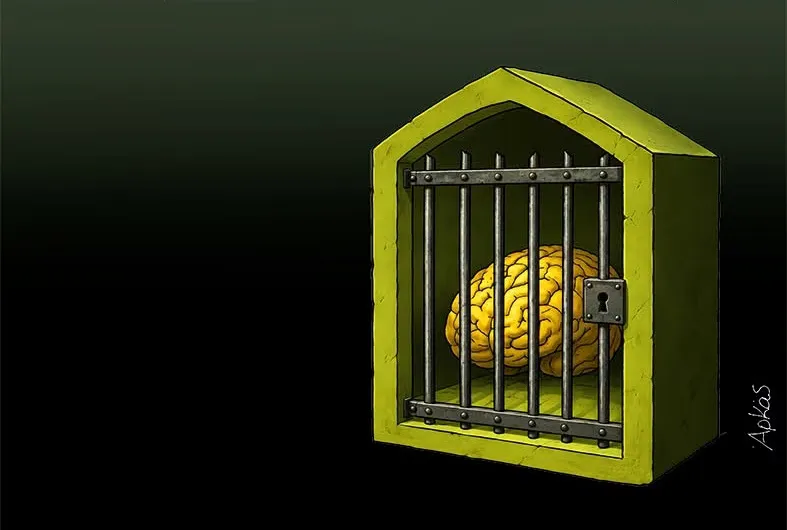
The visual metaphor of the mental prison
The core of the recent Arkas sketch lies in its provocative imagery of a brain trapped behind iron bars. This visual choice serves as a direct commentary on the state of human cognition when it becomes stagnant. By depicting the brain as an inmate, the cartoonist illustrates that certainty is not a position of strength, but rather a state of confinement.
In this context, the "prison" described is not a physical structure but a psychological one. It represents the boundaries we set for ourselves when we decide that certain ideas are beyond reproach. When an individual ceases to consider alternative perspectives or refuses to re-evaluate their stance, they effectively build the walls of their own mental cell. The sketch suggests that the moment we claim to possess absolute truth, we surrender our capacity for growth and exploration.
Doubt as the ultimate tool for escape
According to the message conveyed by Arkas, doubt is not a sign of weakness or confusion, but a mechanism for liberation. The phrase "In the prison of certainties, doubt is an escape" positions skepticism as the key to breaking free from cognitive rigidity. While certainty provides a sense of security, it simultaneously limits the horizon of what an individual can perceive and understand.
Embracing doubt allows for a continuous process of intellectual renewal. It encourages the mind to venture outside the established boundaries of known facts and comfortable opinions. By questioning the "given," the thinker maintains a level of mental agility that is lost when one becomes anchored to unshakeable dogmas. This escape through doubt is what permits the mind to remain dynamic and responsive to a changing world.
The danger of non-negotiable convictions
The sketch highlights a critical danger in modern discourse: the rise of non-negotiable beliefs. When opinions are treated as immutable facts, the possibility of dialogue and mutual understanding vanishes. The "prison" is reinforced every time a person rejects a different version of reality or dismisses the validity of external evidence.
This cognitive closure has significant implications for how we interact with society. If the brain is locked away by its own certainties, it loses the ability to process new information effectively. The resulting isolation is both intellectual and social, as the individual becomes trapped within a self-reinforcing loop of their own making. Breaking these bars requires a conscious effort to remain open to the uncomfortable, the unexpected, and the unproven.
FAQ
What is the main message of the Arkas cartoon?
The main message is that absolute certainty acts as a mental prison that restricts thought. Arkas uses the image of a brain behind bars to suggest that clinging to unchangeable beliefs limits intellectual freedom, whereas embracing doubt serves as a way to escape this confinement.
Why does the cartoonist use a brain behind bars?
The brain behind bars is a metaphor for cognitive stagnation. It represents how human intellect becomes trapped when it stops questioning and starts accepting all ideas as absolute truths. This imagery emphasizes that the prison is psychological and self-imposed rather than physical.
How is doubt defined in the context of this sketch?
In this context, doubt is defined as a liberating force. Rather than being a negative trait, doubt is presented as the essential tool for intellectual escape. It allows individuals to break through the barriers of their own convictions and explore new, diverse perspectives.







