
The satirical narrative of the Prophet
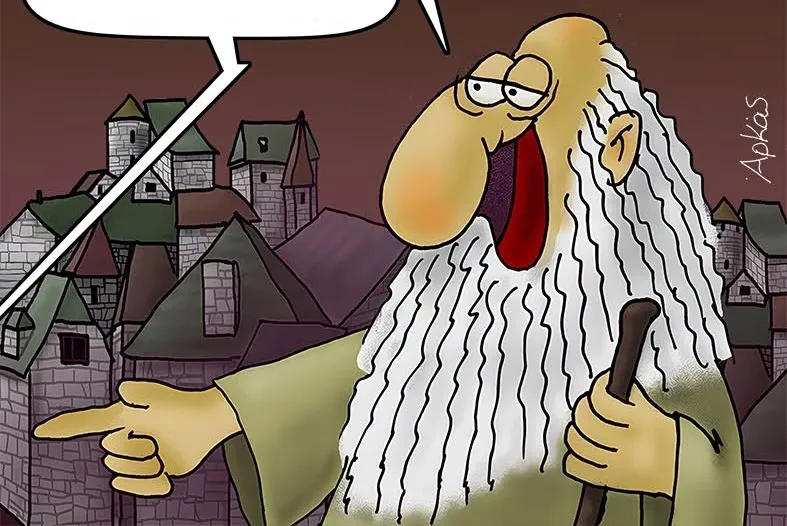
The latest work by the renowned cartoonist Arkas utilizes a classic religious motif to deliver a sharp social critique. In this specific sketch, the Prophet takes center stage, addressing a crowd of citizens with a stern and accusatory tone. He labels the public as irresponsible, claiming they fail to acknowledge their mistakes and refuse to accept their personal duties.
This characterization of the citizenry serves as a setup for the satirical punchline. By casting the Prophet in a role of moral authority, Arkas mirrors the way political rhetoric often adopts a lecturing tone toward the population. The tension in the cartoon is not found in the Prophet's accusation, but in the reaction it provokes from the people he is addressing.
The central question of the sketch
The core of the commentary emerges when a member of the crowd responds to the Prophet's lecture with a single, pointed question: "And what is the state doing about it?" This question effectively dismantles the moral high ground established by the Prophet's accusations.
State vs individual responsibility
The essence of the Arkas cartoon lies in the friction between the concept of individual responsibility and the fundamental role of the state. The sketch suggests that there is a tendency for governing bodies to emphasize the duties of the citizen to avoid addressing systemic failures. When the state focuses heavily on "individual responsibility," it may be attempting to redirect attention away from its own shortcomings.
This dynamic creates a rhetorical shield. By framing social or economic issues as failures of personal character or civic duty, political entities can sidestep the need for policy interventions. The cartoon highlights that while citizens certainly have roles to play, those roles do not exist in a vacuum, independent of the framework provided by the state.
The implications of political accountability
Using individual responsibility as a political tool can be problematic when it is used to transfer the weight of complex societal issues onto the shoulders of the public. Issues that require institutional solutions, legislative changes, or effective governance are often reframed as matters of personal choice or civic failure.
The critique offered by Arkas points toward a broader concern: the erosion of institutional accountability. When the conversation is steered toward what the individual is doing wrong, the essential question of what the state is doing right—or wrong—is often lost. Effective institutions are defined by their ability to manage the very problems that they might otherwise delegate to the citizenry through moralizing rhetoric.







