Revised delivery timeline for the 14 refurbished units
The delivery of the full fleet of 14 refurbished trains has been pushed to the end of 2027, according to STASY. This rescheduling represents a seven-month delay from the original May 2027 target. STASY management is currently working to ensure this new schedule remains final, preventing any deliveries from slipping into the early months of 2028.
The refurbishment process is being managed by the Spanish firm CAF. While the project has faced delays, the current schedule aims to utilize the remaining window through December 2027 to complete the transition. For passengers using the Piraeus–Kifisia route, the primary concern remains the rate at which these new units are integrated into active service to improve reliability and capacity.
Current status of the fleet
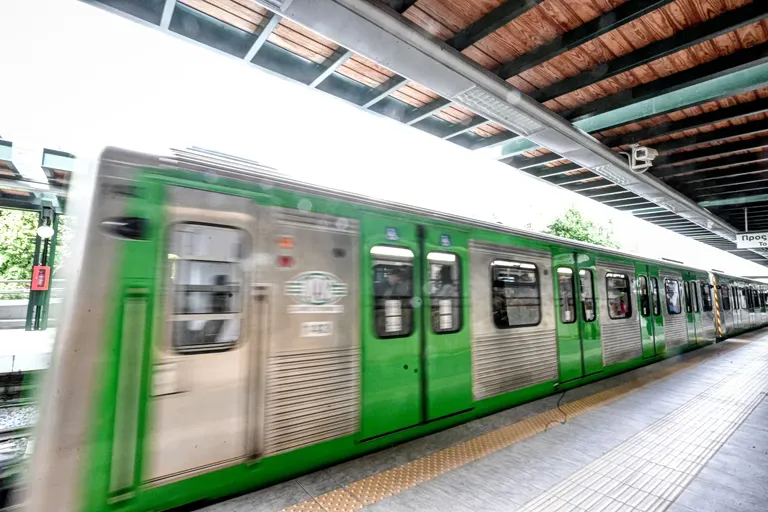
As of November 2026, the first fully refurbished train has been in regular service on Line 1 since October 7, 2026. A second unit, distinguished by its blue color, has completed its primary work and is currently located at the Volos factory. This second train has entered the static testing phase. If dynamic tests conducted on the Athens network prove successful, the unit is expected to join the active schedule within two weeks.
Technical specifications and the Volos manufacturing process
The refurbishment involves a deep overhaul of 1980s-era rolling stock, retaining the original metal bodies while replacing all critical internal systems. The manufacturing process is centered at the CAF facility in Volos, where approximately 80 specialized workers are currently engaged in bodywork and the installation of modern equipment. Once the work in Volos is complete, the carriages are transported by road to the STASY depot in Sepolia.
At the Sepolia depot, the components are assembled into five-carriage train sets. These sets then undergo a rigorous sequence of static and dynamic testing before being cleared for passenger service. The Volos facility has the capacity to reconstruct up to four trains (comprising 20 carriages) simultaneously, with each reconstruction cycle lasting approximately three months. This allows for new batches of four trains to be sent to Volos every quarter.
Upgraded passenger amenities
The reconstruction is designed to extend the operational life of the fleet by at least 25 years. Key technical and passenger-facing upgrades include:
- Replacement of engines and braking control systems.
- Installation of new door mechanisms.
- Upgraded air conditioning systems.
- New passenger information screens and CCTV cameras.
- Dedicated spaces designed for passengers with disabilities (PRM).
Impact on Line 1 service frequency and passenger wait times
Increased train availability is directly linked to reduced waiting times on station platforms. According to STASY CEO Thanasis Kottaras, the introduction of the first refurbished train in October 2026 resulted in an increase of approximately 450 trips compared to the same month in the previous year. This influx of rolling stock has already begun to reduce the average time between trains at stations from 7.5 minutes down to 6 minutes.
The service improvements are expected to scale as more units are added to the daily rotation. The current operational capacity stands at 18 trains per day; the addition of a 19th train is expected to bring the headway down to 5 minutes. Once the full fleet of 14 trains is delivered, STASY intends to extend the former ISAP services to include Saturday evening schedules.
Contractual details and financial penalties for delays
The contract between STASY and the Spanish company CAF was signed in December 2022, with an original completion deadline of 34 months, which would have placed the project end in October 2025. The project is funded through the NSRF (ESPA) framework. The total cost of the project is approximately €71.7 million, an increase from the €65.5 million (excluding VAT) recorded at the time of signing.
Due to the delays in delivering the refurbished units, STASY has invoked penalty clauses within the contract. The company is currently withholding a fine from CAF amounting to 5% of the contract value, which totals €3.85 million. This penalty is being deducted from the ongoing payments made to the Spanish manufacturer.
Future expansion plans
The success of the current 14-train project is seen as a precursor to further modernization. STASY management is currently preparing a new tender aimed at the modernization of an additional 10 Metro trains, seeking to further increase fleet availability and service density across the network.
| Metric | Previous Status | Current/Projected Status |
|---|---|---|
| Average station headway | 7.5 minutes | 6 minutes (moving toward 5) |
| Daily train count | 17 trains | 18 trains (moving toward 19+) |
| Service expansion | Standard daytime | Includes Saturday evenings (post-completion) |