
How did the Ithaca mobile laundry unit begin?
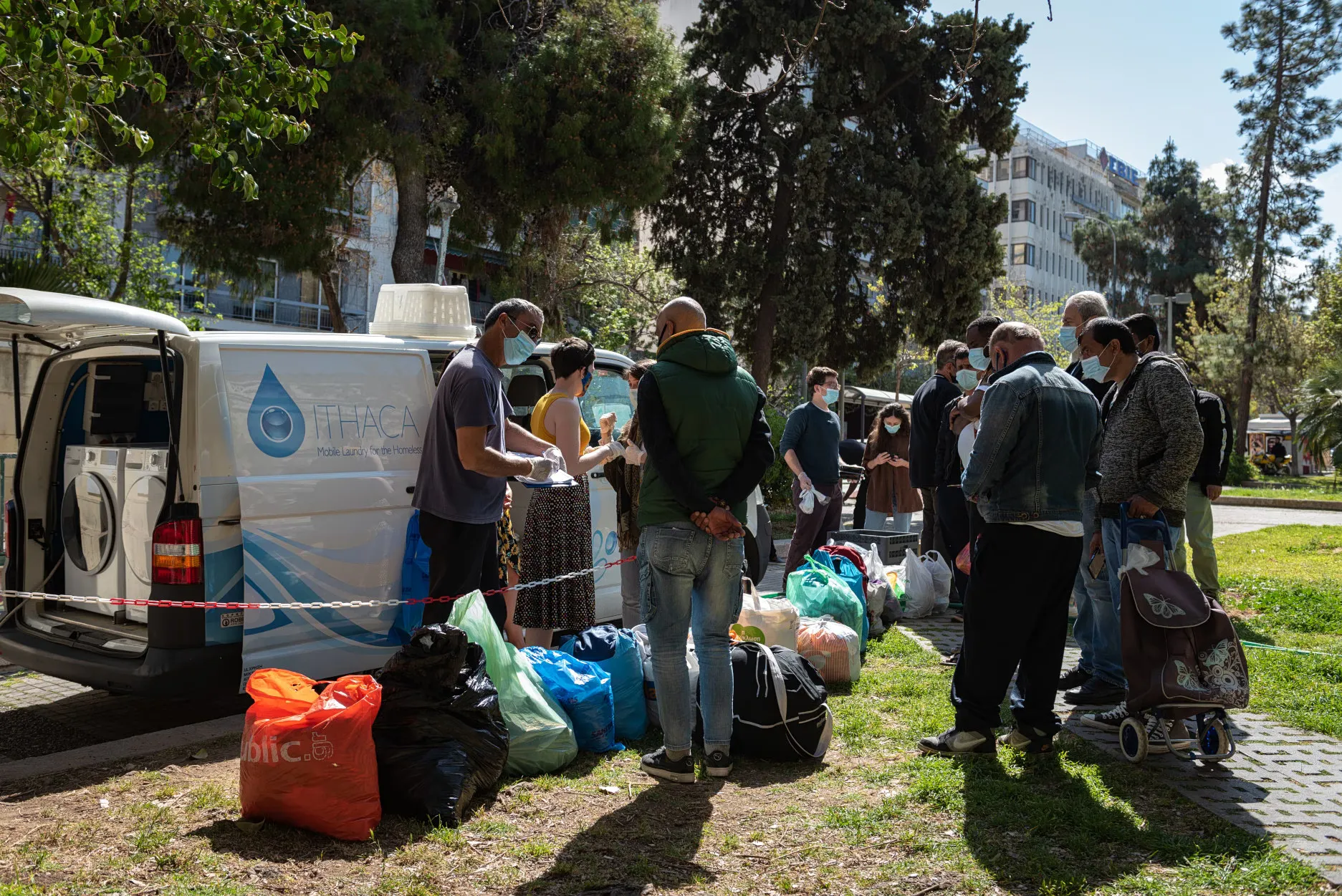
The Ithaca mobile laundry unit was established in 2016 by three Greek students—Thanos Spiliopoulos, Fanis Tsonas, and Andili Rachouti—to address a problem that, at the time, seemed almost unobserved: the total lack of access to basic hygiene services for people living on the streets or in precarious housing conditions. While the initial inspiration for such a concept came from Australia, the urgent reality was already unfolding in the streets of Athens.
In a city grappling with an unprecedented social and economic crisis, these three students began studying the issue of homelessness to find a practical answer to a fundamental human need: the ability to have clean clothing. What began as a vision to address a simple necessity quickly grew into a movement. The first van began moving through the center of Athens, carrying not just washing machines and dryers, but the idea that dignity can begin with something as everyday as a clean shirt.
The founders recognized that the "Ithaca" of their organization's name represented something deeper than a service; it symbolized the journey of every individual toward a different future—a future involving new opportunities, employment, housing, healthcare, and autonomy. This journey is not something to be granted, but something individuals can eventually claim and build for themselves.
The transition from project to institution
When Ithaca was founded in 2015, Greece was navigating the difficult era of capital controls. Thanos Spiliopoulos notes that at the time, he believed they were simply starting a project, never imagining that a decade later they would still be standing alongside thousands of people. The goal from the outset was to build something that could withstand the test of time.
To achieve this, the organization chose to operate with flexibility, professionalism, and "corporate" logic. Rather than functioning as a traditional, temporary charity, Ithaca was designed to be a sustainable social enterprise. This professional approach allowed them to build substantive, long-term partnerships with both the public and private sectors, proving that social entrepreneurship can provide viable, lasting answers to real-world social problems.
What is the scale of Ithaca's impact since 2017?
Since the formal launch of its services in 2017, the scale of Ithaca's impact has been significant. Over the past decade, more than 12,760 people have benefited from the unit's services. The physical magnitude of this support is evidenced by the 384,365 kilograms of laundry that have been washed and dried by the team.
The organization's ability to scale and adapt was particularly evident during the COVID-19 pandemic. During this period of global crisis, Ithaca stepped in to provide the necessary equipment, technical expertise, and staffing for the Municipality of Athens' newly established Multipurpose Center for the Homeless. By doing so, they ensured that even during a pandemic, the residents of the center could maintain access to essential hygiene and personal care, which is a fundamental necessity for those in such vulnerable positions.
How does Ithaca provide holistic support beyond laundry?
The Ithaca model is built on the understanding that hygiene is merely the starting point. The organization views clean clothing as a gateway to broader social reintegration. Once a connection is made through the laundry service, the team can begin addressing much deeper needs, such as access to healthcare, the completion of bureaucratic paperwork, and the reclamation of basic rights.
Since 2021, the organization has expanded its reach by moving its psychosocial support directly to where the people are: on the streets. This approach is designed to be immediate and non-intrusive. Instead of requiring an individual to first navigate a complex and intimidating web of social services, the Ithaca team accompanies them through these processes. By meeting people in their own environment, they reduce the barriers to accessing the very services that could help them move toward a more stable life.
Employment and economic empowerment
Ithaca recognizes that true autonomy requires economic stability. However, the organization has learned through experience that simply opening a job position is not enough; the necessary conditions must be created so that an individual can actually claim and maintain that job. This realization led to the creation of their specialized Vocational Counseling and Empowerment service.
To date, more than 700 individuals have accessed this service, gaining access to the education, empowerment, and practical tools required to search for work. The success of this program is reflected in the fact that more than 120 people have taken the next step, successfully transitioning into employment. This service bridges the gap between being a recipient of aid and becoming an active participant in the workforce.
What makes the Ithaca employment model unique?
A core pillar of Ithaca's philosophy is the concept of "reciprocal work." In this model, personal experience with homelessness is not viewed as a burden or a deficit, but as valuable knowledge. This lived experience is treated as a professional tool that can be transformed into work, strength, and a way to give back to the community.
This is demonstrated by the fact that more than 30 people with personal experience of homelessness have worked within the Mobile Unit as Service Officers. They offer a unique level of support to others who find themselves in the very position they once occupied. One of the most profound examples is Christos, who was the organization's first employee in 2017. At the time, Christos was himself experiencing homelessness and used the Mobile Unit to wash his own clothes. Through Ithaca, he transitioned from someone receiving a service to someone providing it, supporting thousands of others. As Christos has observed, "Clean clothes reduce the distance you have between yourself and other people," emphasizing how hygiene acts as a social bridge.
Who are the people served by these services?
The individuals who encounter the Ithaca team are diverse, reflecting the many different paths that lead to housing instability. The team meets people whose lives have taken unpredictable turns, such as George, who saw his life upended and suddenly found himself without a home. They also work with elderly individuals like Mr. Giannis, for whom the support begins with clean clothes but extends to essential healthcare access.
The demographic includes single-parent families unable to meet basic needs, people displaced by economic collapse, and those who have lost everything due to sudden natural disasters. This includes victims of the Mandra and Thessaly floods, as well as those affected by the wildfires in Evia. Whether the cause is long-term economic hardship or a sudden, catastrophic loss of property, Ithaca provides a consistent point of contact for those navigating life without a fixed address.
Key takeaways
- Ithaca has served over 12,760 individuals through its mobile services since 2017.
- The organization has processed 384,365 kilograms of laundry over the last decade.
- More than 30 staff members at Ithaca are individuals with lived experience of homelessness.
- Over 700 people have accessed vocational training and empowerment tools through the organization.
- Ithaca provides mobile psychosocial support and helps individuals navigate healthcare and bureaucracy directly on the streets.
Frequently asked questions
What services does the Ithaca mobile laundry unit provide?
The unit provides mobile washing and drying services, but its scope is much wider. It offers psychosocial support, assists with administrative and bureaucratic procedures, and helps individuals access healthcare and claim their basic social rights.
How many people has Ithaca helped?
Since 2017, more than 12,760 people have benefited from Ithaca's services. Additionally, the team has processed over 384,365 kilograms of clothing to support these vulnerable populations.
Does Ithaca employ people with lived experience of homelessness?
Yes. Ithaca uses a model of reciprocal work where more than 30 people who have experienced homelessness themselves serve as Service Officers, using their personal experience to support others.
What is the goal of Ithaca's vocational program?
The goal is to provide the training and practical tools necessary for people to not only find work but to maintain it. Through vocational counseling, over 700 people have received empowerment training, with over 120 moving into employment.
How does Ithaca respond to natural disasters?
Ithaca provides support to those displaced by sudden disasters, such as the floods in Mandra and Thessaly or the wildfires in Evia, helping them regain access to basic hygiene and dignity during times of crisis.
Conclusion
Over the past ten years, Ithaca has evolved from a student-led initiative into a sophisticated mechanism of social support. By addressing the immediate, practical need for hygiene, they create a foundation of dignity that allows for much larger goals—employment, health, and autonomy—to become possible. Through its professional approach and its commitment to the concept of reciprocal work, Ithaca proves that social entrepreneurship can offer real, sustainable solutions to the complex challenges of homelessness in the modern city.







