
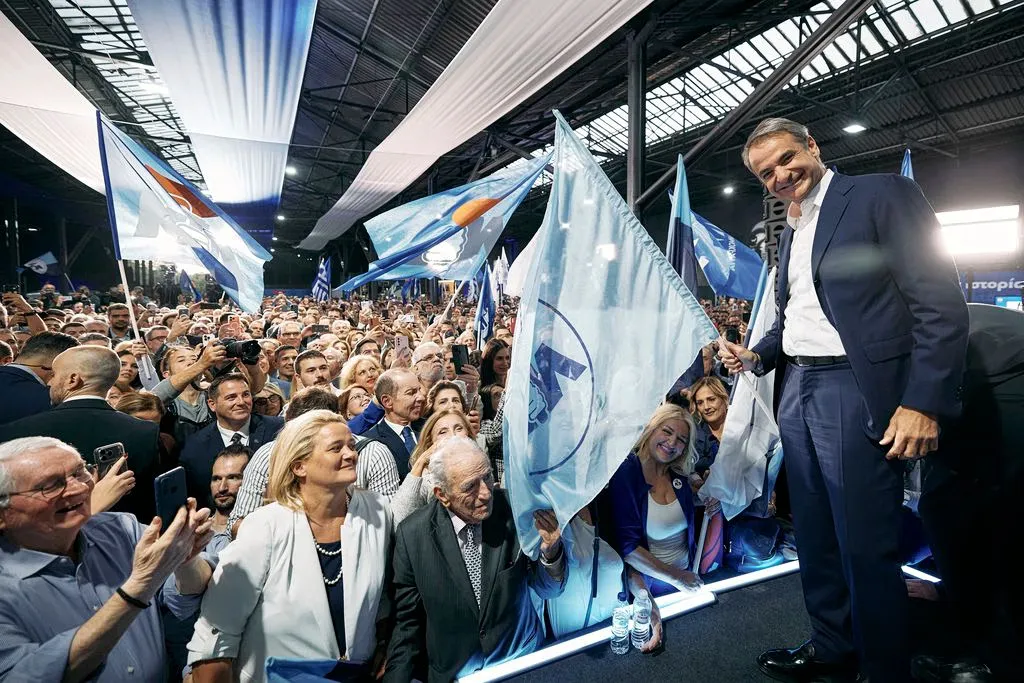
Why did the Kyriakos Mitsotakis ND speech focus on internal opposition?
The central theme of Kyriakos Mitsotakis' address at the New Democracy anniversary event was the perceived threat posed by the emerging political movement led by Antonis Samaras. The Prime Minister used the occasion to address the criticisms leveled against his administration, particularly those concerning the ideological shift of the party. Samaras recently attacked the current leadership, accusing the government of 'muddling' the Tempi train tragedy investigation and transforming the traditional conservative identity of ND into something unrecognizable, even suggesting the party has been turned into a 'Potami'-like entity.
Mitsotakis responded by emphasizing the necessity of adaptability. He argued that the ability to transcend traditional political labels—right, center, and left—is a core strength of the party, citing the founder's original vision in the founding declaration. By framing the party as a modern, flexible entity, he attempted to neutralize the argument that ND has lost its traditional roots. This defensive posture suggests that the leadership views the Samaras faction as a significant potential recipient of dissatisfied traditionalist voters, making the speech a vital exercise in damage control.
The Samaras Factor and Voter Retention
The emergence of a Samaras-led movement represents a strategic challenge for the current ND leadership. If traditional voters feel alienated by the party's shift toward a more neoliberal or modernizing stance, they may migrate to this new political alternative. This potential exodus is a significant concern for the Prime Minister, as the Samaras group is already appearing as a potential vessel for those who feel the party's essence has been lost.
Mitsotakis' emphasis on being a 'broad social, popular party' is a direct attempt to reassure these voters that the party's soul remains intact, even as its structure evolves. He attempted to bridge this gap by telling the gathered crowd, "You are the New Democracy, you are the soul and the heart of the movement." This rhetoric aims to pivot the definition of the party's 'soul' away from Samaras's ideological definitions and toward the collective identity of the current membership.
How is the ideological identity of New Democracy being contested?
Internal friction within New Democracy is intensifying due to the influx of members from other political backgrounds. While Mitsotakis promotes a modernized version of the party, there is growing discontent regarding the heavy reliance on officials originally from PASOK and LAOS. This demographic shift has created a sense of identity crisis among the party's traditionalist core, who feel the 'Karamanlis-style' logic is being sidelined in favor of a more neoliberal approach.
This tension was highlighted by the internal dissatisfaction regarding the utilization of high-ranking officials. For instance, the presence of figures like Giorgos Floridis, who stems from the modernized PASOK, contrasts with the influence of officials from the LAOS party, who have been granted significant roles in both the government and the party structure. This internal tug-of-war makes the Prime Minister's rhetoric regarding 'values' and 'principles' a critical tool for maintaining cohesion, as he tries to convince the base that these new arrivals are being integrated into a unified mission rather than replacing the party's core.
What role does the concept of a 'popular party' play in the current discourse?
The term 'popular party' (laiki parataxi) has become a linguistic battlefield between the current leadership and its critics. Mitsotakis deliberately used the phrase 'soul and heart of the movement' to counter Samaras's claim that the 'popular soul' of the party has died. By attributing the party's essence to its members rather than its current administrative direction, he attempted to decouple the party's survival from the specific criticisms aimed at the leadership.
This linguistic choice also echoes recent statements by Defense Minister Nikos Dendias, who, just three days prior at his own event, emphasized that ND must remain 'the great popular party.' Dendias's insistence on this 'Karamanlis-style' logic serves as a reminder of the traditionalist roots that the current leadership must constantly acknowledge to avoid appearing too neoliberal. The recurring use of this terminology suggests a concerted effort to reclaim the traditionalist narrative and prevent the party from being viewed as a purely technocratic organization.
How is Mitsotakis framing the narrative for the 2027 elections?
To secure his mandate for the upcoming 2027 elections, Mitsotakis has pivoted toward a narrative of 'stability' in an era of global volatility. He framed the current international geopolitical climate as 'turbulent waters' that require a capable captain and a reliable crew. This rhetoric is designed to position New Democracy as the only guarantor of national continuity amidst external chaos, effectively turning global instability into a domestic political asset.
However, the Prime Minister faces the challenge of ensuring that 'stability' is not perceived by the public as 'stagnation.' To counter this, he argued that the party is capable of delivering both stability and significant change simultaneously. By invoking past electoral successes—specifically citing the 40% thresholds achieved under Konstantinos Karamanlis and Kostas Karamanlis, as well as the victories in 2019 and 2023—he seeks to build confidence in the party's ability to win decisively once again. He explicitly stated that they will achieve success again in the elections of spring 2027, using historical precedent to validate his current leadership.
The Shadow of Absent Leaders
A notable aspect of the anniversary event was the absence of several prominent former leaders, creating a palpable void during the celebrations at the old O.S.Y. warehouse. The absence of Antonis Samaras, who has been expelled by prime ministerial decision, was a central subtext of the evening. Furthermore, the absence of Kostas Karamanlis, who has avoided any event where Mitsotakis is the central figure, and Vangelis Meimarakis, who has shown consistent distancing from the current administration, signaled a deepening rift.
This lack of unity was even reflected in the event's production. Despite the party's attempt to use the historical torch emblem more prominently this year, the official anniversary video failed to include all the former leaders, a departure from the previous party congress. Even the absence of Defense Minister Nikos Dendias from the official celebration—due to his participation in the ADRION Initiative in Venice—added to the sense of a leadership spread thin or divided. These absences suggest that the 'cohesive' image the Prime Minister seeks to project is still being challenged by the reality of a fractured political lineage.
FAQ: Kyriakos Mitsotakis and New Democracy Internal Dynamics
What is the primary criticism from Antonis Samaras?
Antonis Samaras has criticized the current New Democracy leadership for fundamentally changing the party's identity. He specifically accused the administration of 'muddling' the handling of the Tempi train tragedy and argued that the party has lost its traditional 'popular soul' in favor of a different political direction, comparing the transformation to that of the 'Potami' party.
Why is there tension regarding new party members?
Tension exists because many new high-ranking officials in the party and government come from different political backgrounds, such as PASOK and LAOS. Traditionalists within New Democracy fear that this influx is diluting the party's original ideological foundations and shifting its core character too far from its roots.
How does Mitsotakis justify the party's evolution?
Mitsotakis justifies the evolution by stating that the ability to adapt beyond traditional political labels is a prophetic strength of the party. He argues that this flexibility allows New Democracy to remain a broad, social, and popular movement that represents all Greek citizens.
What is the Prime Minister's strategy for the 2027 elections?
The strategy focuses on the theme of 'stability' amidst global geopolitical uncertainty. By positioning himself as a steady leader in 'turbulent waters,' Mitsotakis aims to convince voters that New Democracy is the only force capable of ensuring national continuity and progress.
Who were the notable absentees from the ND anniversary?
Several key former leaders were absent, including Antonis Samaras, Kostas Karamanlis, and Vangelis Meimarakis. Their absence highlights the ongoing political distance between the party's traditionalist wing and the current leadership under Kyriakos Mitsotakis.
Key takeaways
- Kyriakos Mitsotakis used the ND 52nd anniversary to indirectly address criticisms from Antonis Samaras regarding the party's identity.
- The Prime Minister emphasized party adaptability and the ability to transcend traditional labels to defend against claims of ideological dilution.
- Internal tensions are rising due to the integration of officials from PASOK and LAOS, causing concern among the traditionalist core.
- Mitsotakis is leveraging a 'stability' narrative, framing the party as a steady hand in 'turbulent waters,' to prepare for the 2027 elections.
- The absence of several former party leaders at the milestone event signaled a significant internal divide within New Democracy.
Conclusion
The 52nd anniversary of New Democracy served as more than a mere celebration; it was a strategic platform for Kyriakos Mitsotakis to defend his leadership against mounting internal and external pressures. By addressing the 'Samaras threat' through a narrative of modernization and stability, the Prime Minister is attempting to consolidate a fractured base. However, the visible absence of traditional party icons and the growing discontent among the grassroots suggest that the path to the 2027 elections will be defined by a struggle for the very soul of the party. The ability to balance institutional stability with ideological continuity remains the central challenge for the current administration.







