
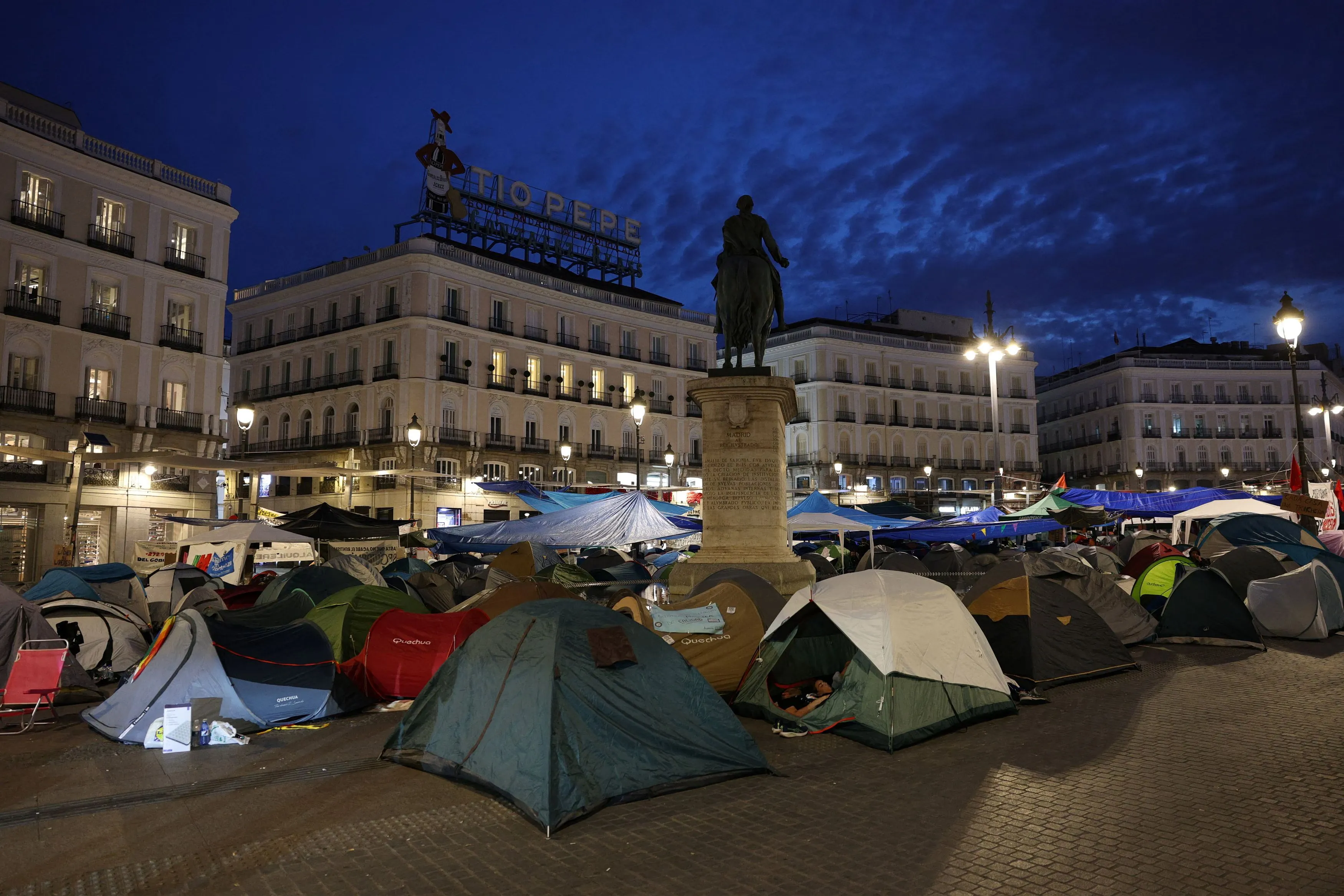
Why are protesters camping in the heart of Madrid?
Protesters have established a continuous 'protest camp' in the Puerta del Sol, one of Madrid's most prominent tourist hubs, to demand immediate action against the housing emergency. Around 100 tents have been erected as citizens voice their frustration with rising costs and perceived government inaction. The movement gained momentum following a massive demonstration involving tens of thousands of people on the preceding Saturday.
The occupation is driven by organized groups, including the Carabanchel Housing Union, which intends to maintain the presence for as long as necessary. The protest is deeply emotional, centered on the story of Maricarmen Abascal, an 87-year-old woman who was recently evicted from her home of nearly 70 years. Her eviction, which involved police forcing entry into her residence, has become a rallying cry for those fighting against austerity and housing instability.
The Spanish Tenants Union has characterized the situation as a breaking point, suggesting that the current rental system is nearing collapse. Their messaging emphasizes that housing should be treated as a fundamental necessity rather than a mere commercial commodity. This sentiment has resonated widely, turning a local grievance into a national movement as the 2027 general elections approach.
What are the proposed government measures to address the crisis?
Prime Minister Pedro Sánchez has committed to presenting a Royal Decree-Law on housing to the Council of Ministers to mitigate the impact on vulnerable populations. The proposed legislation is designed to provide legal protections that have been missing in the current market climate. According to statements from the Prime Minister, the government is working under significant time pressure to finalize these measures.
The core components of the upcoming bill include:
- Automatic contract renewals: Mechanisms to provide greater stability for long-term tenants.
- Eviction restrictions: New limits and protections to prevent the sudden displacement of vulnerable groups, such as the elderly.
- Emergency status: The implementation of a Royal Decree to address the housing situation as a matter of social urgency.
Sánchez has publicly called upon parliamentary groups to cooperate in the validation of this decree, framing the issue as a fundamental question of humanity. The government's goal is to create a framework that prevents the sudden spikes in costs that have recently displaced residents like Abascal.
Political tensions and local government responses
The push for housing reform has highlighted significant political divisions within Spain. While the central government seeks to implement protective decrees, local authorities in Madrid, led by the People's Party (PP), have criticized the administration. These local leaders have called for the restoration of order in Puerta del Sol, accusing the national government of negligence and failing to manage the public space effectively.
How has the rental market changed in Spain over the last decade?
The rental market in Spain has experienced dramatic price increases, making urban living increasingly inaccessible for the average citizen. According to data from the real estate website Idealista, the average price per square meter for rental properties reached 15.1 euros in August, representing a near doubling of prices over the last ten years.
The drivers behind this inflation are multifaceted and continue to put pressure on the supply of affordable homes. Key factors identified by analysts and protesters include:
- Short-term rentals: The proliferation of platforms like Airbnb has reduced the stock of long-term housing available to residents.
- Investment funds: Large-scale real estate funds are purchasing properties, which critics argue drives prices upward and prioritizes profit over social need.
- Luxury demand: Madrid has been ranked as a top global destination for luxury real estate demand in 2025 and 2026 by the Barnes network, further skewing the market.
The impact on individual households can be extreme. In the case of Maricarmen Abascal, her rent was reportedly increased by 275% after her property was acquired by a corporation, jumping to 2,650 euros per month. This level of increase makes it impossible for many residents to remain in their long-term communities.
What is the impact of the housing shortage on social stability?
The shortage of affordable housing is creating significant social friction and influencing the political landscape. Beyond the immediate physical displacement of individuals, the crisis is fostering a sense of systemic injustice among younger generations and the elderly alike. The scarcity of social housing in Madrid is particularly acute, with some units being distributed via lottery due to overwhelming demand.
Prominent cultural figures have also joined the call for change. Renowned Spanish filmmaker Pedro Almodóvar expressed his support for the demonstrators, stating that Spanish society cannot tolerate this problem for another day. He emphasized that the responsibility lies with the political class to resolve the issue they oversee. This intersection of social activism and cultural influence underscores the depth of the crisis and its potential to shape the upcoming 2027 elections.
Frequently asked questions
What is the main cause of the protests in Madrid?
The protests are driven by a severe housing crisis characterized by skyrocketing rents and frequent evictions. Citizens are protesting in Puerta del Sol to demand that the government treats housing as a basic necessity rather than a commercial product, specifically following the widely publicized eviction of an elderly resident.
What does the new Spanish housing bill aim to do?
The bill, presented as a Royal Decree-Law by Prime Minister Pedro Sánchez, aims to introduce automatic contract renewals and stricter limitations on evictions. It is designed to protect vulnerable groups, including the elderly, from sudden displacement and extreme rent hikes caused by market volatility.
Why are rental prices increasing so rapidly in Spain?
Rental prices are rising due to a combination of factors: the growth of short-term tourist rentals, the acquisition of properties by investment funds, and high demand for luxury real estate. These elements reduce the supply of long-term housing and drive up the cost per square meter.
Who is Maricarmen Abascal?
Maricarmen Abascal is an 87-year-old woman who has become a symbol of the Spanish housing crisis. After living in her apartment for nearly 70 years, she was evicted following a massive rent increase and police intervention, an event that sparked widespread public outrage.
How does the housing crisis affect the 2027 elections?
The crisis is becoming a central political issue as the 2027 general elections approach. The government's ability to implement effective housing protections will likely be a decisive factor for voters, as the issue touches on social stability, economic security, and human rights.
Key takeaways
- Protesters have occupied Madrid's Puerta del Sol with 100 tents to demand housing rights.
- Prime Minister Sánchez is introducing a Royal Decree-Law to regulate rent and prevent evictions.
- Rental prices per square meter have nearly doubled in Spain over the last decade.
- The crisis is driven by short-term rentals, investment funds, and a lack of social housing.
Conclusion
The housing crisis in Spain has transitioned from a series of individual grievances into a significant national movement. The occupation of Puerta del Sol and the symbolic weight of Maricarmen Abascal's eviction demonstrate a profound loss of confidence in the current market's ability to provide stability. While the government's proposed Royal Decree-Law offers a potential legislative pathway toward protection, the underlying economic drivers—such as the rise of short-term rentals and luxury real estate demand—remain formidable challenges. The resolution of this crisis will likely serve as a critical benchmark for political leadership ahead of the 2027 elections.







