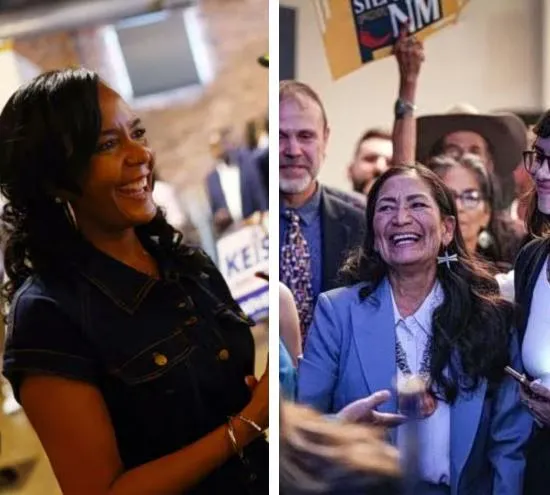
How did Deb Haaland make history in New Mexico?
Deb Haaland has secured a historic victory as the 33rd Governor of New Mexico, making her the first Indigenous woman to lead a U.S. state. The Democratic candidate defeated her Republican opponent, 60-year-old businessman and long-time Rio Rancho mayor Greg Hall. In her victory remarks, Haaland emphasized that the election was about building a brighter future for all New Mexicans, regardless of how they voted, and focusing on the needs of working families.
Haaland’s path to the governorship is defined by both her political experience and her personal resilience. A member of the Laguna Pueblo, she previously served as the U.S. Secretary of the Interior under the Biden administration, where she became the first cabinet secretary of Indigenous descent. Her political career gained national momentum in 2018 when she was elected to Congress, joining a wave of progressive lawmakers. Before her federal service, she held various leadership roles, including serving on the board of the Laguna Development Corporation and managing election efforts for Barack Obama's 2012 campaign.
The personal journey of Deb Haaland
Beyond her policy expertise, Haaland has often shared her personal history to connect with voters. She has spoken openly about her experiences as a single mother who relied on social safety nets such as Medicaid, WIC, and the SNAP food assistance program. These experiences helped fuel her determination to pursue law school later in life, after the age of 30. Her journey from navigating social welfare programs to leading a state government serves as a powerful narrative of social mobility and perseverance.
What is the significance of Keisha Lance Bottoms' victory in Georgia?
Keisha Lance Bottoms has been elected as the Governor-elect of Georgia, becoming the state's first Black governor and the first Black woman to hold the office in the United States. The 56-year-old Democrat, a former Mayor of Atlanta, won in a state traditionally viewed as a competitive battleground. Her victory comes despite a massive financial advantage held by her Republican opponent, billionaire Rick Jackson, who spent over $100 million of his personal wealth on his campaign.
Bottoms’ campaign benefited from high-profile endorsements, including support from Democratic Senator Jon Ossoff and former President Barack Obama. Her political rise began in 2009 when she was elected to the Atlanta City Council, following a career as a lawyer and a judge in Fulton County Peace Court. After serving as Mayor of Atlanta, she transitioned to federal service, working as a senior advisor and Director of the White House Office of Public Engagement until 2023.
The election results in Georgia suggest a shifting political climate. While Jackson's campaign utilized intense media presence—often highlighting the social unrest following the deaths of George Floyd and Sekoria Turner—voters ultimately chose Bottoms' leadership. Her victory is seen by analysts as an indication that the electorate is moving away from the political style associated with the Republican establishment and toward different leadership models.
How is Indigenous political representation evolving in the US?
The election of Deb Haaland reflects a broader trend of increasing political agency among Native American communities. In New Mexico, where Indigenous people comprise approximately 12% of the population, this victory is particularly impactful. The current election cycle saw a record-breaking 358 Indigenous candidates running for public office at local, state, and federal levels across the country.
This rise in participation follows decades of struggle for basic democratic rights. Native Americans only gained full voting rights across the entire United States in the 1960s. Even within specific states, the battle for suffrage was hard-fought; for instance, in New Mexico, Indigenous voters had to fight a legal battle in 1948 to secure their rights. Recent legislative progress, such as the Native American Voting Rights Act passed in New Mexico in 2023, has helped empower tribes by giving them more control over polling locations and district boundaries.
A growing wave of Indigenous leadership
The momentum for Indigenous representation is not limited to governorships. In 2018, Haaland and Kansas Representative Sharice Davids made history as the first two Indigenous women elected to the U.S. Congress. The 2026 cycle has seen further attempts at high-level representation, with candidates like former Alaska Representative Mary Peltola and Minnesota Lieutenant Governor Peggy Flanagan vying for seats in the U.S. Senate, illustrating a sustained push for a seat at the highest tables of American governance.
What were the key themes of the 2026 midterm elections?
The 2026 midterm elections were characterized by a tension between massive campaign spending and shifting voter sentiment. In Georgia, the contrast between Rick Jackson's $100 million personal expenditure and Keisha Lance Bottoms' victory highlights that financial dominance does not guarantee electoral success. The election also served as a barometer for the national mood, with many voters signaling a desire for a departure from the political era defined by Donald Trump and the Republican Party.
Furthermore, the elections highlighted the importance of identity and lived experience in modern American politics. Both Haaland and Bottoms utilized their unique backgrounds—one as an Indigenous woman who navigated social welfare systems, and the other as a Black woman who rose through municipal leadership in Atlanta—to build coalitions. These victories suggest that voters are increasingly looking for leaders whose personal histories align with the challenges faced by working families and marginalized communities.
Key takeaways
- Deb Haaland becomes the first Indigenous woman to serve as a U.S. state governor in New Mexico.
- Keisha Lance Bottoms makes history as the first Black female governor in the United States.
- Indigenous political participation reached a record high with 358 candidates running nationwide.
- Georgia's election results indicate a significant shift in the state's traditional political dynamics.
FAQ: US midterm elections 2026
Who is the new Governor of New Mexico?
Deb Haaland, a member of the Laguna Pueblo and former U.S. Secretary of the Interior, has been elected as the 33rd Governor of New Mexico. She defeated Republican candidate Greg Hall to become the first Indigenous woman to lead a U.S. state.
What makes Keisha Lance Bottoms' win historic?
Keisha Lance Bottoms' election is historic because she is the first Black woman to serve as a governor in any U.S. state. Her victory in Georgia marks a major milestone for representation in a state that has historically been a key political battleground.
How much did the Republican candidate in Georgia spend?
The Republican candidate, billionaire Rick Jackson, utilized over $100 million of his personal wealth to fund his campaign. Despite this massive financial advantage and heavy media presence, he was unable to secure the governorship against Democrat Keisha Lance Bottoms.
Is Indigenous political influence growing in the US?
Yes, Indigenous political influence is seeing significant growth. The 2026 election cycle saw a record 358 Indigenous candidates running for various offices, and New Mexico recently passed the Native American Voting Rights Act to further support tribal participation.
What was Deb Haaland's previous role in the US government?
Before being elected Governor of New Mexico, Deb Haaland served as the U.S. Secretary of the Interior under President Joe Biden. She was the first person from an Indigenous community to hold this cabinet-level position in United States history.
Conclusion
The 2026 midterm elections have fundamentally altered the landscape of American state leadership. By electing Deb Haaland and Keisha Lance Bottoms, voters have not only chosen new executives but have also broken long-standing racial and gender barriers. These victories reflect a maturing political process where Indigenous and Black communities are translating increased civic engagement into direct governing power. As these two women take office, their leadership will be closely watched for its ability to address the needs of diverse constituencies and navigate the evolving political tensions within their respective states.