
What is the concept behind the 'Antibiblioteca' collection?
The 'Antibiblioteca' concept serves as the philosophical foundation for the Valentino Spring/Summer 2027 collection, drawing a direct parallel between fashion and the untapped potential of unread literature. Alessandro Michele utilized this term to describe a collection of books that remain unread, where their value is derived not from their consumption, but from the inherent possibility of the knowledge they contain.
Michele suggests that fashion operates under a similar logic. A garment does not necessarily need to be worn, purchased, or actively consumed to possess meaning. Instead, clothes can exist as pure possibilities—ideas that reside in the cultural consciousness even if they never touch skin. This approach shifts the focus from the utility of fashion to its conceptual weight, suggesting that a piece of clothing's significance is not tethered to its practical application.
The intersection of clothing and unread volumes
By framing the collection through the lens of the 'antibiblioteca,' Michele challenges the traditional lifecycle of a fashion season. Rather than viewing a collection as a series of products to be sold, he views it as a repository of ideas. Just as an unread book represents a frontier of undiscovered thought, a runway look represents a frontier of aesthetic possibility. This conceptual framework allows the collection to exist in a state of constant becoming, rather than a state of finality once the sale is made.
How did the Bibliothèque Sainte-Geneviève influence the show?
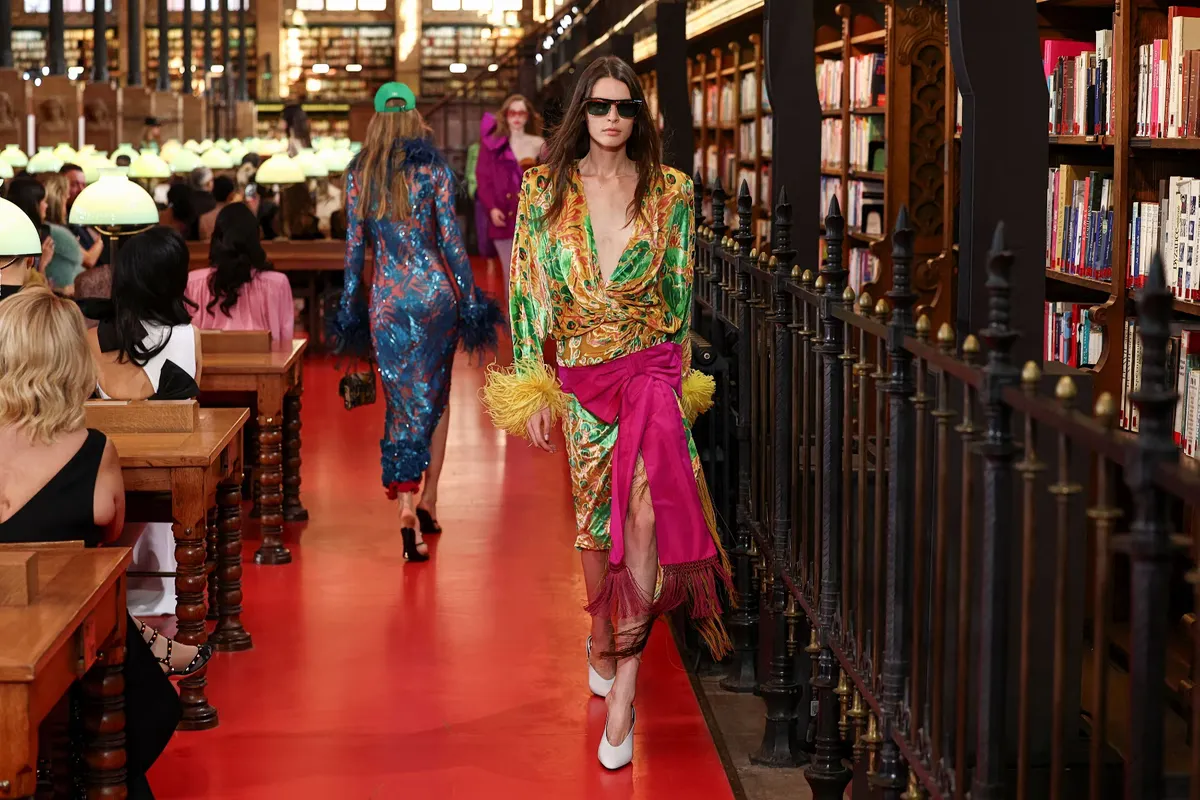
The choice of the Bibliothèque Sainte-Geneviève in Paris provided a structural and atmospheric backdrop that reinforced the themes of memory and accumulation. The setting, characterized by long wooden reading tables, green lighting, and iron railings, created a space dedicated to concentration and the preservation of history. This environment was not merely a backdrop but an active participant in the narrative of the show.
This environment established a quiet contrast between the permanence of the library and the ephemeral nature of a fashion show. While the books remained fixed on their shelves as symbols of accumulated knowledge, the Valentino models moved through the space, presenting a different kind of archive. The collection acted as a transient layer passing through a permanent institution, highlighting how fashion itself functions as a living archive where forms return, mutate, and take on new meanings over time. The interplay between the static, heavy presence of the library and the fluid movement of the models emphasized the tension between what is recorded and what is lived.
What is the connection between fashion and Nassim Nicholas Taleb's theories?
The intellectual depth of the show was heavily influenced by Nassim Nicholas Taleb's descriptions in his work, *The Black Swan*. Specifically, Michele drew inspiration from Taleb’s observation regarding the library of Umberto Eco, noting that unread books can be more precious than those already read.
According to the presentation's logic, unread books represent the limits of one's current knowledge and the vast potential for future discovery. Michele extended this argument to the realm of textiles. He posited that every fashion collection contains items with different futures: some may exist briefly on a runway, some will survive through digital imagery, and others will remain almost untouched in wardrobes. In this sense, the value of a garment is not lost if it remains unconsumed; its value lies in the 'what if' that it represents. By invoking Taleb, Michele elevates the fashion collection from a commercial endeavor to a philosophical inquiry into the boundaries of human experience and the unknown.
How does Michele redefine the value of fashion?
Alessandro Michele’s vision challenges the standard metrics used to judge the success of a fashion collection, such as frequency of wear or practical utility. He argues that if a garment is judged solely by its usefulness, the industry loses the profound intellectual and emotional contributions that fashion can make. This critique targets the reductionist view of clothing as mere tools for the body.
A runway look can transcend its physical form to become an image, a memory, or a pure idea. It can suggest a new silhouette or a different way of perceiving the human body. These conceptual contributions can endure long after the physical garment has disappeared from the public eye. This perspective aligns with the concept of 'potentiality' as defined by philosopher Giorgio Agamben, which Michele used to describe the state of possibilities that remain open before they are realized into reality. In this light, a garment is not just an object, but a vessel for potential human expression.
Redefining utility in the modern era
In a world increasingly driven by fast consumption, Michele's approach is a radical departure. He views the runway as a space for things that might never enter daily life, yet show us how such a life could look. This creates an optimistic outlook where the unconsumed is not seen as wasted, but as a vessel for future potential. It suggests that the value of creativity lies in the act of imagining, regardless of whether that imagination is immediately translated into a consumer purchase.
What was the social impact of the Valentino event?
The Valentino presentation integrated a tangible act of social contribution by involving the guests in a literary donation drive. High-profile attendees, including Colman Domingo, Clairo, and Alexander Skarsgard, were asked to bring books from their personal collections to the event.
These books were selected with the intention that they would be read by others, and following the show, they were donated to local libraries. This initiative transformed the fashion event from a purely aesthetic display into a community-focused gesture, bridging the gap between the exclusive world of high fashion and the public accessibility of literature. By asking guests to share their personal libraries, the event turned the concept of the 'antibiblioteca' into a practical act of spreading knowledge and making potential discovery accessible to the wider public.
Key takeaways
- The Valentino Spring/Summer 2027 collection was themed around 'Antibiblioteca,' exploring the concept of unread books.
- Alessandro Michele linked fashion's value to the philosophical idea of 'potentiality' rather than just utility.
- The show was hosted at the Bibliothèque Sainte-Geneviève to emphasize themes of memory and archives.
- Celebrity guests donated personal books to local libraries as part of the event's social mission.
- The presentation drew intellectual inspiration from Nassim Nicholas Taleb's writings on Umberto Eco.
FAQ: Valentino Spring/Summer 2027
What was the main theme of the Valentino Spring/Summer 2027 show?
The main theme was 'Antibiblioteca,' a concept exploring the relationship between fashion and unread books. Alessandro Michele used this to suggest that fashion, like unread literature, holds significant value through its potential and the ideas it represents, even if the items are never worn or consumed.
Who attended the Valentino show in Paris?
The event included several notable figures such as Colman Domingo, Clairo, and Alexander Skarsgard. These guests participated not only as observers but also by contributing personal books from their own collections to be donated to local libraries following the presentation.
Where did the Valentino Spring/Summer 2027 collection debut?
The collection was presented at the Bibliothèque Sainte-Geneviève in Paris. This historical location was chosen to provide a backdrop of permanence and concentrated knowledge, creating a contrast with the ephemeral nature of the fashion models and the garments they wore.
How does the concept of 'potentiality' apply to fashion here?
Drawing on Giorgio Agamben's philosophy, Michele applied 'potentiality' to describe how garments exist as possibilities. A piece of clothing has value as an idea, a silhouette, or a memory, even if it remains unworn in a wardrobe or exists only as a photographic image.
What is the significance of the 'Antibiblioteca' term?
'Antibiblioteca' refers to a collection of unread books. In the context of the show, it symbolizes the idea that the value of an object—whether a book or a garment—lies in the knowledge or aesthetic possibilities it holds for the future.
Conclusion
The Valentino Spring/Summer 2027 collection marks a significant moment where fashion transcends mere apparel to engage with deep philosophical inquiry. By intertwining the intellectual weight of the Bibliothèque Sainte-Geneviève with the concept of the 'Antibiblioteca,' Alessandro Michele has reframed the fashion cycle. He moves the conversation away from consumption and utility toward a celebration of potentiality and memory. This approach suggests that fashion is not just a transient industry of trends, but a permanent archive of human ideas and possibilities that continues to resonate long after the runway lights have dimmed.







