European mobilization follows Spanish call for action
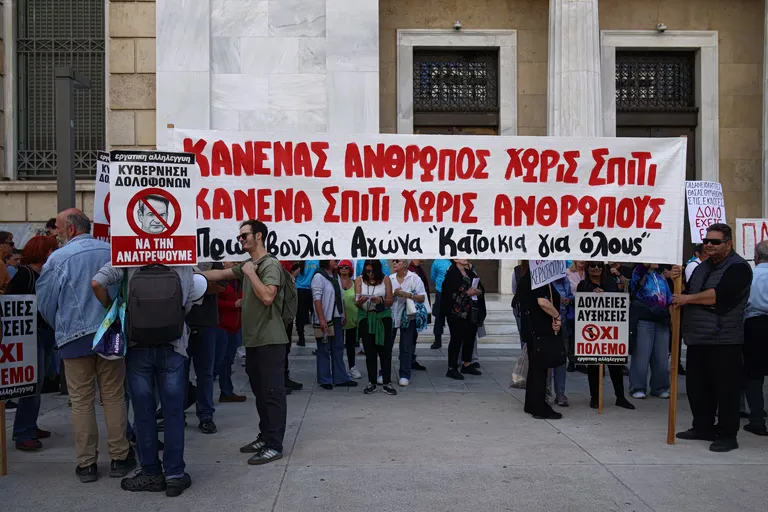
Protesters are taking to the streets in dozens of European cities to demand the right to housing, a movement catalyzed by calls from Spanish tenants' unions. This coordinated action on November 11 reflects a growing sentiment among renters, debtors, and laborers across the continent. While the protests are organized by various housing movements through unified platforms and collective networks, the core focus remains on those facing imminent threats of eviction and foreclosure.
In Greece, the mobilization has gained significant traction among diverse groups. The calls for protest, which maintain a non-partisan character, have been met with support from dozens of public and private sector employee unions, student associations, and municipal movements. Additionally, political organizations from the Left, both within and outside Parliament, as well as organizations affiliated with PAME, are supporting the demonstrations.
The demonstrations are organized around the common goal of ensuring that "no person is without a home, and no home is without a person." This sentiment bridges the gap between different activist groups, from those focusing on legal defense against foreclosures to those advocating for systemic changes in urban planning and social housing.
Greece faces extreme housing cost disparities in the EU
Greece continues to struggle with housing affordability, with statistics showing a significant gap between national reality and European averages. According to Eurostat, in 2025, 26.4% of Greek residents lived in households that spent more than 40% of their disposable income on housing. This figure is more than triple the European average of 7.7% and represents the highest rate in the European Union.
The economic pressure on Greek households is further evidenced by poverty risk metrics. Among those at risk of poverty in Greece, the percentage is estimated at 82.6%, compared to the EU average of 29.1%. The cost of living in urban centers like Athens has reached levels that outpace typical earnings.
Urban rent and income comparisons
Research from the Center for Liberal Studies suggests that the average rent in Athens now exceeds the minimum wage. Specifically, housing costs in the capital correspond to between 70% and 94% of the average salary. This disparity has turned housing into a central point of political contention, with various political factions debating the responsibility for funding and managing housing policies.
| Metric | Greece (2025) | EU Average |
|---|---|---|
| Households spending >40% income on housing | 26.4% | 7.7% |
| Population at risk of poverty | 82.6% | 29.1% |
Demands for the re-establishment of the OE K
Activists and labor representatives are calling for the re-establishment of the Housing Organization (OEK), which was abolished in 2012 during the second bailout program. Konstantinos Liveris, President of the Panhellenic Association of OAED (now DYPA) employees and a member of the "Housing for All" initiative, argues that the current housing crisis is a direct result of specific policy decisions.
According to Liveris, the abolition of the OEK deprived workers of an organization they had personally funded. He claims that current housing policies essentially present the new indebtedness of households as a solution, while properties are increasingly transferred to investment funds. These management companies are reportedly recording millions in profits while workers struggle to cover rent with stagnant wages.
The movement emphasizes that the re-establishment of the OEK is not merely a technical request but a necessary step to utilize trapped resources. Liveris estimates that more than €1.2 billion in funds belonging to the former organization remains unallocated. He argues these resources should be redirected toward social housing programs, ensuring that public real estate serves society rather than becoming a privilege for the wealthy.
The impact of foreclosures and debt management
Foreclosure statistics reveal a deepening crisis for homeowners and tenants alike. According to a count by PAN SYPO, between 2021 and October 2026, 23,065 properties were put up for auction and subsequently awarded. This figure represents a significant loss of stability for thousands of families.
The complexity of debt management often leaves individuals vulnerable. Eleni Pieropoulou of the United Initiative Against Foreclosures notes that debt is frequently fragmented into various "products" and passed between different companies, making it difficult for debtors to identify who holds their debt. This lack of transparency complicates the process of negotiating sustainable debt solutions.
Case study of debt vulnerability
The struggle for debt sustainability is exemplified by recent cases involving municipal workers and low-income families. In one instance in Agia Paraskevi, a mother of three facing a €17,000 debt saw that amount rise to €45,000 due to interest. Her home, valued at €190,000, was facing auction. Through the intervention of the Initiative, the debt was negotiated back to the original amount, allowing for manageable installments of €250.
Pieropoulou criticizes the current vulnerability criteria, which set income limits as low as €7,000 per year, noting that even those meeting these criteria face insurmountable costs. She argues that Greece currently lacks adequate protection for primary residences, leading to situations where families in apartment buildings cannot afford basic heating while facing high rents.
Expanding the scope of the protest movement
The mobilization for the right to housing is designed to be inclusive of all demographics affected by the rising cost of living. Nikos Vrantsis of the Tenants' Union of Thessaloniki emphasizes that the movement is not limited to renters. The call extends to over-indebted homeowners facing pressure from investment funds, students, and even workers within the construction industry.
The paradox identified by activists is that many of those building the cities cannot afford to live in them. By uniting these different groups—tenants, mortgage holders, and laborers—the movement seeks to highlight the systemic nature of the housing crisis. The goal is to move beyond political rhetoric and demand concrete social housing and public oversight of the housing market.