
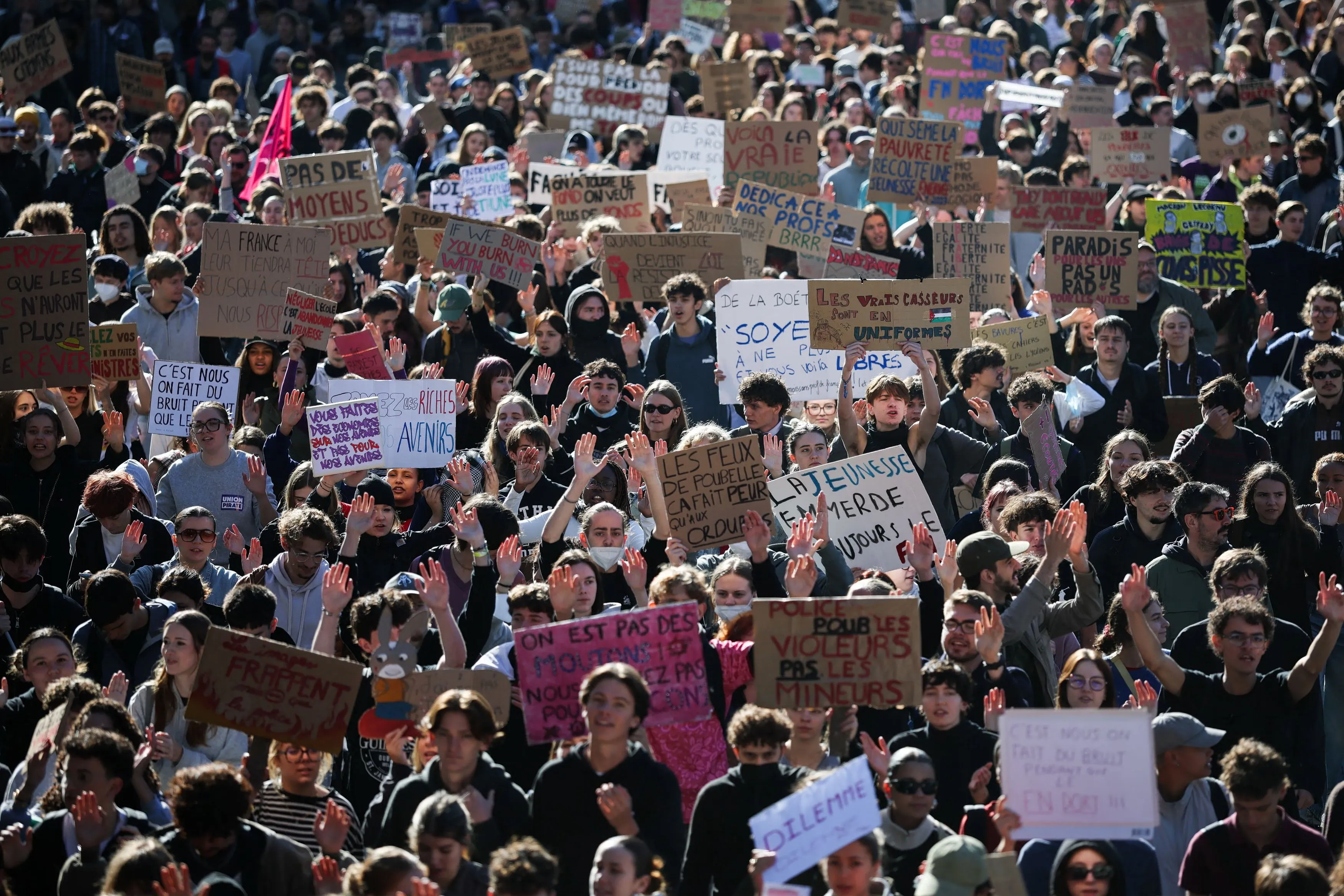
Why are student protests in France triggering such widespread concern?
The massive student demonstrations in France on October 6 and October 8, 2026, serve as a primary indicator of a deepening social crisis. These protests were marked by high levels of participation and significant scale, even in the face of repressive measures by the French government. The intensity of these movements has resulted in hundreds of injuries among both students and educators, highlighting the volatile nature of the current confrontation.
While the immediate grievances focus on practical issues such as staff shortages, the maintenance of school buildings, and changes to university access, the scale of the movement suggests a much deeper cause. The resilience of these protests, bolstered by significant solidarity from parents and teachers, indicates that the movement is not merely about educational reform but is a manifestation of a broader societal anger regarding the future of social security and the perceived abandonment of the youth by the state. This sense of indignation stems from a feeling that the future is defined by increasing inequality—a trend that has been a consistent promise to the younger generation since the beginning of the century.
How does austerity policy drive social unrest across the continent?
Austerity measures and the management of public debt are central drivers of the current social explosion in Europe. Many European governments, including the French administration—which itself is a product of political negotiation amidst a deep crisis—have prioritized fiscal discipline and debt reduction. This approach has frequently relied on the justification of managing bloated debt, but it has come at a significant cost to the social fabric.
The tension arises from a fundamental conflict between economic management and social stability. Governments frequently frame social spending, infrastructure support, and income redistribution as "unacceptable forms of fiscal deviation." By treating these essential social functions as economic risks rather than necessities, the state threatens to undermine the very elements of the social state that remain in force. This creates a cycle where social protests are treated primarily as matters of "public order" and "disruption" rather than legitimate political expressions of need, often accompanied by a systematic stigmatization of those who choose to protest.
The pattern of state response to dissent
A recurring theme in the response to social unrest is the shift from dialogue to suppression. In France, the government's approach has been criticized for following a pattern of heavy-handed policing, reminiscent of the "Yellow Vests" era. This tendency to prioritize security-led responses over social negotiation is a structural feature of many modern European administrations facing economic stagnation.
The use of force is not merely a reaction to specific events but reflects a broader strategy. When governments view social demands through the narrow lens of maintaining order, they bypass the underlying causes of discontent. This pattern of using repressive measures to manage social explosions has become a hallmark of current political leadership, where the primary goal is the preservation of the status quo through policing rather than addressing the socioeconomic drivers of unrest.
What is the link between neoliberalism and the rise of authoritarianism?
The current crisis suggests that the neoliberal ideological toolkit, which has dominated European politics for decades, has reached its limits. For years, privatization and fiscal discipline were promoted as the only viable paths for political and economic action. However, these methods have struggled to address the needs of modern societies or to move large economies out of their current state of stagnation.
As these economic models fail to deliver promised prosperity, there is an observable trend toward authoritarianism. This is not merely a temporary reaction to unrest but a structural characteristic where "order," maintained through policing, becomes the primary promise of the state. In this environment, the state often constructs "enemies"—such as migrants—to serve as targets for public frustration, creating a sense of a "threatened nation" to justify the increase in security-focused governance. This authoritarianism serves as a substitute for effective political and economic solutions that the current neoliberal framework is unable to provide.
How do different European nations handle social crises?
The methods used to address social crises vary by country, but a pattern of resistance to relief measures is evident. In Spain, for instance, when faced with potential social unrest regarding the housing crisis, the response of the right-wing was to oppose and block legislation that could have functioned as a relief measure for the population.
This mirrors historical patterns seen in Greece, particularly during the era of the "Memorandums" (bailout agreements). During those periods, the political consensus was that social measures must be implemented "at any cost," regardless of the scale of social explosion or the level of public discontent. This systemic refusal to respond to social needs in favor of fiscal compliance has become a defining feature of the regional political landscape, where the protection of economic mandates is prioritized over the stability of the social contract.
Can social movements offer an alternative to the current crisis?
Despite the volatility, large-scale social movements represent a potential space for reconstructing new forms of solidarity and collective action. Rather than relying on the orchestrated hostility against "the other" or the false sense of community found in "threatened nations," these movements are fostering a new collective "we" based on shared struggles for social justice.
These movements act as a field where alternatives to the current neoliberal crisis can be formulated. By reframing demands around social justice and collective rights, they provide a counter-narrative to the rise of far-right ideologies. The ability of these movements to redefine the social contract and create new forms of collective identity may determine whether Europe moves toward further fragmentation or toward a more inclusive social model that addresses the root causes of instability.
FAQ: Social unrest in Europe
What are the main causes of the French student protests?
The protests are driven by immediate issues like school staffing and building maintenance, but the root cause is a broader anger over declining social services. Students feel that the future promises increasing inequality rather than the social stability once guaranteed by the state.
How has the French government responded to the demonstrations?
The French government has largely utilized a repressive approach, employing police force to manage the protests. This strategy has led to significant injuries among students and teachers, following a pattern of prioritizing order over addressing the underlying social grievances.
Is austerity linked to the rise of authoritarianism?
Yes, as governments prioritize fiscal discipline and debt reduction, they often lose the ability to meet social needs. This failure can lead to a reliance on authoritarian methods and the use of "security" and "order" as the primary tools for maintaining control.
How do these movements differ from far-right ideologies?
While far-right ideologies often rely on creating enemies and nationalist division, these social movements tend to build solidarity through shared economic and social struggles. They focus on collective demands for justice rather than the exclusion of specific groups.
What role does neoliberalism play in this crisis?
Neoliberalism, characterized by privatization and fiscal austerity, is seen as having reached its limits. It has failed to resolve economic stagnation or provide the social protections necessary to prevent widespread public discontent and social instability.
Key takeaways
- French student protests in October 2026 reflect deep systemic discontent beyond mere educational reforms.
- Austerity-driven governance is increasingly viewed as a threat to the fundamental pillars of the social state.
- Political responses to unrest are shifting toward authoritarianism and increased reliance on police-led order.
- Social movements are creating new forms of solidarity as an alternative to far-right divisive politics.
Synthesis of the European social landscape
The current social explosion in Europe is more than a series of isolated incidents; it is a symptom of a profound crisis in the prevailing political and economic order. The tension between austerity-focused governance and the growing demand for social justice has created a volatile environment where traditional political tools are failing. As governments lean toward authoritarianism to maintain order, social movements are simultaneously emerging as spaces for new collective identities. The future of European stability likely depends on whether political structures can move beyond neoliberal constraints to address the fundamental needs of their citizens.







