
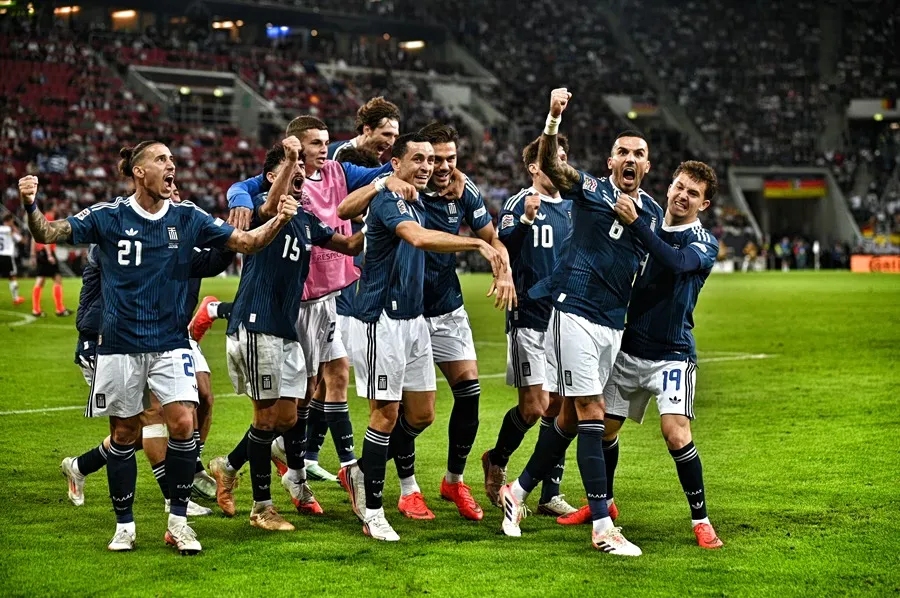
How did Greece achieve such high efficiency with low possession?
The Greece national football team maintained a highly effective offensive output despite controlling only 36% of ball possession during their first four Nations League fixtures. While traditional football metrics often equate possession with dominance, Jovanović's tactical setup prioritized high-value opportunities within the opponent's penalty area. This approach allowed Greece to remain competitive against elite European sides by maximizing the impact of every offensive transition.
In these four matches, Greece produced a total of 34 shots from inside the penalty area. This volume of high-quality chances resulted in five goals, distributed among a diverse group of scorers including Tzolis, Douvikas, Kourbelis, Ioannidis, and Masouras. The statistical breakdown reveals a conversion rate of one goal for every 8.5 shots taken from within the box, a figure that highlights the team's ability to find openings even when playing a reactive style of football.
The tactical discipline of Ivan Jovanović
The efficiency observed is a direct result of the disciplined structure implemented by Ivan Jovanović. By conceding possession, the team creates space for rapid counter-attacks that target the most vulnerable zones of the opposition defense. This method requires extreme concentration from both the midfield and the attacking line to ensure that limited possession is converted into meaningful threats.
How does Greece compare to the Netherlands and Germany?
When comparing Greece's clinical performance to that of the Netherlands and Germany, the statistical advantage for the Greek side becomes evident. Although the Netherlands scored more total goals, their efficiency per attempt was significantly lower than that of the Greek squad during this period.
The Netherlands, managed by Xavi, recorded seven goals in their four matches. While six of these goals came from inside the penalty area, the Dutch side required 59 total shots to achieve this tally. This equates to approximately one goal for every 10 shots taken. In contrast, Greece achieved their five goals with a much higher degree of precision, requiring fewer attempts to breach the opposition's net.
The performance of Germany, led by Jürgen Klopp, showed an even greater disparity in efficiency. Despite being the favorites in several matchups, including a home defeat to Greece, the German side managed only three goals from 46 shots inside the penalty area. This results in a conversion rate of one goal for every 15 attempts, making the German attack significantly less potent than the Greek offensive unit during the opening window of the tournament.
What does the data reveal about Serbia's offensive output?
Serbia also featured in the group and provided a useful benchmark for measuring offensive productivity in the Nations League. While Serbia demonstrated a respectable level of threat, they did not reach the clinical heights achieved by the Greek national team.
According to the match statistics, Serbia scored three goals across their four encounters. To achieve this, the Serbian team required 25 shots from within the penalty area. This means they averaged one goal for every 8.3 shots from inside the box. While this ratio is numerically similar to Greece's 8.5 ratio, the total volume of clinical opportunities and the overall impact on the group standings favored the Greek approach of maximizing limited possession into high-impact scoring moments.
What are the key statistical takeaways from the group stage?
The opening phase of the Nations League highlights a shift in how underdog teams can compete with European giants through statistical optimization. The data suggests that shot quality and positioning are more critical to success than total possession volume.
The table illustrates that while the Netherlands had a higher goal count, Greece's ability to convert shots into goals was more efficient than Germany's, and nearly matched the high-intensity efficiency seen in the Serbian matches, all while operating with much lower ball control.
Frequently asked questions
How many points did Greece earn in the first four matches?
Greece earned a total of eight points during the first four matches of the Nations League group stage. This performance allowed them to sit at the top of the group, tied with the Netherlands, having remained undefeated against high-ranking opponents like Germany.
Who were the goalscorers for the Greek national team?
The goals for Greece were scored by a variety of players, demonstrating depth in the attacking lineup. The specific scorers identified in these matches include Tzolis, Douvikas, Kourbelis, Ioannidis, and Masouras, all contributing to the team's five-goal total.
How did Greece's possession compare to their scoring efficiency?
Greece operated with a relatively low possession rate of 36%. Despite this lack of ball control, they were highly efficient, creating 34 chances from inside the penalty area and scoring once every 8.5 attempts from that zone.
How did Germany perform in terms of attacking efficiency?
Germany struggled with clinical finishing, scoring only three goals from 46 shots taken within the penalty area. This resulted in a low efficiency rate of one goal for every 15 shots, which contributed to their difficulty in securing wins.
How does the Netherlands' efficiency compare to Greece?
The Netherlands scored seven goals, but their efficiency was lower than Greece's. The Dutch side required approximately 10 shots to score one goal, whereas the Greek team required only 8.5 shots from inside the box to achieve a goal.
Key takeaways
- Greece secured eight points in the first four Nations League matches, matching the Netherlands at the top.
- The Greek team maintained a high efficiency of one goal for every 8.5 shots in the box.
- Despite only 36% possession, Greece produced 34 high-quality chances inside the penalty area.
- Germany's attacking efficiency was notably lower, with one goal per 15 shots in the box.
The strategic evolution of Greek football
The recent performance of the Greek national team under Ivan Jovanović represents a significant tactical evolution. By prioritizing clinical finishing over possession-based dominance, Greece has found a way to neutralize the advantages held by traditionally stronger European nations. The ability to remain undefeated while facing teams like Germany and the Netherlands suggests that this high-efficiency model is sustainable. As the Nations League progresses, the focus will likely remain on maintaining this defensive discipline while ensuring the attacking precision remains high enough to capitalize on the limited opportunities afforded by a counter-attacking style.
| Team | Goals Scored | Shots in Box | Efficiency (Goals per Shot in Box) |
|---|---|---|---|
| Greece | 5 | 34 | 1 in 8.5 |
| Netherlands | 7 | [Not specified] | 1 in 10 |
| Germany | 3 | 46 | 1 in 15 |
| Serbia | 3 | 25 | 1 in 8.3 |







