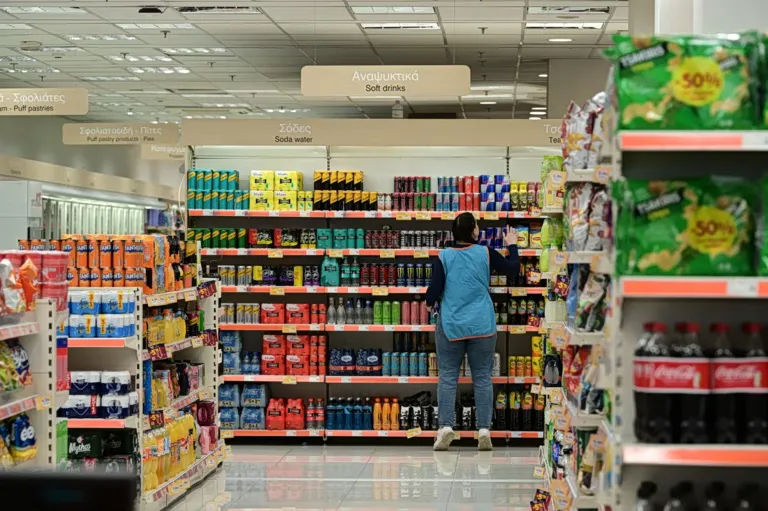
The Greek supermarket sector reached a total revenue of €16 billion in 2025, reflecting significant growth and increasing market concentration. According to the EY-Parthenon "Grocery retail sector outlook 2026" report, the market expanded by €4 billion in absolute terms between 2020 and 2025, averaging an annual increase of nearly €1 billion. While the top six players now control 71% of organized retail, the top three leaders hold a 56% share. This article examines the shifting market shares, EBITDA performance of key players, and the strategic investment plans driving the industry's evolution.
How has the Greek grocery market evolved between 2020 and 2025?
The Greek grocery retail market experienced a period of robust expansion, adding approximately €1 billion to its total revenue every year between 2020 and 2025. By the end of 2025, total revenues for the organized retail sector hit the €16 billion mark, according to data from the EY-Parthenon "Grocery retail sector outlook 2026" study.
This growth has been accompanied by a notable trend toward market concentration. The industry is increasingly dominated by a small group of large-scale operators. In 2025, the six largest players in the sector accounted for 71% of all organized retail. Furthermore, the market is heavily weighted toward the top tier, with the three leading supermarket chains commanding 56% of the total market share.
Who are the dominant leaders in the supermarket market share?
Sklavenitis has significantly strengthened its market leadership, increasing its share from 26% in 2020 to 32% in 2025. This growth positions it as the undisputed leader in the Greek organized retail landscape.
In contrast, other major players have seen varying degrees of success or decline. AB Vassilopoulos has faced a gradual erosion of its market position, dropping from a 17% share in 2020 to 13% in 2025. The EY-Parthenon research indicates that this chain is currently under pressure from competitors within a mature market and is strategically focusing on maintaining profitability.
Comparative Market Share Data (2020 vs 2025)
| Retailer | 2020 Market Share | 2025 Market Share | Trend |
|---|---|---|---|
| Sklavenitis | 26% | 32% | Increasing |
| AB Vassilopoulos | 17% | 13% | Decreasing |
| Metro | 11% | 11% | Stable |
| Masoutis | 7% | 8% | Increasing |
| Kritikos | 3% | 5% | Increasing |
| Galaxias | 4% | 3% | Decreasing |
While some players struggled, others demonstrated resilience. Metro maintained a stable 11% market share throughout the five-year period, while Masoutis saw a slight increase from 7% to 8%. Kritikos also showed impressive growth, rising from 3% to 5% due to successful store expansions and improved market positioning. Conversely, Galaxias saw its share dip from 4% to 3% during the 2024-2025 period.
Which companies reported the highest EBITDA growth?
Sklavenitis achieved consistent and significant growth in its EBITDA, rising from €225 million in 2020 to €343 million in 2025. During this same period, its total revenues reached €5.1 billion, resulting in net profits of €96 million.
The company's growth strategy includes both acquisitions and new service concepts. Recently, Sklavenitis acquired a 49% stake in Eurcontact, the company behind the Freskoulis brand. It has also piloted a "Food to Go" concept in four locations. Looking ahead, the retailer has announced an investment plan of €350 million for the 2026-2027 period, which includes the launch of a "Food Hall" and the opening of 15 new stores, including large-scale locations in Oraiokastro and Loutraki.
Metro AEBE also showed positive momentum, with EBITDA growing by 4% to reach €70 million in 2025, up from €57 million in 2020. The company reported revenues of €1.7 billion and is currently investing €70 million in a new distribution center in Aspropyrgos. Additionally, Metro is aggressively expanding its My Market Local brand through a franchising model, with a planned investment of €250-€280 million between 2026 and 2029 to open approximately 150 new stores.
How is the Masoutis and Kritikos merger reshaping the landscape?
Masoutis has maintained steady financial performance, with EBITDA increasing from €60 million in 2020 to €72 million in 2025, alongside revenues of €1.2 billion. The company recently completed a significant merger with Kritikos, creating a combined group valued at over €2 billion with a network exceeding 800 stores.
The newly formed group plans to develop a multifunctional hub in Thessaloniki that will integrate retail, food and beverage (F&B), sports, and office spaces. Kritikos itself saw a 10% growth in EBITDA between 2020 and 2025, despite a slight dip in 2025 (€29 million) compared to 2024 (€37 million). Its 2025 revenues reached €836 million.
According to the EY-Parthenon study, Kritikos achieved rapid expansion through strategic acquisitions and new store openings, though this growth has led to increased debt levels. The company also acted as an investor in the Spanos supermarket chain, supporting its restructuring efforts.
What are the challenges facing AB Vassilopoulos and Galaxias?
AB Vassilopoulos has faced significant financial pressure, with adjusted EBITDA plummeting from €174 million in 2020 to just €27 million in 2025—a 31% decrease in profits before interest, taxes, and depreciation. Despite this, the company reached revenues of €2 billion and is attempting to rationalize its network by converting 35 owned stores into franchises and opening 46 new franchise locations.
The company aims to reach 900 stores by 2028, supported by an investment plan of €41.5 million. In 2026, AB Vassilopoulos also inaugurated a new 35,000 square meter logistics center in Elefsina to bolster its operations.
Galaxias has taken a more cautious approach to expansion, relying on self-financing and strong liquidity rather than bank loans. However, this has not prevented a decline in profitability; its EBITDA fell from €38 million in 2020 to €12 million in 2025, representing a 21% decrease. To improve its infrastructure, the company plans to build a 45,000 square meter logistics center in Aspropyrgos and a new commercial hub in Agrinio. In 2026, Galaxias also secured €3.5 million through the Recovery and Resilience Mechanism to upgrade energy efficiency in 50 existing stores.
Frequently asked questions
What was the total revenue of the Greek supermarket sector in 2025?
The total revenue of the organized grocery retail sector in Greece reached €16 billion in 2025. This follows a period of steady growth where the market added approximately €1 billion in annual revenue between 2020 and 2025.
Which supermarket chain holds the largest market share in Greece?
Sklavenitis is the market leader, holding a 32% share of the Greek supermarket market in 2025. This is a significant increase from its 26% market share recorded five years earlier in 2020.
How has the market concentration changed in the Greek grocery sector?
Market concentration has increased significantly. By 2025, the six largest players in the industry controlled 71% of the organized retail market, while the top three companies alone accounted for 56% of the total share.
What is the strategic focus of AB Vassilopoulos?
AB Vassilopoulos is currently focusing on maintaining profitability and rationalizing its network. This strategy includes converting owned stores into franchises and investing in new logistics infrastructure, such as a 35,000 square meter center in Elefsina.
How are companies like Metro and Sklavenitis investing for the future?
These companies are investing heavily in logistics and expansion. Sklavenitis has a €350 million plan for 2026-2027, while Metro is planning an investment of up to €280 million between 2026 and 2029 to expand its My Market Local franchise model.
Key takeaways
- The Greek grocery market grew by €4 billion in absolute terms between 2020 and 2025.
- Sklavenitis increased its market dominance from 26% to 32% over five years.
- The top six retailers now control 71% of the organized Greek retail market.
- Metro and Masoutis have demonstrated high resilience with stable or growing market shares.
- AB Vassilopoulos has faced declining EBITDA, dropping from €174 million to €27 million.
Conclusion
The Greek supermarket sector is undergoing a profound transformation characterized by rapid revenue growth and intense consolidation. While the overall market has expanded by €4 billion since 2020, the benefits of this growth are increasingly concentrated among a few dominant players. Sklavenitis has successfully leveraged its scale to expand its leadership, while others like Metro and Masoutis are pursuing strategic mergers and franchise models to maintain competitiveness. Conversely, the challenges faced by AB Vassilopoulos and Galaxias highlight the difficulties of maintaining profitability in a mature, highly competitive landscape. The coming years will likely see continued investment in logistics and digital-ready infrastructure as retailers vie for dominance.