
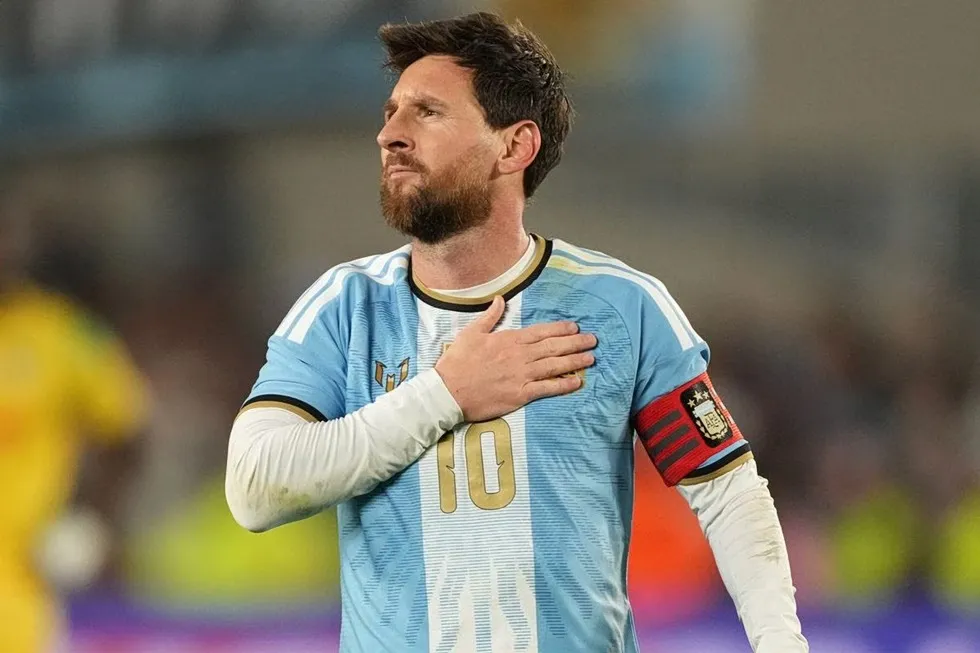
How did Lionel Messi perform in his final match for Argentina?
Lionel Messi delivered a commanding performance in his final international outing, contributing directly to all three goals in Argentina's 3-0 win against Benin. Playing before a sold-out crowd at the Monumental stadium, the 39-year-old forward demonstrated that his technical influence remains profound even at the twilight of his career. The atmosphere was electric as the stadium was packed to capacity to witness the final chapter of the 'Albiceleste' legend.
The match was defined by Messi's ability to orchestrate the attack and finish clinical opportunities. He provided two decisive assists—one for Otamendi and another for Paz—before converting a penalty in the 71st minute to score his final goal for the national team. This statistical contribution ensured his farewell was as impactful as his career has been, leaving the fans with a sense of profound gratitude and emotion. As the final whistle blew, the scene was one of tears and a massive tribute to a player who defined an era.
Final match statistical breakdown
According to data shared by The Touchline, Messi's final appearance was characterized by high involvement and efficiency. Despite his age, his ability to create chances remained elite, proving that his vision and presence on the pitch were undiminished by time. His statistical output in this single match was nothing short of incredible:
- Goal Contributions: 3 (1 goal, 2 assists)
- Attacking Threat: 9 shots and 4 key passes
- Chance Creation: 2 big chances created
- Ball Involvement: 91 touches and 48 passes
- Defensive/Physical: 4 duels won and 2 long balls
These figures highlight a player who remained central to Argentina's tactical structure until the very end. Even in his final minutes, his ability to find teammates and maintain ball control was evident, ensuring that his departure was marked by excellence rather than decline. The sheer volume of touches and key passes suggests that even at 39, Messi remained the primary engine of the Argentine offensive machine.
What are the career statistics of Lionel Messi with Argentina?
Lionel Messi retires as the undisputed statistical leader of the Argentine national team, holding the records for most appearances, goals, and assists. His journey spanned over two decades, beginning with a brief and turbulent debut in 2005 and culminating in a legendary status that transcends mere numbers. The sheer longevity of his service to the national team is a feat rarely seen in the modern game.
Over the course of 21 years, Messi earned 208 caps for the Albiceleste. His scoring record is equally prolific, with 126 international goals. Beyond his finishing, his playmaking abilities are reflected in his 70 assists. This combination of scoring and creating makes him the most productive player in the history of the national team, setting a benchmark that may stand for generations.
The timeline of his international journey is marked by a staggering consistency. He made his debut in a friendly against Hungary on August 17, 2005, entering as an 18-year-old and experiencing a chaotic start when he was sent off just seconds after coming on. From that difficult beginning to his final appearance 7,722 days later, Messi's evolution from a young prospect to a global icon is complete. His career represents a bridge between different eras of Argentine football, moving from the uncertainty of a teenager to the absolute certainty of a veteran leader.
Which major trophies did Lionel Messi win with Argentina?
Lionel Messi's international trophy cabinet is among the most decorated in football history, featuring every major honor available to an Argentine player. His career was marked by early struggles and intense scrutiny, but his later years provided the ultimate redemption through multiple championship titles that silenced his critics.
The pinnacle of his career was the 2022 FIFA World Cup victory, an achievement that solidified his legacy. However, his success was not limited to a single tournament. He also secured two Copa América titles in 2021 and 2024, alongside the 2022 Finalissima. His trophy collection also includes earlier successes, such as the 2008 Olympic gold medal in Beijing and the 2005 FIFA World Cup U20 title. He also reached two World Cup finals, in 2014 and 2026, adding to the drama of his international tenure.
The progression of his success can be summarized as follows:
- FIFA World Cup: Winner (2022), Runner-up (2014, 2026)
- Copa América: Winner (2021, 2024)
- Finalissima: Winner (2022)
- Olympic Games: Gold Medal (2008)
- FIFA U20 World Cup: Winner (2005)
This progression from a youth champion to a World Cup winner represents one of the most complete developmental arcs in sporting history, moving through periods of heartbreak to reach the highest possible summits. The fact that he reached the final in 2026, his final year, underscores his ability to remain at the top of the world stage well into his late thirties.
How does Messi's legacy compare to Diego Maradona?
The debate regarding whether Lionel Messi or Diego Maradona is Argentina's greatest player has been a central theme of his career. While Maradona remains a cultural icon of unparalleled emotional significance, Messi's statistical dominance and trophy haul have led many to argue that he has surpassed the myth. This comparison has been a constant backdrop to his achievements.
Maradona's legacy is built on individual brilliance and the 1986 World Cup, but Messi has provided a level of sustained excellence over 21 years that is difficult to match. Messi's ability to lead Argentina to multiple major titles in the 2020s has provided a sense of redemption and fulfillment that has allowed him to stand alongside, and for many, above the legend of Maradona. While the debate may never be fully settled by the fans, Messi's era has been defined by a level of consistent greatness that has redefined the expectations for an Argentine superstar.
The source notes that while many believe Messi has surpassed the myth, Maradona himself would likely never admit to being overtaken. This tension between the raw, emotional magic of Maradona and the clinical, record-breaking longevity of Messi remains the defining narrative of Argentine football history.
Conclusion
Lionel Messi’s departure from the Argentina national team marks the end of an era. From a red-carded debut in 2005 to a triumphant 3-0 victory in 2026, his path was filled with both bitterness and glory. He leaves the pitch not just as a record-breaker, but as a player who achieved the ultimate redemption, leaving a lasting legacy for the generations of footballers that will follow in his footsteps. The 'last tango' was a masterclass in skill and leadership, ensuring that his exit was as magnificent as his arrival.
Key Takeaways
- Messi finished his Argentina career with 208 caps, 126 goals, and 70 assists.
- His final match against Benin saw him contribute 1 goal and 2 assists in a 3-0 victory.
- His trophy haul includes the 2022 World Cup, two Copa Américas, and an Olympic Gold medal.
- He holds the all-time records for appearances, goals, and assists for the Argentine national team.
Frequently Asked Questions
What was Messi's final score for Argentina?
Messi scored a penalty in the 71st minute of Argentina's final match against Benin.
How many years did Messi play for the Argentina national team?
Messi played for Argentina for 21 years, spanning from 2005 to 2026.
Did Messi win the World Cup?
Yes, Messi won the FIFA World Cup in 2022.







