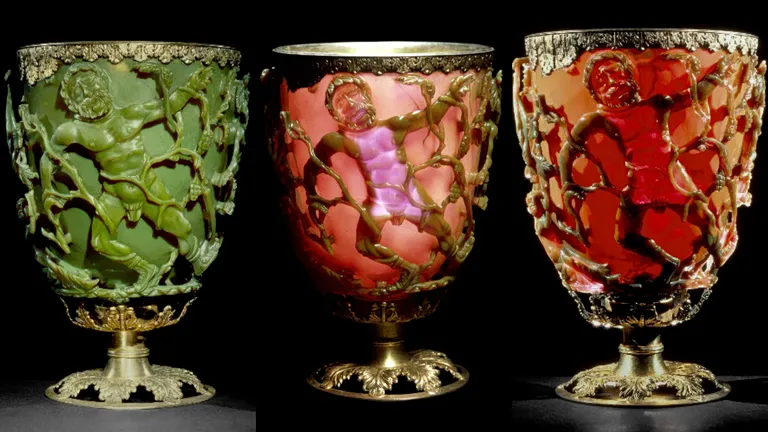
How does the Lycurgus Cup change color?
The color-shifting property of the Lycurgus Cup is caused by the presence of microscopic gold and silver particles embedded within the glass structure. This phenomenon, known as dichroism, occurs because these metallic nanoparticles interact with light in two distinct ways depending on the angle of illumination.
When light strikes the surface of the glass and reflects back to the viewer, the particles scatter the light in a manner that produces an opaque green hue, reminiscent of nephrite. However, when light passes through the translucent body of the vessel—such as when a candle is placed inside—the particles act as a filter. They obstruct shorter wavelengths, specifically blue and green light, while allowing longer wavelengths, such as red and orange, to pass through to the eye.
The role of light scattering
The mechanism relies on the specific size and distribution of the metal particles. Because the particles are roughly 1,000 times smaller than a grain of sand, they do not simply block light like a solid wall; instead, they selectively absorb and scatter specific parts of the light spectrum. This creates the dramatic visual transition from green to red that has fascinated historians for centuries.
How did scientists replicate this ancient technique?
Researchers at the University of Sheffield successfully recreated the cup's optical effect by applying a recipe derived from the analysis of authentic glass fragments. The process required precise control over the incorporation of nanoparticles into molten glass during the manufacturing stage.
The team, led by Dr. Lisa Hollandts in collaboration with Professor Caroline Jackson, a specialist in Roman glassmaking, focused on the thermal requirements of the process. To achieve the desired effect, the metal particles must be integrated into the glass while it is at temperatures exceeding 1,000 degrees Celsius. As the material cools, these particles coalesce into gold and silver nanocrystals, which are essential for the dichroic effect.
Dr. Hollandts described the endeavor as a "work of love," noting the complexity involved in mimicking a process that ancient craftsmen mastered long before the advent of modern microscopy. While similar glass was produced in laboratory settings as early as the 1960s, this recent Sheffield study is considered significantly more accurate, as it more closely captures the specific tonal nuances of the original Roman artifact.
Was the Roman technique a result of skill or luck?
Despite the scientific success in replicating the cup, experts remain divided on whether Roman glassmakers possessed a standardized method for producing such objects or if they occasionally achieved these results through serendipity.
Ian Fristoeun, an emeritus professor of archaeological materials at University College London, suggests that the process was highly sensitive to environmental variables. He noted that even the specific positioning of the glass within the kiln could drastically alter the final color of the piece. According to Fristoeun, the creators of the Lycurgus Cup may have essentially "hit the jackpot," suggesting that while they understood the materials, the perfect execution might have been a rare occurrence rather than a repeatable industrial standard.
What is the historical and mythological significance of the cup?
The Lycurgus Cup, which dates back to the 4th century AD, is more than a technical marvel; it is a profound piece of narrative art. The vessel features intricate relief carvings inspired by the myth of King Lycurgus, a figure mentioned in Homer's Iliad.
The carvings depict the punishment of Lycurgus by the god Dionysus, showing the king being ensnared by vines. This mythological connection is believed to be intentional, as the color-changing properties of the glass may have served a ritualistic purpose. One theory suggests that the transition from green to red mirrored the ripening of grapes, a fitting visual metaphor for a vessel used in Dionysian ceremonies involving wine.
This connection is supported by historical records. Fristoeun points out that a letter attributed to Emperor Hadrian makes reference to color-changing cups intended for use during festive banquets. In 2022, an international committee officially recognized the Lycurgus Cup as one of the seven wonders of glassmaking globally, cementing its status as a pinnacle of ancient craftsmanship.
What are the modern implications of this discovery?
The successful scientific replication of the cup has transcended academic study and entered the realm of contemporary art. The breakthrough has inspired new creative works that bridge the gap between ancient nanotechnology and modern aesthetics.
Artist Elliot Walker has created a modern glass sculpture inspired by the rediscovered technique. This piece is scheduled for exhibition in Sheffield this November and will eventually find a permanent home at the Turner Glass Museum. Such projects demonstrate how understanding ancient technologies can continue to fuel modern artistic expression and scientific curiosity.
Key takeaways
- The Lycurgus Cup uses gold and silver nanoparticles to create a dichroic color-changing effect.
- The vessel appears green under reflected light and deep red when illuminated from within.
- University of Sheffield scientists successfully replicated the 1,600-year-old technique using molten glass.
- The cup's design features reliefs of King Lycurgus being punished by the god Dionysus.
- Experts debate whether the original creation was a repeatable skill or a rare stroke of luck.
FAQ: Lycurgus Cup
Why does the cup change from green to red?
The change is caused by gold and silver nanoparticles embedded in the glass. When light reflects off the surface, the particles scatter light to create a green color. When light passes through the glass, the particles filter out blue and green wavelengths, allowing red light to pass through.
When was the Lycurgus Cup created?
The Lycurgus Cup dates back to the 4th century AD. It is currently held in the British Museum and is considered one of the most significant examples of ancient Roman glassmaking technology in existence today.
Was the technique used for religious purposes?
It is highly likely the cup was used in Dionysian wine rituals. The color change from green to red may have symbolized the ripening of grapes, and historical texts mention similar color-changing vessels used during imperial banquets and celebrations.
How did the Sheffield scientists replicate it?
The researchers used a recipe based on the analysis of authentic glass fragments. They incorporated gold and silver nanoparticles into molten glass at temperatures above 1,000 degrees Celsius, allowing nanocrystals to form as the material cooled.
Is the color-changing effect a common feature of Roman glass?
No, it is an extremely rare phenomenon. Experts like Ian Fristoeun suggest that the perfect combination of metal concentration and kiln placement made such objects exceptionally rare, potentially representing a "jackpot" moment of ancient craftsmanship.
Conclusion
The resolution of the Lycurgus Cup mystery provides a profound window into the sophistication of Roman artisans. By demonstrating that these ancient craftsmen were utilizing principles of nanotechnology—long before the term existed—the research from the University of Sheffield elevates our understanding of classical technology. Whether the result of precise, repeatable skill or a rare alignment of environmental factors, the cup remains a testament to human ingenuity. This discovery not only honors the legacy of the original makers but also continues to inspire modern scientists and artists alike through its enduring visual magic.