
Why is the melting of Swiss glaciers accelerating so rapidly?
The melting of Swiss glaciers is accelerating due to a combination of unprecedented thermal anomalies and shifting precipitation patterns. According to the latest data from the Swiss Glacier Monitoring Network (GLAMOS), the year 2026 has been categorized as "catastrophic," representing the second-worst year for ice volume loss since 2020. The specific loss recorded this year stands at 5.5%, a figure that represents the most significant single-year volume reduction documented since 1950.
This rapid decline is fueled by a summer that was exceptionally hot and a winter characterized by a lack of significant snowfall. Without a sufficient snowpack to act as an insulating layer, the underlying glacial ice is directly exposed to rising atmospheric temperatures. This exposure triggers a feedback loop where the ice absorbs more heat, further speeding up the melting process. The lack of snow cover in winter meant that by the time summer arrived, the glaciers had no protective buffer against the heat.
The role of temperature anomalies
The fundamental driver of this phenomenon is the rapid increase in regional temperatures. Data from MétéoSuisse, the Swiss meteorological service, indicates that temperature rises in Switzerland are occurring at twice the global average rate. This regional warming trend is significantly outstripping global norms, creating a localized crisis for Alpine ecosystems. During the summer of 2026, temperatures reached levels that surpassed previous records, including the heatwave of 2023.
Specifically, the summer temperatures in 2026 were 3.4°C higher than the 1991-2020 reference period. This level of warming is approaching the projected scenario of a +3°C world; in fact, MétéoSuisse notes that if the global temperature increase reaches 3°C, the summer of 2026 will effectively become the new "average" summer. This extreme heat has had a direct impact on the mountains, where snow that once protected the glaciers had already melted by June and was completely gone by September, even at altitudes as high as 3,500 meters.
How much ice volume has been lost in recent years?
Swiss glaciers have lost approximately 20% of their total volume since 2021, according to GLAMOS measurements. The rate of loss has intensified significantly when compared to previous decades. To understand the scale of this loss, researchers monitor approximately 20 representative glaciers that serve as indicators for the nearly 1,300 glaciers currently existing in Switzerland. These measurements reveal a highly volatile and accelerating downward trajectory in ice mass.
The historical comparison is stark. While the 1990s saw a volume loss of roughly 10%, and the period between 2016 and 2021 saw a 27% decline, the most recent five-year window (2022–2026) shows a consistent and rapid depletion. The physical manifestations of this loss are visible to researchers on the ground. Matthias Coos, head of GLAMOS, has observed that some glaciers are on the verge of total disappearance, with some specific sites potentially devoid of ice within the next 10 to 15 years. He noted the tragedy of seeing these mountains "naked" and without snow, a sight he described as "unbelievable."
- 1990s: 10% volume loss.
- 2016–2021: 27% volume loss.
- 2021–2026: 20% volume loss.
The loss is not uniform across the country. While some glaciers have been slightly mitigated by higher snowfall or reduced dust from the Sahara—which allows the ice to reflect more sunlight rather than absorbing it—the overall trend remains devastating. The reduction in Saharan dust has helped some ice reflect solar energy back into the atmosphere, but this has not been enough to offset the massive temperature increases.
What is the impact of glacier retreat on Alpine landscapes?
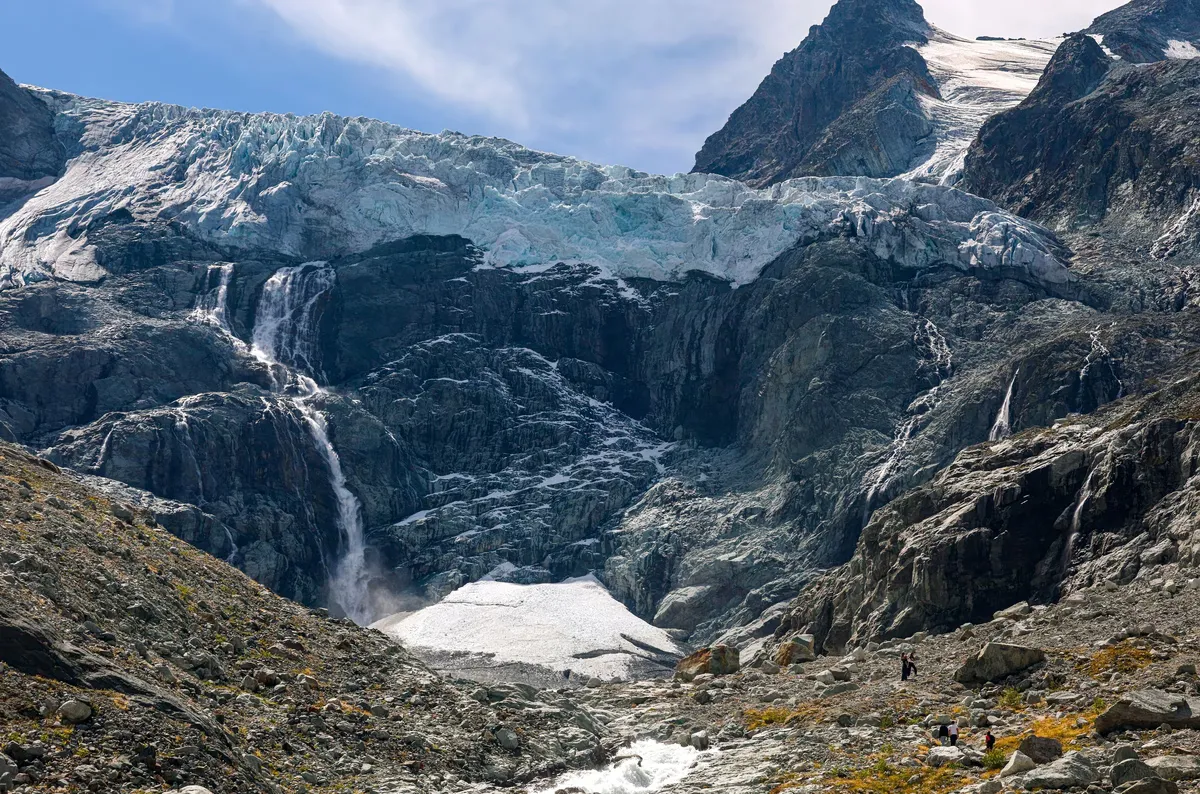
The retreat of glaciers is fundamentally altering the topography and physical structure of the Swiss Alps. As the ice thins, the mountains are being left "naked," with rock and debris becoming increasingly exposed. In some areas, the average thickness of the ice has decreased by 2.5 to 4 meters, while certain glacial "tongues" have seen contractions of up to 10 meters during the summer season. This extreme thinning has forced scientists to constantly adapt their monitoring methods. Due to the extreme melting, measurement poles that were previously stable have been forced to be reinstalled at higher altitudes because the ice surrounding them has simply vanished. For example, a four-meter aluminum rod used by GLAMOS that was clearly visible above the surface in July has seen its exposed portion increase to over three meters today.
Specific glacier case studies
Not all glaciers are reacting to the heat in the same way, but several iconic landmarks are facing extreme distress. The Rhone Glacier, one of the most emblematic in the region, and the Aletsch Glacier—the largest in the Alps—have both suffered record-breaking melting this year. These specific losses are particularly concerning because they serve as major hydrological regulators for the surrounding valleys. Despite some glaciers having slightly more snow than they did four years ago, the extreme heat of 2026 has ensured that several major glaciers still experienced their most significant melting on record.
How will the loss of ice affect water availability?
The melting of Swiss glaciers poses a direct threat to future water security and resource management. Between July and September 2026, the glaciers lost an estimated 2.2 trillion liters of water. To put this volume into perspective, Matthias Coos stated that this amount is four times the annual water consumption of all Swiss households combined. This massive loss of stored freshwater represents a significant depletion of the region's natural capital.
As these natural reservoirs disappear, the seasonal regulation of water flow is disrupted. Glaciers act as a buffer, releasing water during dry periods to maintain river levels. Without this ice, the timing and volume of water available for agriculture, drinking, and hydroelectric power will become increasingly unpredictable. The GLAMOS report warns that in current conditions, Alpine glaciers have no chance of long-term survival.
FAQ: Swiss Glacier Melting
What is the total volume loss of Swiss glaciers since 2021?
Swiss glaciers have lost approximately 20% of their total volume between the years 2021 and 2026. This rapid decline is significantly faster than the melting rates observed in previous decades, such as the 10% loss recorded during the 1990s.
Why is the melting happening faster in Switzerland than globally?
Temperature increases in Switzerland are occurring at twice the global average rate, according to MétéoSuisse. This regional warming, combined with reduced winter snowfall and warmer summers, creates an environment where Alpine ice cannot maintain its mass.
How much water is lost during the summer melting season?
Between July and September 2026, Swiss glaciers lost roughly 2.2 trillion liters of water. This massive volume of water is equivalent to four times the total annual water usage of all households in Switzerland.
Are all Swiss glaciers melting at the same rate?
No, the melting is not uniform across all 1,300 glaciers. While some areas experience slightly more snow or less dust, major glaciers like the Rhone and the Aletsch have experienced record-breaking melting this year.
How long until some Swiss glaciers disappear completely?
Experts from GLAMOS warn that some specific glaciers could disappear entirely within the next 10 to 15 years. The current lack of long-term survival prospects for many Alpine glaciers is due to the sustained increase in summer temperatures.
Key takeaways
- Swiss glaciers lost 20% of their total volume between 2021 and 2026.
- The year 2026 saw a 5.5% volume loss, the highest since 1950.
- Switzerland's temperature rise is twice the global average rate.
- Glaciers lost 2.2 trillion liters of water between July and September 2026.
Conclusion
The data presented by GLAMOS and MétéoSuisse paints a sobering picture of the current state of the Swiss Alps. The loss of 20% of glacial volume in just five years is a clear indicator of the accelerating impact of climate change on high-altitude ecosystems. Beyond the visual loss of the iconic Alpine landscape, the disappearance of these ice masses threatens the hydrological stability of the region. As the natural water reservoirs diminish, the implications for water security and resource management in Switzerland and beyond will become increasingly critical in the coming decades.







