The narrative structure and thematic focus of Axios
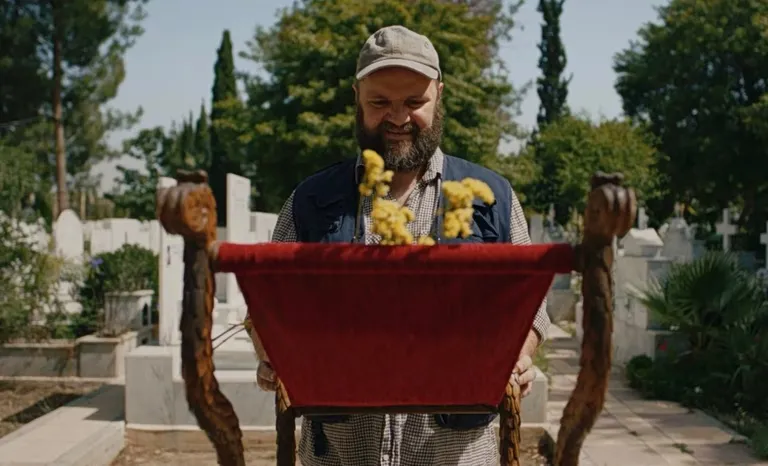
The Axios film follows the journey of Elias, a cemetery caretaker in a small town, whose life changes after discovering an image he believes is weeping. This discovery transforms him from a simple worker into the "chosen one" of a local community. The film utilizes this central premise to weave together a multi-layered story that includes three additional human narratives, each centered on individuals seeking to fulfill their wishes through the mysterious image.
The film is categorized as a dramatic comedy, using the cemetery setting not merely as a location but as a symbolic space for wishes, belief, and the inherent absurdities of daily life. According to the production details, the film seeks to examine human vulnerabilities through a tender and sweet lens, maintaining the human-centric cinematic style established by director Christos Georgiou.
Character dynamics and the role of Elias
The protagonist, Elias, is depicted as an emotional and dreamy character waiting for a change in fortune. The transition from a routine caretaker to a figure of communal importance serves as the primary driver of the film's emotional arc. This transformation allows the narrative to explore how belief can reshape an individual's social standing and internal reality.
Makis Papadimitriou's performance in a diverse role
Makis Papadimitriou delivers a performance that departs from his previous work, taking on a complex and multi-layered role. As Elias, Papadimitriou portrays the character's evolution with naturalism, moving from the mundane tasks of a cemetery employee to the heightened emotional state of a man caught in a social phenomenon. The actor's ability to navigate the film's shifts between comedy and drama is central to the film's reception.
The performance is noted for its emotional depth, capturing the essence of a man who is both a dreamer and a victim of his own circumstances. This role highlights Papadimitriou's versatility, as he manages the delicate balance required for a character that serves as both a comedic figure and a vessel for the film's more profound existential questions.
Director Christos Georgiou and his cinematic background
Christos Georgiou brings a significant international pedigree to the Axios film, following previous successes in the European film circuit. His prior works have garnered notable recognition, including the Prix de Montreal in 2001 for "Kato Ap' ta Astra" and the Variety Critics Award at Karlovy Vary for "Mikro Egklima." The latter also achieved commercial success in Germany in 2009.
Georgiou's direction in Axios continues his exploration of human-centric storytelling. His approach focuses on the intricacies of human nature and the quiet moments of life, a style that has become a hallmark of his filmography. The 100-minute runtime is designed to facilitate this intimate look at the characters' lives and their interactions with the supernatural elements of the plot.
Production details and the filming experience in Cyprus
The production of the Axios film took place in Cyprus, providing the specific atmospheric setting required for a story centered on a cemetery. Despite the somber nature of the location, the filming process was described by Georgiou as a source of tranquility rather than a difficulty. The director noted that the cemetery environment created a sense of calm and peace during the shoot.
| Production Element | Details |
|---|---|
| Director | Christos Georgiou |
| Lead Actor | Makis Papadimitriou |
| Music Composer | Konstantis Papakonstantinou |
| Filming Location | Cyprus |
| Duration | 100 minutes |
| Genre | Dramatic Comedy |
The film's technical elements, particularly the original music composed by Konstantis Papakonstantinou, are intended to complement the film's unique atmosphere. The combination of the Cypriot landscape and the specific tonal requirements of a dramatic comedy provided the foundation for the film's visual and auditory identity.
Inspiration and the philosophy of life and death
The inspiration for the film stems from the director's observations on the human relationship with mortality. Georgiou stated that as people age, they often move closer to the concept of death, becoming more acquainted with it through the loss of loved ones or through their proximity to cemeteries.
The central message of the film is one of continuity. Georgiou explained that the story aims to demonstrate that when something leaves a life, something new arrives, suggesting that life continues and brings new elements even in the wake of death. This philosophical underpinning provides the "sweet" and "tender" quality that characterizes the film's view of human weakness and the cycle of existence.