Why is the Musk documentary reportedly being withdrawn from cinemas?
The documentary titled 'Musk' is reportedly facing an abrupt end to its theatrical run following a significant disconnect between its critical reception and commercial performance. According to the industry news site Showbiz411, the film has almost vanished from American cinemas, leaving only a few isolated locations that reportedly did not receive notice of the change.
The reports suggest that while the film initially garnered positive reviews during its festival circuit, its transition to a wider audience was problematic. For instance, the distributor, Bleeker Street Films, had expanded the release to 472 theaters last week. However, recent claims suggest that the scheduled screenings for many of these locations have been removed without prior explanation.
Social media activity has added weight to these claims. On Reddit, users have confirmed instances where previously purchased tickets for 'Musk' screenings were cancelled without warning. While these reports are circulating widely on social platforms, mainstream media outlets have yet to provide independent confirmation of a formal, industry-wide withdrawal.
The disconnect between critical acclaim and commercial reality
The difficulty in sustaining a theatrical run for 'Musk' may stem from its massive 225-minute runtime. Such a long duration inherently limits the number of daily screenings a theater can host, which directly impacts the potential revenue per screen. In an industry where most films aim for a 45-day theatrical window, a two-week disappearance is an outlier that signals either a catastrophic commercial failure or external interference.
How did the Musk documentary perform at the box office?
The box office trajectory of the 'Musk' documentary shows a sharp decline from its limited engagement to its wide release. During its initial prestige run on October 9 in just four theaters across New York and Los Angeles, the film performed exceptionally well, averaging $17,225 per screen for a total of $68,900.
However, the expansion to 472 theaters did not yield the expected growth. During its second weekend, the film's performance plummeted to a mere $614 per screen, resulting in a disappointing total of $290,000 for that period. According to Box Office Mojo, the total cumulative earnings for the film stood at $571,902 at the time of recent reporting.
| Release Phase | Number of Theaters | Avg. Revenue per Screen | Total Weekend Revenue |
|---|---|---|---|
| Limited Release | 4 | $17,225 | $68,900 |
| Wide Release (2nd Weekend) | 472 | $614 | $290,000 |
This dramatic drop-off illustrates the challenge of moving a niche, long-form documentary from high-end urban art houses to a broader commercial market. The low per-screen average in the wider release likely made the film a liability for exhibitors, who prefer to allocate screen time to more profitable blockbusters.
What role did corporate acquisitions play in the controversy?
The sudden shifts in the film's distribution landscape coincide with a significant corporate acquisition involving its distributor. On October 15, Bleeker Street Films was acquired by the media investment firm Outerlight Entertainment. This acquisition is notable because Outerlight is backed by Pierre Omidyar, the billionaire founder of eBay.
The timing of this acquisition has raised eyebrows within the industry, though no direct link has been proven between the change in ownership and the film's theatrical status. The connection is particularly sensitive due to the perceived political and ideological friction between the two primary figures involved.
The Omidyar-Musk dynamic
The relationship between Pierre Omidyar and Elon Musk is often viewed through a lens of ideological opposition. Omidyar’s philanthropic foundations are known to fund various causes that are frequently positioned against the political alignment of Musk and the MAGA movement. While it is speculative to suggest that this acquisition was a strategic move to suppress the documentary, the synchronicity of the takeover and the film's sudden disappearance has fueled intense industry debate.
Was the film targeted by Elon Musk himself?
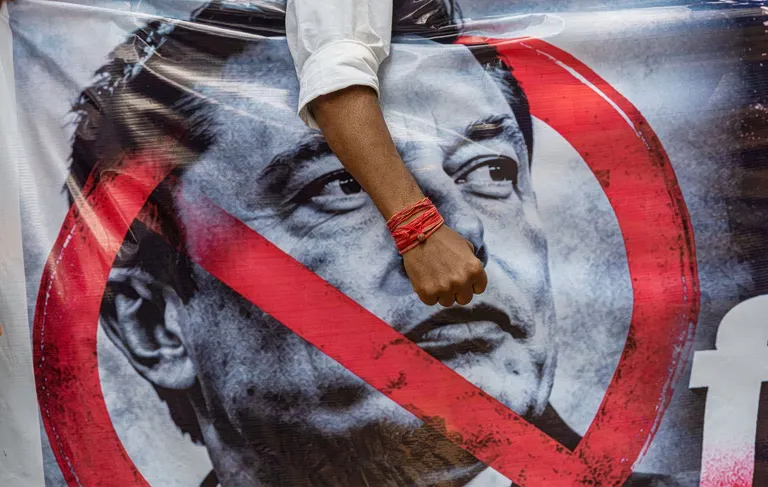
Elon Musk has been an active participant in the controversy surrounding the documentary, moving beyond mere criticism to direct opposition. He has publicly characterized the film as a "psyop" (psychological operation) and has utilized his influence to create friction for the production.
Musk's opposition has manifested in several ways:
- Legal Threats: The billionaire has threatened the filmmakers with litigation.
- Platform Restrictions: He has reportedly prohibited advertisements for the documentary on his social media platform, X (formerly Twitter).
- Algorithmic Friction: The documentary faced challenges on other platforms as well; for example, TikTok briefly suspended the film's promotional account, later citing a "error" after significant user backlash.
This level of direct involvement from a subject of a documentary is rare and creates a unique set of pressures for distributors. When the subject of a film actively works to de-platform its promotion, it can create a chilling effect on both exhibitors and digital marketers.
Frequently asked questions
Is the Musk documentary actually cancelled?
While reports from Showbiz411 suggest the film has vanished from most American theaters, it has not been officially confirmed by major news outlets. The disappearance appears to be a sudden withdrawal from scheduled screenings rather than a formal cancellation of the project itself.
Why did the film's revenue drop so significantly?
The drop from $17,225 per screen to $614 per screen occurred when the film moved from a limited release in major cities to a wide release. The 225-minute runtime and the transition to a broader, less specialized audience contributed to this decline.
Who owns the distributor of the film?
Bleeker Street Films, the film's distributor, was acquired on October 15 by Outerlight Entertainment. This investment firm is backed by eBay founder Pierre Omidyar, a move that has sparked discussion due to Omidyar's political reputation.
How has Elon Musk responded to the documentary?
Elon Musk has actively opposed the film, calling it a "psyop" and threatening the creators with legal action. He has also restricted the film's ability to advertise on his platform, X, complicating its promotional efforts.
What happens to the film after it leaves theaters?
Once a film completes its theatrical run, it typically moves to the secondary market. This includes Premium Video on Demand (VOD), streaming services, and cable television, which allows the film to reach audiences outside of the cinema environment.
Key takeaways
- The 225-minute 'Musk' documentary is reportedly being withdrawn from US theaters.
- Box office earnings dropped from $17,225 per screen to $614 per screen during wide release.
- Bleeker Street Films was recently acquired by Pierre Omidyar's Outerlight Entertainment.
- Elon Musk has labeled the documentary a "psyop" and threatened legal action.
The future of the documentary
The immediate future of the 'Musk' documentary remains uncertain as the industry waits for official clarification regarding its theatrical status. If the reports of withdrawal are accurate, the film's lifecycle will likely shift rapidly toward digital platforms. Whether the disappearance is a result of commercial failure, the logistical challenges of a long runtime, or the complex web of corporate and personal animosities, the saga highlights the increasing intersection of billionaire influence and media distribution.