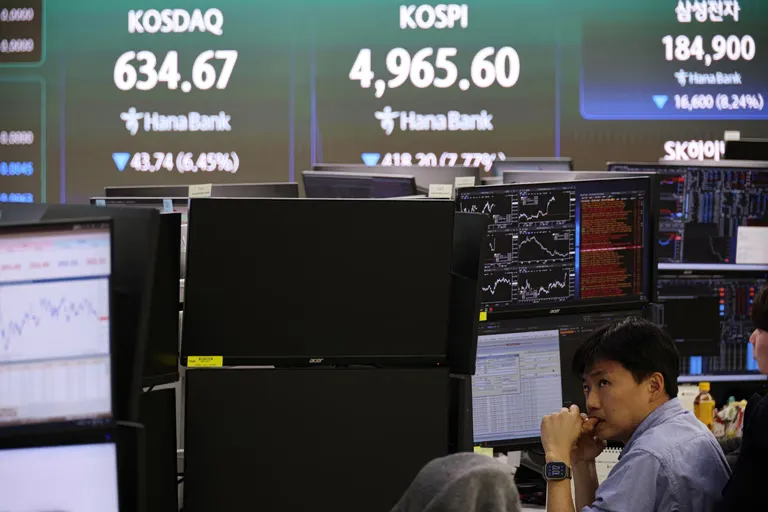
A massive global stock market sell-off occurred as investors reacted to the US midterm election results, wiping out more than $3 trillion in US market value in a single session. The downturn was primarily driven by fears that a Democratic sweep in Congress will lead to stricter regulations on artificial intelligence (AI) infrastructure. With the Nasdaq 100 falling 6.4% and the S&P 500 dropping 4.4%, the volatility spread from Wall Street to major Asian indices. This article examines the causes of the sell-off, the specific impact on the semiconductor sector, and the diverging performance of global markets.
Why did a global stock market sell-off occur following the US elections?
The primary catalyst for the sudden market volatility was the Democratic Party's decisive victory in the US midterm elections, which sparked fears regarding the future of AI-driven capital expenditure. While some investors initially viewed the Democratic sweep as a sign of political stability, the prevailing sentiment shifted toward concern over regulatory hurdles. According to the Financial Times, investors are worried that increased Democratic influence will lead to tighter restrictions on the construction of massive data centers.
These data centers are the backbone of the current artificial intelligence boom, but they face growing scrutiny due to their immense consumption of electricity and water. Many successful Democratic candidates campaigned on platforms opposing the unchecked expansion of such facilities, citing concerns from local communities. This political shift has led to fears that the era of rapid, unhindered AI infrastructure spending may be coming to an end.
The regulatory threat to AI growth
The uncertainty stems from the potential for new legislative frameworks that could slow down the deployment of AI technologies. Investors are specifically concerned that a Democratic-controlled Congress will initiate investigations into major tech giants and implement policies that prioritize environmental and community resources over technological expansion. This perceived "regulatory brake" has caused a significant reassessment of the growth trajectories for companies heavily invested in the AI ecosystem.
How much market value was lost in the US and Asia?
The financial impact of the sell-off was staggering, with US equities losing over $3 trillion in market capitalization during a single trading session. The technology-heavy Nasdaq 100 bore the brunt of the decline, plummeting by 6.4%, while the broader S&P 500 fell by 4.4%. This wave of selling was not contained within American borders, as Asian markets experienced equally severe contractions.
In Asia, the Nikkei 225 in Japan dropped by approximately 6%, while South Korea's Kospi saw losses of up to 8.5%, which was severe enough to trigger a 20-minute trading halt. The contagion effect was particularly visible in the semiconductor industry, which is seen as the primary engine of AI development. Key players saw massive declines:
- SK Hynix: down 8.6%
- Samsung Electronics: down 5.6%
- TSMC: down 4.7%
- SoftBank: down 11% (noting its 13% stake in OpenAI)
What is the impact of the sell-off on the semiconductor sector?
The semiconductor industry faced intense pressure as investors decoupled the rapid growth of AI from the practical realities of infrastructure limitations. The sell-off extended beyond the largest chipmakers to include companies that provide essential components for semiconductor manufacturing. For instance, Ajinomoto, a Japanese company known for producing specialized films used in chip construction, saw its shares drop by more than 12%.
Ajinomoto's decline highlights how the volatility is hitting the entire supply chain. The company, which had reached historical highs in June, has now seen its valuation erode by more than 30%. This suggests that the market is not just punishing the end-users of AI, but also the specialized manufacturers that the industry relies upon to scale its operations.
The broader reach of the semiconductor slump
The impact was felt across various regional hubs that serve as critical nodes in the global chip supply chain. Malaysia, which has established itself as a regional center for data center operations and chip production, saw its stocks fall by over 1%. This interconnectedness means that even if a company is not a direct manufacturer of AI chips, its proximity to the industry's physical infrastructure makes it vulnerable to shifts in AI investment sentiment.
How did different global markets react to the volatility?
While most markets moved in unison toward the downside, India emerged as a notable exception to the global trend. The Nifty 50 index actually gained 0.5% during the period of turmoil. This divergence suggests that investors are actively seeking out markets that have less direct exposure to the volatile AI and semiconductor cycles. In India, growth is being driven by more traditional sectors such as banking, domestic consumption, and infrastructure, providing a buffer against the tech-led sell-off seen in South Korea and Taiwan.
In contrast, other Southeast Asian markets struggled significantly. Indonesia's main index fell by 2%, widening its year-to-date losses to 43%. Singapore also saw a decline of 2.5%. The contrast between the stability in India and the volatility in the rest of Asia underscores a global shift in investor strategy toward defensive, non-tech-centric assets.
What is the current outlook for US markets?
Despite the massive intraday losses, US stock futures showed signs of a potential cooling in selling pressure. Nasdaq 100 futures rose by 0.8%, and S&P 500 futures increased by 0.1%, suggesting that the most intense part of the panic might have passed. However, the long-term outlook remains clouded by significant uncertainty regarding the impact of the new political landscape on corporate spending.
Investors are currently caught between two interpretations of the market movement. One view is that the sell-off represents a necessary correction following a period of extreme growth in tech valuations. The other, more concerning view is that the Democratic victory represents a fundamental structural shift that will permanently lower the ceiling for AI-related capital expenditures due to regulatory and resource constraints.
Frequently asked questions
Why did the Nasdaq 100 fall so sharply?
The Nasdaq 100 fell by 6.4% primarily because it is heavily weighted toward technology and AI-related companies. Investors feared that the Democratic Party's victory in the US midterm elections would lead to stricter regulations on data centers and AI infrastructure, reducing the expected growth of these firms.
What caused the trading halt in South Korea?
The Kospi index in South Korea experienced a drop of up to 8.5%. This rapid and significant decline triggered automatic circuit breakers, resulting in a temporary 20-minute suspension of trading to prevent further uncontrolled selling and allow market participants to reassess.
How did India's market behave differently?
Unlike most global markets, India's Nifty 50 rose by 0.5%. This occurred because Indian investors moved capital toward sectors with less reliance on the AI cycle, such as domestic consumption, banking, and traditional infrastructure, providing a hedge against the semiconductor-driven volatility.
Who are the main companies affected in the semiconductor sector?
Major semiconductor companies saw significant losses, including SK Hynix (-8.6%), Samsung Electronics (-5.6%), and TSMC (-4.7%). Additionally, SoftBank fell by 11% due to its significant stake in OpenAI, reflecting broader fears regarding the future of AI investment.
Is the sell-off considered a permanent change?
It is currently unclear if this is a permanent shift or a temporary correction. While futures indicate a slight recovery, the long-term impact depends on whether the new US political environment actually implements the regulatory restrictions that investors currently fear.
Key takeaways
- The global sell-off erased over $3 trillion in US market value in one session.
- The Nasdaq 100 dropped 6.4% due to fears of AI regulatory constraints.
- Asian markets saw heavy losses, with the Kospi falling 8.5% and triggering a halt.
- India's Nifty 50 rose 0.5%, benefiting from its lower AI-dependency.
- Semiconductor stocks like SK Hynix and Samsung faced significant downward pressure.
Conclusion
The recent global stock market sell-off highlights the extreme sensitivity of modern markets to the intersection of technology and politics. The loss of $3 trillion in US market value underscores how deeply the AI narrative is embedded in current valuations. While the immediate panic may be subsiding, as indicated by rising futures, the underlying fear remains: a potential regulatory slowdown in the US could fundamentally alter the trajectory of artificial intelligence investment. Whether this event is a mere correction or the beginning of a structural shift depends on the forthcoming legislative actions in Washington.