How much agricultural damage has the flooding caused?
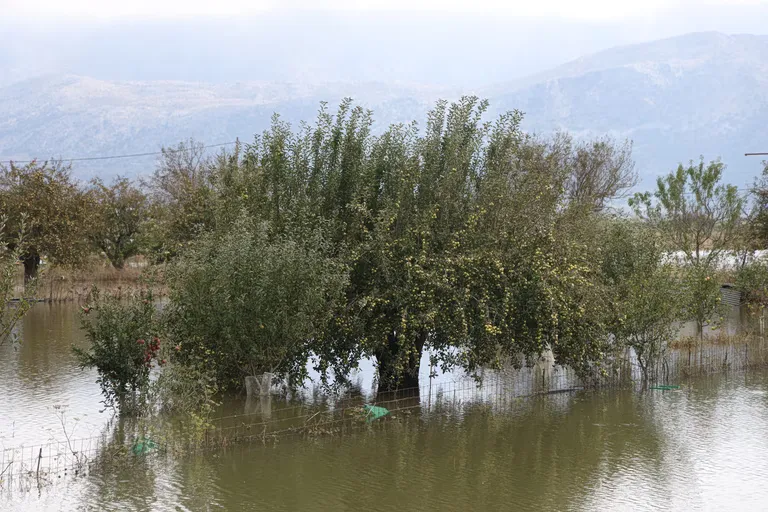
The agricultural sector in the Lasithi Plateau is facing a catastrophic loss, with estimates suggesting that between 60% and 70% of all crops have been rendered useless. Manolis Krasanakis, Director of the Lasithi Plateau Agricultural Cooperative, described the current situation as being in a state of total collapse. The timing of the weather events was particularly devastating; farmers typically plant in mid-April for a September or October harvest, but heavy rains in April and May delayed planting until June, leaving the crops vulnerable when the October floods arrived.
The primary crops affected include potatoes and various vegetables. The scale of the impact is reflected in the formal requests for aid: the cooperative has already received 280 applications from farmers reporting total product destruction across 5,300 stremmata (approximately 530 hectares). This follows a pattern of recurring vulnerability, with significant flooding events also recorded in 2003, 2015, and 2019.
The impact on local livelihoods
For the local community, the loss is not merely financial but existential. The agricultural cycle has been completely disrupted, and with the season effectively lost to the weather, farmers are left waiting for government announcements regarding compensation levels. The unpredictability of the weather has made traditional farming schedules obsolete, forcing a reliance on emergency state aid that has yet to be fully determined.
What caused the extreme rainfall in October 2026?
Extreme weather patterns, characterized by two major storms within an eight-day window, delivered nearly 530 mm of rain to the region in just 18 days. According to Kostas Lagouvardos, Research Director at the National Observatory of Athens and head of the METEO unit, this volume represents an extreme meteorological event. The rainfall was distributed in several intense bursts that prevented the ground from drying out between storms.
The specific rainfall measurements recorded in the Lasithi Plateau were as follows:
The massive accumulation on October 1st, reaching 231 mm, served as the primary catalyst for the flooding. The subsequent rainfall, even though lower in volume, arrived before the plateau could drain, leading to a cumulative effect that overwhelmed the natural and artificial drainage systems.
Why did infrastructure failures exacerbate the flooding?
Technical malfunctions in critical water management systems prevented the effective diversion of floodwaters, turning a natural event into a man-made disaster. Local farmers and officials point to a two-day delay in opening a dam gate, known as the 'Chonos,' due to a valve failure. Manolis Krasanakis noted that this lost time was critical, as the water had no way to escape the plateau during the height of the first storm.
Furthermore, Manolis Paterakis, President of the Lasithi Agricultural Association, highlighted technical issues with the artificial tunnel designed to transport rainwater from the plateau to the Aposelemi dam. This valve problem is not new; similar issues were reported in April of the same year. The inability of this tunnel to absorb high volumes of water quickly enough is a primary reason why the plateau experiences frequent flooding.
Incomplete irrigation and drainage networks
Beyond the dam and tunnel issues, the broader infrastructure remains insufficient. The reservoirs of Agios Georgios are considered incomplete because the necessary irrigation networks required to distribute water to the fields have not been finished. This lack of a cohesive system means that instead of managing water for agricultural use, the infrastructure often fails to manage excess water during crises.
How does the flooding affect regional water security?
While the floods have been disastrous for local farmers, they have provided a significant boost to regional water security by filling the Aposelemi dam. The dam, located approximately 20 km from the plateau, has seen its capacity exceed 85%, with reserves surpassing 20.3 million cubic meters. This increase of 11 million cubic meters ensures water supply for the municipalities of Heraklion, Hersonissos, and Agios Nikolaos through 2030.
This creates a stark dichotomy in the region: the Lasithi Plateau suffers from flooding while the surrounding areas benefit from the resulting water reserves. Residents of the plateau have expressed frustration, noting that they bear the brunt of the flooding without receiving compensatory benefits from the dam's success. This tension highlights a fundamental conflict between local agricultural protection and regional water management strategies.
What are the long-term geological and structural concerns?
Geologists suggest that the plateau's physical characteristics make it naturally prone to water accumulation. Kostas Voudouris, a hydrogeologist and professor at the Aristotle University of Thessaloniki, explained that the area is geologically similar to a depression or sinkhole. This natural topography means that without highly efficient drainage, flooding is an inevitability during heavy rains.
The debate continues between local stakeholders and the Crete Development Organization (OAK), which manages the dam. While residents blame the dam's operation for the flooding, OAK workers maintain that the infrastructure operates within safety limits. However, experts like Voudouris argue that the current system is primarily designed for drainage rather than comprehensive flood protection, a deficiency that becomes increasingly dangerous as climate change brings more frequent extreme weather events.
Frequently asked questions
What is the main cause of the Lasithi Plateau flooding?
The flooding is caused by a combination of extreme rainfall—nearly 530 mm in 18 days—and technical failures in the drainage infrastructure. Specifically, a valve failure delayed the opening of a dam gate for two days, preventing the timely discharge of excess water from the plateau.
How much of the local crop has been lost?
Local agricultural officials report that between 60% and 70% of the crops in the Lasithi Plateau have been destroyed. This includes significant losses in potato and vegetable production, with 280 farmers already reporting total destruction across 5,300 stremmata.
Does the flooding benefit the rest of Crete?
Yes, the heavy rainfall has replenished the Aposelemi dam, which is crucial for regional water security. The dam's reserves have exceeded 20.3 million cubic meters, helping to secure water supplies for Heraklion, Hersonissos, and Agios Nikolaos until 2030.
Is this a recurring problem in the region?
Yes, the Lasithi Plateau is a vulnerable area that has experienced major flooding events repeatedly in the past, including significant instances in 2003, 2015, and 2019. Geologists note the area's natural tendency to act as a depression.
What is the role of the Crete Development Organization (OAK)?
OAK is the body responsible for managing the Aposelemi dam. While they maintain that their infrastructure operates within safety parameters, they face intense criticism from local farmers who claim the dam's management contributed to the flooding of the agricultural fields.
Key takeaways
- Between 60% and 70% of Lasithi Plateau crops were destroyed by October 2026 floods.
- The region received nearly 530 mm of rain within an 18-day period.
- Technical valve failures delayed floodwater diversion by two critical days.
- The Aposelemi dam reached over 85% capacity, securing regional water until 2030.
- Geological depressions in the plateau make it naturally prone to flooding.
Synthesis of the crisis
The 2026 flooding of the Lasithi Plateau represents a complex intersection of extreme meteorological events and infrastructure inadequacy. While the deluge has successfully mitigated long-term water scarcity for the wider Crete region by filling the Aposelemi dam, the immediate cost has been borne by the local agricultural community. The combination of natural geological vulnerability, incomplete irrigation networks, and technical failures in water management systems has turned heavy rainfall into a recurring economic disaster. Addressing this requires a shift from simple drainage to robust, integrated flood protection systems that can withstand the increasing frequency of climate-driven weather extremes.
| Date | Rainfall (mm) |
|---|---|
| September 30 | 40.6 mm |
| October 1 | 231.0 mm |
| October 2 | 107.2 mm |
| October 3 | 35.6 mm |
| October 4 | 33.4 mm |
| October 13-15 | 81.0 mm |