The mechanics of the Leonid meteor shower
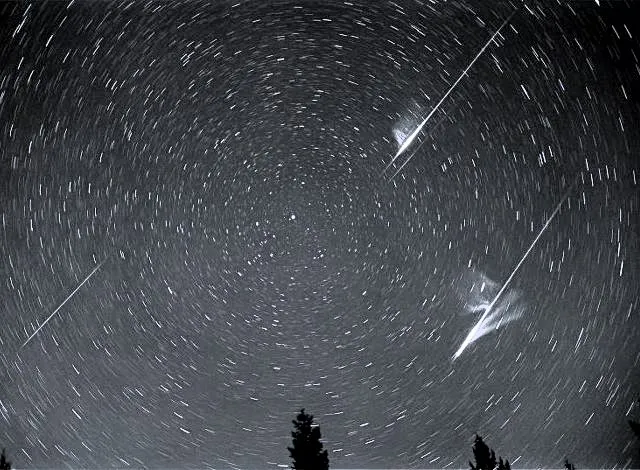
The Leonid meteor shower is a predictable annual event caused by the Earth's passage through a dense field of cosmic debris. This debris is the remnant of Comet 55P/Tempel-Tuttle, which orbits the Sun once every 33 years. As the comet nears the Sun, it sheds a trail of dust and particles that remains in its orbital path. When Earth's orbit intersects this specific trail, the particles enter our atmosphere.
These particles, often described as "dust grains," travel at extreme velocities. Upon entering the upper atmosphere, they move at speeds exceeding 70 kilometers per minute. This high-speed friction compresses the air in front of the particle, raising temperatures to thousands of degrees Celsius. The resulting heat causes the particle to vaporize, leaving behind a glowing trail of ionized gas that we perceive as a shooting star or meteor.
The role of Comet 55P/Tempel-Tuttle
The intensity of the Leonid shower is directly linked to the proximity of Comet 55P/Tempel-Tuttle to the Sun. Every 33 years, the comet reaches its perihelion, depositing a fresh, thick layer of debris into its orbit. The current distance between the comet and Earth is approximately 1.9 billion kilometers as it moves through the inner solar system. While this distance is vast, the historical debris left behind is sufficient to trigger the annual shower observed every November.
Viewing conditions for the 2026 peak
Observers can expect a steady rate of 10 to 15 meteors per hour during the peak period. To maximize the chances of seeing these meteors, enthusiasts should seek locations with minimal light pollution. The presence of city lights creates a "sky glow" that can drown out the relatively faint light produced by standard meteor activity.
The lunar phase for the November 2026 peak provides favorable conditions for stargazing. The Moon is currently in a waxing crescent phase, with its disk illuminated at no more than 44%. This relatively low brightness means the Moon will not significantly interfere with the visibility of the meteors, allowing for a clearer view of the night sky.
| Viewing Factor | Condition for 2026 Peak |
|---|---|
| Expected Meteor Rate | 10–15 meteors per hour |
| Moon Phase | Waxing Crescent (max 44% illumination) |
| Optimal Location | Dark sky areas away from urban centers |
Distinguishing the shower from the constellation Leo
Despite the name, the Leonid meteor shower has no direct physical connection to the constellation Leo. The term "Leonid" refers to the radiant point—the spot in the sky from which the meteors appear to originate. From our perspective on Earth, the meteors seem to emerge from the direction of the Leo constellation, but they are not part of the stars themselves.
It is important to remember that a constellation is a human-defined pattern of stars rather than a physical object. The stars in Leo are not physically linked to one another, nor are they linked to the meteor debris. The shower is simply a matter of perspective; as Earth moves through the debris field, the geometry of our movement makes the meteors appear to radiate from that specific area of the celestial sphere.
Historical meteor storms and extreme activity
While the annual shower is a consistent event, the Leonids are famous for producing massive "meteor storms" when Earth encounters particularly dense pockets of comet debris. These storms are influenced by the gravitational pull of major planets like Jupiter and Saturn, which can shift the position of the dust clouds relative to Earth's orbit. When these conditions align, the meteor rate can jump from dozens per hour to thousands or even hundreds of thousands.
Historical records highlight the extreme variability of this phenomenon. The following table outlines notable Leonid events and their recorded intensities:
)~3,000The 1833 storm remains one of the most spectacular in recorded history. In contrast, some expected peaks, such as those in 1899 and 1933, proved to be disappointing for observers. The current 2026 event is a standard annual occurrence, lacking the density required for a full-scale storm, but it remains a significant opportunity for astronomical observation.
| Year | Event Type | Estimated Rate (Meteors per hour) |
|---|---|---|
| 1799 | Historical Storm | Not specified |
| 1833 | Major Meteor Storm | ~100,000 |
| 1866 | Historical Storm | Not specified |
| 1966 | Historical Storm | Not specified |
| 1999–2001 | Significant Activity |