Mapping the visual landscape of near-death experiences
Researchers have moved beyond traditional verbal interviews to investigate the visual nature of near-death experiences (NDEs) by asking participants to draw their recollections. This methodological shift aims to bypass the linguistic limitations that often hinder the description of intense colors, strange landscapes, or the sensation of being outside one's body. By focusing on imagery rather than testimony, the study seeks to identify objective commonalities in how the human mind processes these profound events.
The study involved 50 individuals recruited through the International Association for Near-Death Studies (IANDS). During individual sessions, participants were tasked with a gradual reconstruction of their memories. They were asked to represent their perceived location, the direction of their movement, and the presence of other entities. Crucially, the researchers avoided using leading terms such as "tunnel" or "light" to prevent influencing the participants' spontaneous recollections.
The data collection went beyond simple shapes, as participants also recorded specific textures, the speed of movement, the intensity of colors, and the emotional states accompanying each scene. This comprehensive approach resulted in a dataset of 112 unique scenes, which provided the basis for a structural analysis of the NDE visual experience.
The four geometric categories of NDE imagery
Out of the 112 scenes recorded, 108 fell into four distinct geometric categories, suggesting a highly structured way in which survivors perceive non-physical spaces. These patterns represent a recurring spatial architecture in the reported experiences.
Spatial structures and environmental forms
The analysis identified the following four primary configurations:
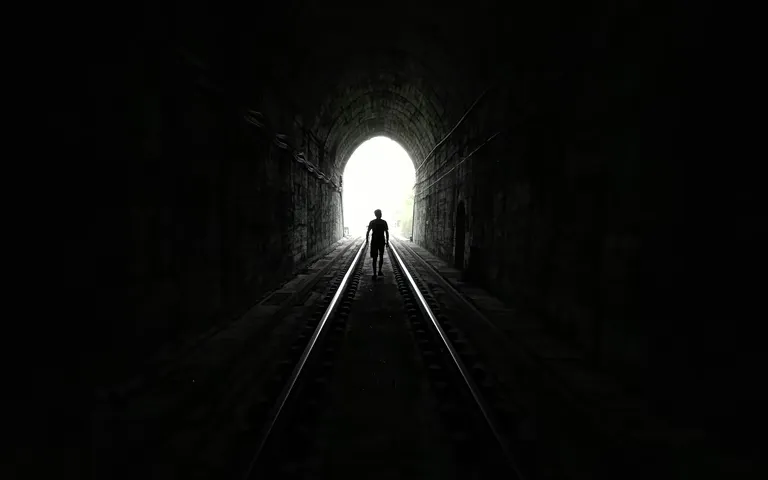
- Tunnel or cone shapes: These images featured straight or slanted lines that enclosed the visual field, creating a sense of moving through a narrow passage.
- Wide curves: Some participants described open spaces defined by large, sweeping curves, reminiscent of circles or ellipses.
- Level horizons: These experiences were characterized by nearly horizontal lines and a much more expansive, open visual field.
- Spherical spaces: In several instances, participants felt they were contained within a sphere or a bubble, offering a 360-degree panoramic view.
These categories demonstrate that while the content of an NDE may feel chaotic or overwhelming to the individual, the underlying spatial geometry often adheres to predictable mathematical or structural forms.
Color associations and environmental lighting
The research highlighted a significant correlation between the geometric shape of the perceived environment and the colors reported by participants. The visual atmosphere of an NDE appears to shift predictably depending on the spatial structure being navigated.
| Geometric Pattern | Primary Visual Characteristics | Reported Colors |
|---|---|---|
| Tunnel/Cone | Narrow, enclosed passages | Darker spaces with minimal color |
| Wide/Open Horizons | Expansive, open fields | Intense shades, often lavender and pink |
| Spherical Spaces | 360-degree panoramic views | Intense white or golden light |
According to the study, approximately 79% of experiences resembling a tunnel were described as dark spaces lacking significant color. In contrast, 87% of those describing wide, open horizons included intense hues, specifically mentioning lavender and pink tones. The spherical environments were most frequently associated with a brilliant white or golden light, suggesting a link between spatial openness and luminous intensity.
The sequence of the out-of-body journey
Beyond the static images, the study observed a recurring chronological sequence in the narratives of the participants. This sequence suggests a standardized progression of consciousness during the transitionary phase of an NDE.
The movement typically follows a three-stage trajectory:
- Separation: The initial phase where participants report a distinct feeling of departing from their physical bodies.
- Transition: A period of movement through non-physical or surreal environments, as captured in the geometric drawings.
- Reintegration: A final stage where the participant feels a sense of returning or merging back with their physical body.
This repetitive sequence provides a framework for understanding the "journey" aspect of NDEs, moving from the physical self to an externalized state and back again.
Scientific limitations and memory reliability
While the visual mapping provides a novel dataset, the researchers noted several critical limitations that must be considered when interpreting the results. These constraints affect the certainty of the structural patterns identified.
Challenges in long-term recollection
A primary concern involves the stability of the memories being drawn. Some participants reconstructed their experiences 15 or more years after the initial event occurred. This significant time lapse raises questions about memory malleability and whether the drawings represent the original experience or a reconstructed version shaped by years of reflection or cultural influence.
Furthermore, the study lacked recorded sessions for independent evaluation. Without a secondary layer of verification or a standardized way to audit the drawing process, the subjective nature of the data remains a hurdle for establishing absolute scientific certainty. Consequently, while the findings offer a powerful new method for studying NDEs, they do not provide definitive proof regarding the existence of an afterlife or a conclusive explanation for the biological mechanisms behind these visions.