
What is the schedule for The Day play at Sifendoni Theatre?
The production is scheduled to run for a total of eight performances, beginning on November 9, 2026. To accommodate audience members, the performances are set to take place on Mondays and Tuesdays. This limited engagement follows a highly successful previous season where the play received positive critical reviews and significant public interest.
The decision to return to the Sifendoni Theatre provides a platform for this specific ensemble to revisit a work that has already established a connection with the local theatre-going community. By scheduling the shows on consecutive weekdays, the production targets a specific segment of the audience looking for mid-week cultural engagement. The eight-performance run ensures that the production remains an exclusive, high-impact event rather than a long-term residency.
How is Dostoevsky's novella being adapted for the modern stage?
The adaptation focuses on the 1876 novella by Fyodor Dostoevsky, utilizing a translation by Lefteris Vogiatzis to bring the Russian classic to a contemporary Greek audience. Directed by the duo of Danae Karoupi and Anthi Kolesi, the production aims to breathe new life into the text through a modern lens, emphasizing intensity and emotional sensitivity.
A key element of this adaptation is the integration of a unique auditory landscape. The original music is composed by The Boy, who has crafted a specific soundscape designed to complement the psychological tension inherent in Dostoevsky's writing. This sonic layer is intended to deepen the immersive experience for the audience, bridging the gap between 19th-century literature and modern theatrical techniques. The collaboration between the directors and the composer ensures that the auditory experience is as vital to the storytelling as the spoken word.
The creative direction and musical integration
The direction by Karoupi and Kolesi moves away from traditionalist interpretations, opting instead for a style that highlights the raw, visceral emotions of the characters. This approach is supported by the musical contributions of The Boy, whose work is not merely background accompaniment but an integral part of the storytelling process. By combining a contemporary directorial vision with a bespoke musical score, the production seeks to make the historical themes of the novella feel immediate and relevant to a 2026 audience.
The directors use the music to underscore the protagonist's internal chaos, creating a sensory environment that mirrors his psychological state. This integration allows the production to transcend simple dialogue, using sound to communicate the unspoken grief and the feverish rhythm of the character's mind. The result is a multidisciplinary approach to classical drama that prioritizes atmosphere and emotional truth.
What is the plot and psychological theme of The Day?
The narrative centers on a man in the throes of extreme despair, attempting to unravel the complexities of his memories through a frantic, first-person monologue. The catalyst for his psychological breakdown is the recent suicide of his wife, a tragedy that leaves him haunted by the singular, unanswered question: "Why?"
The protagonist’s internal struggle is characterized by a feverish rhythm of thoughts, where logic and emotion become indistinguishable. He reflects on the failed architecture of his marriage, having married a young, gentle woman with the explicit, albeit misguided, intention of molding her into his ideal life partner. He describes her as a sixteen-year-old girl—simple, calm, and kind—whom he hoped to transform into the perfect companion. However, this domestic scheme quickly collapses, leading to the dissolution of their union and eventually to the tragic end that sets the play in motion.
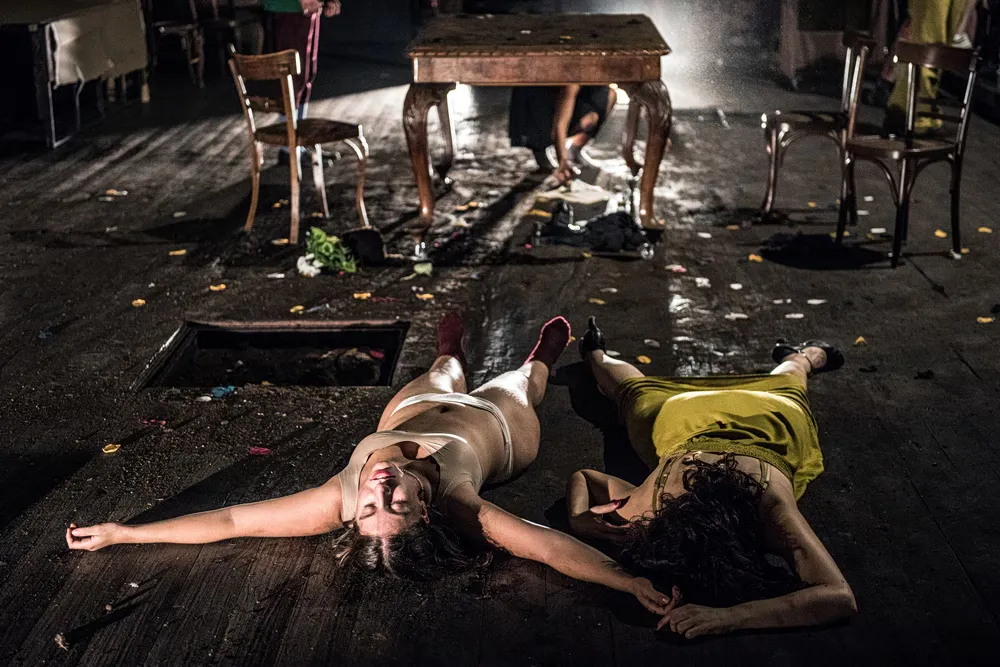
The play captures a specific moment of existential crisis, illustrated by the protagonist's haunting observations of the mundane—such as his wife's boots left by the bed, appearing as if they are waiting for her. These details serve to highlight the profound disorientation and the heavy weight of his grief, as he struggles to understand the reality of his loss.
What are the directorial intentions regarding the theme of suicide?
The directors intend to approach the subject of suicide by exploring the questions it generates rather than providing definitive answers or moral conclusions. The goal is to create a space where the story and its events can emerge naturally, allowing the audience to confront the tragedy without the requirement of a neat resolution or a clinical explanation.
This approach honors the original intent of Dostoevsky, who wrote about suicide—a phenomenon that was increasingly prevalent in 19th-century Russia—not to offer a definitive interpretation, but to "touch" upon the reality of the act. The production seeks to mirror this by focusing on the emotional resonance and the psychological fallout rather than a purely analytical breakdown of the motive. By refusing to provide an easy answer to the "Why?" that haunts the protagonist, the play forces the audience to sit with the discomfort of the unknown.
Exploring the human condition through tragedy
By avoiding a prescriptive narrative, the production invites the audience to participate in the character's search for meaning. The directors emphasize that the story is about the "touching" of a phenomenon rather than its explanation. This philosophical stance allows the play to remain an open-ended exploration of grief and the fragility of human plans, ensuring that the weight of the narrative rests on the emotional truth of the performance rather than a structured plot resolution.
The production suggests that some human experiences are too complex to be solved by logic. By focusing on the character's attempt to make sense of his failed "original plan" for his marriage, the play highlights the tension between human intention and the unpredictable nature of life and death. This creates a bridge between the 19th-century setting and the modern viewer, as the struggle for control in the face of tragedy remains a universal human experience.
Who is the cast performing in this production?
The production features a dedicated team of young actors tasked with bringing the intense and sensitive atmosphere of the novella to life. The ensemble includes Maro Gortsou, Danae Karoupi, Anthi Kolesi, Nikiforos Kouyoumtzoglou, Leonidas Bakalis, Giorgos Boufidis, and Lazaria Fragkou.
This group of performers is central to the play's success, as they must navigate the complex, high-speed psychological shifts required by the protagonist's monologue and the surrounding emotional tension. The casting of a younger ensemble aligns with the production's overall goal of providing a contemporary perspective on a classic work, ensuring that the energy and intensity of the performance feel fresh and vital. Each actor contributes to a collective effort to realize the directors' vision of a visceral, emotionally charged theatrical experience.
FAQ: The Day play at Sifendoni Theatre
When does the play take place?
The play begins its run on November 9, 2026. The performances are scheduled for Mondays and Tuesdays, with a total of eight shows planned for this specific engagement at the Sifendoni Theatre.
What is the source material for the play?
The play is an adaptation of a novella written by the famous Russian author Fyodor Dostoevsky in 1876. This specific production uses a translation by Lefteris Vogiatzis to present the story to the audience.
Who directed the production?
The production is directed by a collaborative duo consisting of Danae Karoupi and Anthi Kolesi. They are responsible for the modern directorial vision and the sensitive approach to the narrative's heavy themes.
What is the central theme of the story?
The central theme revolves around the psychological aftermath of a woman's suicide and the existential questioning of the husband left behind. It explores themes of despair, failed expectations, and the search for meaning in the wake of tragedy.
Who composed the music for the play?
The original music for the production is composed by The Boy. The music is designed to create a unique and immersive soundscape that supports the intense emotional atmosphere of the performance.
Key takeaways
- The production begins on November 9, 2026, at the Sifendoni Theatre.
- There will be eight performances held every Monday and Tuesday.
- The play is based on Fyodor Dostoevsky's 1876 novella.
- Danae Karoupi and Anthi Kolesi serve as the production's directors.
- The Boy provides the original musical score for the performance.
Conclusion
The return of "The Day" to the Sifendoni Theatre represents a significant cultural event for those interested in modern interpretations of classical literature. By blending Dostoevsky's profound psychological insights with a contemporary directorial style and a bespoke musical atmosphere, the production offers more than a mere retelling of a classic. It serves as an immersive exploration of grief and the human condition. As the cast prepares to bring this intense monologue to life this November, the production promises to challenge and engage audiences through its refusal to provide easy answers to life's most difficult questions.







