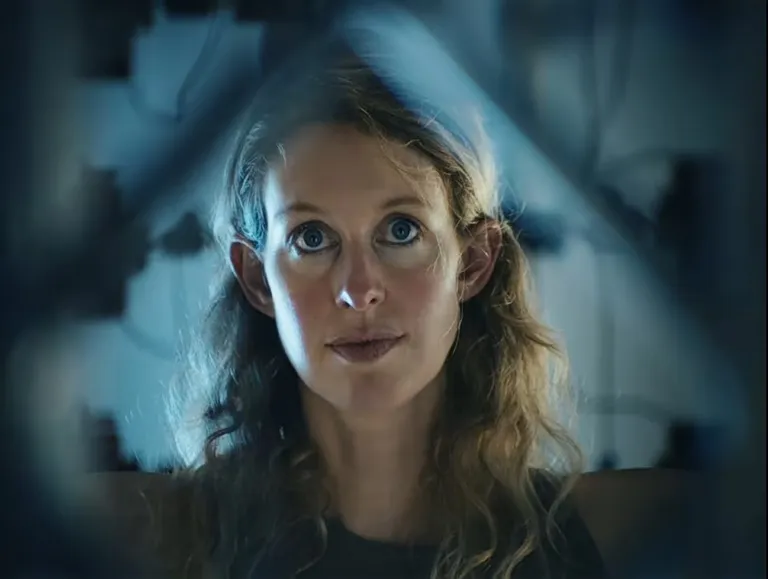
What is the core focus of the new Elizabeth Holmes documentary?
The documentary 'You Can See Everything' moves beyond the well-documented collapse of Theranos to examine the individual psychology of Elizabeth Holmes. While previous accounts, such as the documentary 'The Inventor' or the series 'The Dropout,' focused heavily on the mechanics of the corporate fraud, this A24 production seeks to understand how Holmes perceives her own reality. The film explores the tension between her status as a convicted fraudster and her persistent claims of innocence.
Elizabeth Holmes rose to prominence as a Silicon Valley icon after dropping out of Stanford University at age 19. Her company, Theranos, promised revolutionary blood-testing technology capable of detecting hundreds of diseases from a single drop of blood. However, the technology failed to meet these claims, leading to her conviction for fraud in 2022 and her imprisonment in May 2023. The new documentary uses this backdrop to ask whether a person can truly be understood when they are actively constructing a different version of the truth.
How are critics reacting to the film's controversial approach?
Critical reception of the documentary is sharply divided, with reviewers struggling to determine if the film is a condemnation or a rehabilitation. Monica Hesketh, writing for the Washington Post, described the experience as simultaneously hilarious, awkward, strange, and terrifying. She noted that the film leaves viewers questioning who is actually deceiving whom, as the boundary between the subject and the filmmaker begins to blur.
The film is characterized by a unique, almost experimental cinematic style. Rather than a standard investigative report, it functions as a psychological study. Some critics argue that the film's ambiguity is its greatest strength, forcing the audience to confront their own perceptions of Holmes. Others, however, worry that this ambiguity serves to soften the reality of her crimes.
The blurring lines of the filmmaker's perspective
A significant point of discussion is the relationship between director Nathan Fielder and Elizabeth Holmes. Fielder gained unprecedented access to Holmes’s daily life, including time spent with her partner, Billy Evans, and their children, shortly before her incarceration. This intimacy has led to observations that even the filmmaker appears influenced by her presence. As the relationship evolves on screen, it becomes increasingly difficult for the viewer to distinguish between objective observation and emotional entanglement. This dynamic suggests that the film is not just about a woman who may manipulate others, but an attempt to make the audience experience that manipulation firsthand.
Why does the film's presentation face accusations of bias?
Despite its technical mastery, the documentary has faced criticism for what it chooses to omit. Linda Holmes, writing for NPR, argued that the film operates more as a blend of reality and fiction than as a reliable account of the Theranos case. Her primary concern lies in the selective presentation of facts, which may create a false sense of uncertainty regarding established truths.
The documentary spends considerable time exploring the possibility that Holmes was misunderstood—specifically regarding her use of the word 'maybe' to describe technological potential. However, critics point out that it fails to investigate more concrete allegations. For instance, the film does not deeply examine claims that Holmes falsely represented Theranos technology as being used by the U.S. military on battlefields. Furthermore, the voices of former employees, who reported facing threats and pressure when attempting to expose the company's practices, are largely absent from the narrative.
Does the documentary achieve its promise of total visibility?
The title 'You Can See Everything' appears to be intentionally provocative, perhaps even misleading. While the film promises total transparency, it ultimately forces the viewer to question what remains hidden from the frame. The central conflict for the audience is deciding whether the film provides a new perspective on a known scandal or simply offers a different, more curated version of a story that has already been legally and journalistically settled.
Ultimately, the film's impact lies in its ability to refocus the conversation on the personality of the perpetrator rather than the mechanics of the crime. Whether this focus provides insight into the nature of deception or merely provides a platform for a sophisticated manipulator remains the subject of intense debate among film scholars and the American press. The documentary serves as a reminder that in the era of high-stakes storytelling, the truth is often shaped by what the camera chooses to capture—and what it chooses to ignore.
FAQ: Elizabeth Holmes documentary
Is the documentary 'You Can See Everything' a factual account?
The film is viewed by many critics as a hybrid of reality and psychological exploration rather than a traditional factual documentary. While it uses real footage and interviews, its stylistic choices and focus on ambiguity lead some, like NPR's Linda Holmes, to question its reliability as a definitive historical record.
What makes the direction of Nathan Fielder unique in this film?
Nathan Fielder employs a style that blurs the line between observer and participant. By gaining intimate access to Holmes's personal life, the direction creates an emotional entanglement that makes it difficult for viewers to maintain an objective distance, turning the documentary into a psychological thriller.
Has Elizabeth Holmes been convicted of crimes?
Yes, Elizabeth Holmes was convicted of fraud in 2022 following the collapse of her company, Theranos. She was sentenced to prison and began serving her term in May 2023. Despite her convictions, she continues to maintain her innocence in various public and private capacities.
What are the main criticisms of the documentary?
The primary criticisms involve the omission of key facts, such as the alleged misuse of military claims and the experiences of whistleblowing employees. Critics argue that by focusing on linguistic nuances and personal charm, the film creates an artificial ambiguity around proven criminal actions.
How does this film differ from 'The Dropout'?
Unlike 'The Dropout,' which focuses on the investigative journey and the systemic fraud within Theranos, 'You Can See Everything' focuses on the internal psyche of Elizabeth Holmes. It prioritizes the study of her personality and her ability to influence those around her over the technical details of the corporate scandal.
Key takeaways
- 'You Can See Everything' is an A24 documentary exploring Elizabeth Holmes's psychology.
- Critics are divided on whether the film rehabilitates or condemns the convicted fraudster.
- The film's style is described as a psychological thriller rather than a standard documentary.
- Omissions regarding military claims and employee threats have led to accusations of bias.
Conclusion
The debate surrounding 'You Can See Everything' highlights a growing tension in modern documentary filmmaking: the balance between artistic expression and journalistic integrity. By shifting the lens from the corporate mechanics of Theranos to the enigmatic persona of Elizabeth Holmes, Nathan Fielder and Lance Oppenheim have created a work that is as unsettling as it is innovative. While the film succeeds in making the viewer feel the seductive power of manipulation, it leaves unanswered whether it has truly revealed the truth or simply provided a new stage for a long-standing deception.