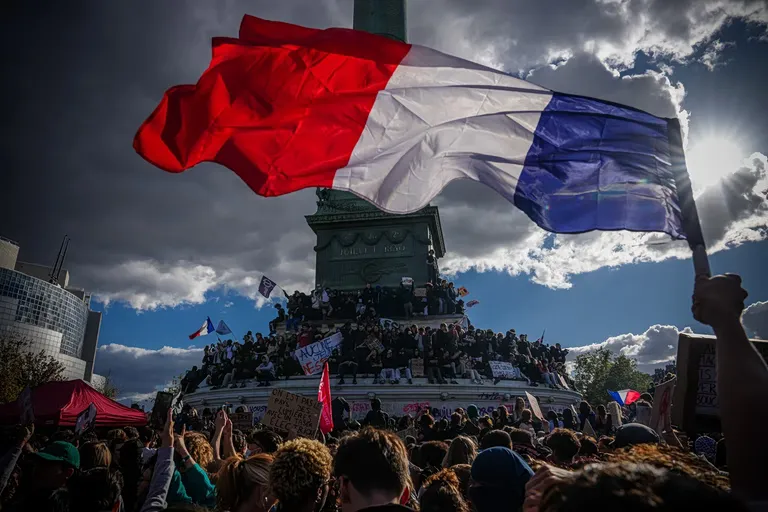
Why is the rhetoric of 'order' used to counter social unrest?
The call for 'order' and 'stability' is frequently deployed by political actors to delegitimize mass protests and redirect public attention toward the perceived dangers of chaos. Following recent unrest in France, many observers have characterized the demonstrations as destructive acts that ultimately benefit conservative governments. This narrative suggests that citizens, fearing instability, will instinctively choose established leadership to ensure continuity and predictable management of national challenges.
This rhetorical strategy often frames any deviation from the current administration as a risk to the nation. For instance, political commentators have argued that such uprisings might inadvertently empower right-wing leaders by activating a 'silent majority' that prioritizes security over reform. By equating protest with chaos, those in power can present themselves as the only viable shield against social breakdown, effectively silencing calls for systemic transformation.
The psychological appeal of the 'strong hand'
The fear of instability is a powerful political tool. When governments frame protests as purely disruptive, they tap into a primal desire for predictability. This allows for the promotion of authoritarian-leaning policies under the guise of protecting the public from the very unrest that the government's own inaction helped create. Consequently, the debate is shifted from the legitimacy of the protesters' demands to the necessity of maintaining the existing social fabric.
How has mass mobilization shaped historical social progress?
Historical evidence contradicts the notion that social unrest is purely destructive; rather, mass mobilization has frequently been the primary driver of significant social advancements. Throughout the 20th century, large-scale movements—often fueled by the fear of radical revolution—forced ruling classes to implement essential reforms. These include the establishment of social security, universal healthcare, public education, collective bargaining rights, and progressive income redistribution.
A common misconception is that political leaders win elections by suppressing unrest, whereas history shows they often win by responding to it. While it is true that French leader Charles de Gaulle won elections following the May 1968 protests, the victory was accompanied by massive concessions from the French center-right. These included significant wage increases that ultimately de-escalated the strikes and stabilized the country through reform rather than mere repression.
Similarly, in the Greek context, the era of democratic transition (Metapolitefsi) was defined by intense social struggles. These movements shifted the national trajectory toward more progressive democratic values, culminating in major political shifts in 1981. Even during the height of the debt crisis, anti-austerity movements played a crucial role in challenging the logic of technocratic governance and forcing the question of whether a government could truly represent the interests of the people rather than just international creditors.
What are the hidden costs of maintaining the status quo?
The concept of 'stability' is often a misnomer that masks the progressive erosion of social rights and economic security. For many, the current version of stability represents a continuation of policies that leave the youth vulnerable to inflation and housing crises. When governments prioritize the appearance of order over structural reform, they often exacerbate the very inequalities that lead to unrest in the first place.
Maintaining the status quo can lead to several long-term societal risks:
- Economic Vulnerability: Increased social inequality and the loss of purchasing power for the working classes.
- Erosion of Public Services: The gradual privatization and weakening of essential sectors like healthcare and education.
- Institutional Decay: The manipulation of the rule of law and increased police repression against dissenters.
- Political Extremism: The creation of a fertile environment for the rise of far-right movements.
When public resources are managed to favor specific interests rather than the general welfare, the resulting 'stability' is fragile and built on a foundation of growing resentment. True security is not found in the absence of protest, but in the presence of responsive institutions that address human needs.
Is the fear of chaos actually a fear of political change?
The opposition to mass mobilization is often less about a fear of disorder and more about a fear of losing political influence. Those who most vehemently condemn social movements are frequently the social minorities who benefit from the current political and economic arrangements. For these groups, any movement toward radical policy change represents a direct threat to their privileged position.
While it is natural for citizens to fear periods of intense social turbulence, this fear should not be confused with a rejection of legitimate demands. History demonstrates that when social pressures become unsustainable—when 'the knife reaches the bone'—even the most cautious citizens are forced into the streets to demand change. The real insecurity in modern societies does not stem from the protesters, but from a political class that prioritizes economic metrics over the actual lived experiences of the population.
FAQ: Understanding social unrest and political change
Why do protests often lead to conservative electoral victories?
Protests can lead to conservative wins if the public perceives them as purely chaotic and lacking clear objectives. However, this is often a temporary reaction. Long-term stability usually requires governments to address the underlying grievances of the protesters through meaningful policy concessions and structural reforms.
What is the difference between 'order' and 'stability'?
Order is often enforced through top-down control and the suppression of dissent, which can create a veneer of calm. Stability, conversely, is a sustainable state achieved when institutions are responsive to the needs of the people, reducing the friction that causes unrest.
How do social movements influence public policy?
Social movements influence policy by raising the political cost of inaction. By mobilizing large numbers of people, they force issues like healthcare, wages, and inequality into the mainstream political discourse, making it impossible for governments to ignore them without risking legitimacy.
Can mass mobilization lead to authoritarianism?
While unrest can be used as a pretext for authoritarian crackdowns, history shows that mass mobilization is also a primary tool for democratic expansion. The outcome depends on whether the state responds with repression or with inclusive, reformist political engagement.
Why is the 'silent majority' often mentioned during unrest?
The 'silent majority' is a political concept used to suggest that most citizens support the current government and fear the disruption caused by protesters. It is frequently used as a rhetorical device to marginalize the voices of those demanding systemic change.
Key takeaways
- Mass mobilization has historically been a primary driver for essential social reforms like healthcare and education.
- The rhetoric of 'order' is often used to delegitimize legitimate political demands for systemic change.
- True social stability requires addressing economic inequalities rather than merely suppressing public dissent.
- Political inertia and the refusal to reform can inadvertently fuel the rise of extremist movements.
Conclusion
The tension between social stability and deep change is not a conflict between order and chaos, but a struggle between institutional inertia and the necessity of evolution. While the immediate effects of unrest can be disruptive, the long-term cost of maintaining a stagnant status quo is often far greater, manifesting as increased inequality and social fragmentation. Societies do not need more 'order' in the sense of enforced silence; they require deep, structural changes that address the fundamental needs of their citizens. Real security is found in a political system that values human welfare over mere economic metrics.