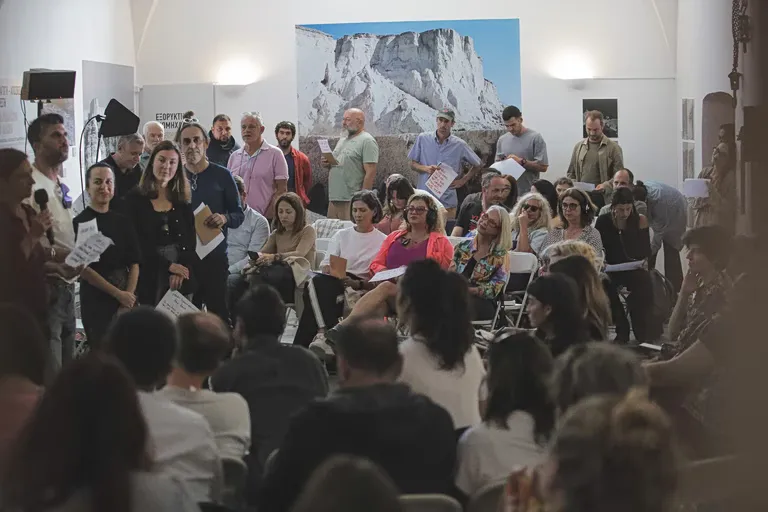
What drove the focus of the Hearth Summit Aegean 2026?
The Hearth Summit Aegean 2026 served as a critical junction for connecting grassroots Aegean activism with concrete strategic frameworks for resilience and economic viability. Held in Santorini, the event brought together a diverse coalition of 160 attendees, including local government officials, producers, entrepreneurs, researchers, artists, and civil society representatives from 20 different islands and across the globe.
The summit moved beyond simple diagnosis, utilizing field pathways, workshops, and specialized panels to address the complex realities of island life. Rather than focusing solely on grievances, the discussions aimed to identify scalable solutions for tourism management and the implementation of a regenerative economy. With over 20 presentations showcasing existing island initiatives, the summit sought to transform local discontent into actionable political proposals that can be adapted to specific regional needs.
Key thematic pillars of the summit
The discussions were structured around several critical dimensions of island life, ensuring that the dialogue remained practical rather than purely theoretical. These included:
- Carrying Capacity: Analyzing the physical and social limits of island destinations to prevent environmental and social degradation.
- Regenerative Economics: Moving from extractive tourism models toward systems that actively improve the local ecosystem and community wealth.
- Social Resilience: Addressing the isolation and lack of educational or cultural infrastructure that threatens long-term habitation.
- Cultural Heritage: Developing strategies to protect local identity against the homogenizing effects of mass tourism.
By focusing on these pillars, the summit attempted to bridge the gap between the immediate, often chaotic, reactions of local residents and the long-term planning required for sustainable island survival.
Why are local island movements shifting their approach?
Local island movements are currently at a crossroads where spontaneous protest must evolve into organized, professionalized advocacy to avoid stagnation. While initiatives such as the "Towel Movement," "Sustainable Cyclades," "Umbrella" in Rhodes, and the "Sustainable Kos Citizen Movement" gained significant momentum in 2024, experts warn that protest alone has a limited lifespan.
According to Ioannis Spilani, an economist and regional development expert, the primary challenge is that protest is often reactive—an attempt to prevent harm rather than a proactive plan to build something better. Spilani notes that without a clear vision or institutional support, these movements risk losing energy. The geographical isolation of the islands exacerbates this, as a lack of collective spaces, such as universities or community centers, makes it difficult for younger generations to organize and sustain momentum.
Furthermore, the legal and financial burdens of activism can lead to burnout. Many movements find themselves trapped in long-running legal battles or limited to issuing press releases that fail to influence actual legislative changes. To overcome this, there is a growing call for these groups to become "professionalized," engaging in daily, structured work to influence policy rather than just reacting to crises.
How does the current governance model fail island communities?
Current local governance in the Aegean often fails to bridge the gap between citizens and the central state, frequently relying on personal negotiations rather than systemic reform. This structural weakness leaves islanders vulnerable to recurring issues, such as the mismanagement of coastal resources and the pressures of aggressive construction.
Ioannis Spilani criticizes the tendency of local mayors to engage in "personal transactions" with central government ministers. For example, a mayor might successfully negotiate the removal of certain beach concessions, but because the underlying legislation remains unchanged, the problem inevitably returns in subsequent seasons. This approach treats symptoms rather than the disease.
The political paralysis of local authorities
Several factors contribute to the perceived weakness of local government in the Aegean region:
- Fear of Populism: Many local leaders avoid championing strong community demands because they fear being labeled as "populists," a stigma that has intensified in the post-austerity era.
- Loss of Political Weight: Local authorities have seen their influence diminish, leaving them with limited capacity to challenge central state decisions effectively.
- Lack of Social Engagement: Instead of mobilizing the community to create collective pressure, many officials prefer to negotiate behind closed doors with ministries, often with temporary or negligible results.
This disconnect creates a vacuum where the needs of the residents—such as affordable housing, access to public services, and the right to remain in their homes—are secondary to the islands' roles as investment vehicles.
What is the vision for the "next day" of island life?
The vision for the future of the Aegean islands centers on a fundamental shift in how these territories are perceived: moving from being treated as mere investment destinations to being recognized as sustainable places of residence. This shift is essential to combat the demographic and social crises facing the region.
A core component of this vision is the right of inhabitants to live, work, and remain in their communities without being forced out by the rising cost of living, housing shortages, or the degradation of public services. This concept was a central theme in the public consultations for the first comprehensive European Strategy for Islands, which highlights the global relevance of the Greek experience.
To achieve this, the movement seeks to build "social capital"—the trust between individuals and between citizens and institutions. Currently, Spilani suggests that this capital is at a near-zero level in Greece, characterized by high individualism and a lack of institutional trust. The goal for the "next day" is to foster a more organized, cohesive identity that can advocate for a human-centric approach to tourism and development, ensuring that the Aegean remains a vibrant, lived-in archipelago rather than a seasonal museum for tourists.
Frequently asked questions
What was the main goal of the Hearth Summit Aegean 2026?
The summit aimed to connect Aegean island citizen movements with practical policy proposals. It sought to move the conversation from reactive protests regarding overtourism toward proactive, long-term strategies for economic resilience, sustainability, and improved quality of life for permanent residents.
What are the specific issues being addressed by island movements?
Movements are tackling a wide range of issues, including unregulated and aggressive construction, the impact of overtourism on local resources, the lack of educational and cultural infrastructure, and the rising cost of living that threatens to displace local populations.
Why is spontaneous protest considered insufficient by experts?
Experts argue that protest is often reactive and lacks a long-term constructive roadmap. Without transitioning into organized, professionalized advocacy, movements risk losing momentum, facing legal exhaustion, and failing to influence the underlying legislation that causes the problems.
How do local mayors influence island policy?
Currently, many mayors rely on personal negotiations with central government ministers to solve specific, localized issues. However, this method often fails to create lasting change because it does not address the systemic legislative issues affecting the islands.
What is the "human-centric" approach to tourism?
A human-centric approach seeks to balance tourism with the needs of the local community. It focuses on managing the carrying capacity of islands to ensure that tourism supports, rather than destroys, the social fabric, environment, and economic stability of the permanent residents.
Key takeaways
- The Hearth Summit Aegean 2026 focused on transforming island protests into structured policy proposals.
- Experts warn that island movements must professionalize to avoid the stagnation of reactive activism.
- Current local governance often relies on temporary negotiations rather than systemic legislative reform.
- The future vision requires treating islands as permanent residences rather than just investment hubs.
The path toward institutionalized advocacy
The transition from spontaneous civic outbursts to structured political influence represents the most significant challenge for the Aegean islands. As the Hearth Summit has demonstrated, the grievances of residents are not merely complaints about tourism, but profound concerns regarding the viability of their way of life. For these movements to succeed, they must overcome geographical isolation and political hesitation, building a collective voice that demands systemic changes to how islands are governed and developed. The success of this transition will determine whether the Aegean remains a thriving, inhabited archipelago or becomes a series of seasonal assets for global capital.