How was the dark vision of Gotham City created?
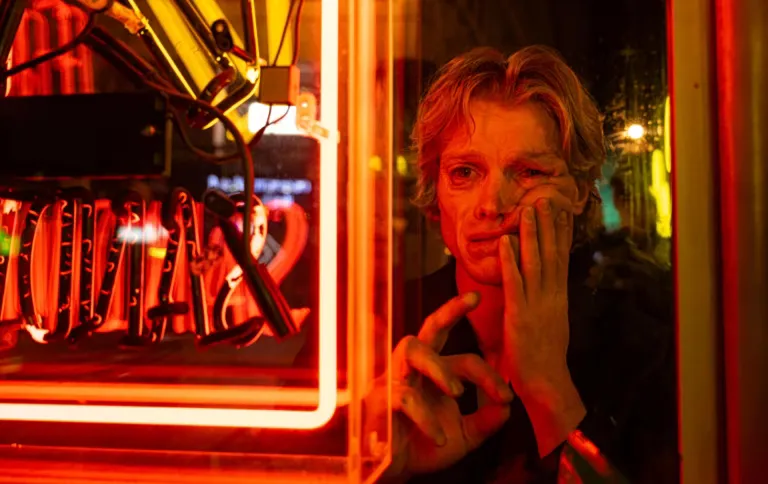
Gotham City serves as a central character in the film rather than a mere backdrop. To achieve this, director James Watkins and cinematographer James Priest drew significant inspiration from 1930s German Expressionist cinema. This stylistic choice manifests through the use of imposing architecture, unusual camera angles, and heavy, dramatic shadows that define the city's oppressive atmosphere.
Beyond historical film movements, the production team looked to the gritty reality of late 20th-century urban life. They studied photographic records of New York City from the 1970s, 1980s, and 1990s—periods prior to widespread gentrification. This research allowed the creators to incorporate elements of neon lighting, authentic light sources, and a sense of urban grime and eccentricity into the streets of Gotham.
The resulting aesthetic is a claustrophobic environment where massive buildings dominate the skyline and the sky is rarely visible. This creates a stark visual contrast to the bright, optimistic atmosphere of Metropolis, which was featured in James Gunn's Superman. By prioritizing these textures, Watkins ensures that the setting reflects the internal decay of the protagonist.
What are the 19 versions of the Clayface monster?
The transformation of the protagonist, Matt Heigen, presented a massive creative challenge for the production team. While the character has various iterations in DC Comics, translating a shapeshifting entity to live-action required extensive conceptual work. Watkins confirmed to Variety that the team designed approximately 19 distinct versions of the creature before settling on the final look used in the film.
The goal was not merely to create a grotesque monster, but to maintain a connection to the human soul trapped within the shifting mass. Watkins placed specific emphasis on the character's left eye, using it as a visual anchor to convey the pain and psychological devastation experienced by Matt. This emotional core prevents the character from becoming a mere special effect.
The stages of physical mutation
To depict the gradual loss of human identity, the production utilized 65 different stages of physical deformity. These transformations were not achieved through a single method but through a complex layering of techniques designed to show the character's body literally breaking down and reforming. This meticulous approach ensures the audience feels the weight of the character's tragic descent.
Why were practical effects used for the transformations?
A significant portion of the most extreme transformations in the Clayface movie were achieved through practical effects rather than digital CGI. Watkins expressed a strong preference for physical methods whenever possible, noting that real materials provide a sense of weight and materiality that digital tools struggle to replicate. This commitment to realism enhances the visceral impact of the horror elements.
Specific scenes required highly specialized mechanical rigs and makeup. For example, during a pivotal scene where Matt kills his friend Corey by pulling him into his own body, the actor wore a specialized mechanism featuring a cavity in the chest. Similarly, a scene set on an airplane involved five different sets of scissors, detailed makeup, and a moving set to simulate turbulence while the character attempts to cut the clay from between his eyes.
How does Aaron Paul contribute to the story?
One of the film's most notable casting decisions is the brief appearance of Aaron Paul, recognized for his work in Breaking Bad. Paul portrays Matt's father, appearing during a sequence where Matt takes on his father's likeness as part of a transformation. This casting was largely spontaneous, occurring because Paul was working in Paris during the production period.
Despite the brevity of the role, Watkins expressed high regard for Paul's acting ability. The decision to include him added a layer of emotional depth to the shapeshifting sequences, grounding the supernatural elements in a recognizable human relationship. The character's ability to mimic loved ones serves as a key driver for the film's themes of identity theft and loss.
Why is Batman missing from the film?
Despite the story being set in Batman's iconic city, the Caped Crusader does not appear in the movie. Watkins clarified that there was no pressure from DC to include cameos or tie the film directly into other ongoing cinematic franchises. The director was primarily drawn to the project because it offered a standalone narrative that could exist on its own merits.
The absence of Batman allows the film to focus entirely on the psychological and physical tragedy of Matt Heigen. Watkins avoided treating the film as a setup for future confrontations, such as a potential meeting with Robert Pattinson's Batman. Instead, the story is treated as a complete arc, even if it concludes with the protagonist living in isolation within the Gotham underworld, having lost his humanity entirely.
FAQ: Clayface movie
Why doesn't Batman appear in the Clayface movie?
Batman is absent because the director wanted to tell a standalone, self-contained story. Watkins chose to focus on the specific tragedy of the protagonist rather than creating a setup for future superhero crossovers or connections to other DC cinematic properties.
How was the Clayface character designed?
The production team developed 19 different versions of the creature to find the right balance between horror and humanity. They also created 65 different stages of physical mutation to show the character's gradual transformation through practical and digital means.
What inspired the look of Gotham City?
The visual style of Gotham was inspired by 1930s German Expressionism and the gritty urban atmosphere of New York City during the 1970s, 80s, and 90s. This resulted in a dark, shadow-heavy, and claustrophobic environment.
Who plays the lead role in Clayface?
Tom Ris Harris portrays the central character, Matt Heigen, an actor whose life is destroyed by a gangster's attack. His transformation into the monster Clayface is the core focus of the film's narrative.
Does the movie use a lot of CGI?
While digital effects are used, the film relies heavily on practical effects. Many of the most intense scenes, including complex body transformations and mechanical rigs, were filmed using physical makeup and props to ensure a sense of realism.
Key takeaways
- The film uses 19 different creature designs and 65 stages of physical mutation.
- Gotham City's aesthetic is heavily influenced by 1930s German Expressionism.
- Director James Watkins prioritized practical effects over CGI for a sense of weight.
- The story is a standalone narrative that intentionally excludes Batman.
Conclusion
The Clayface movie represents a departure from standard superhero cinema, opting for a character study rooted in body horror and identity loss. By blending the stylistic shadows of German Expressionism with the gritty reality of late 20th-century urbanism, James Watkins has crafted a unique vision of Gotham City. The heavy reliance on practical effects and the decision to keep the story independent of the broader Batman mythos suggest a film that prioritizes thematic depth over franchise expansion. Ultimately, the movie seeks to find the human tragedy hidden beneath the monstrous exterior of one of DC's most complex villains.