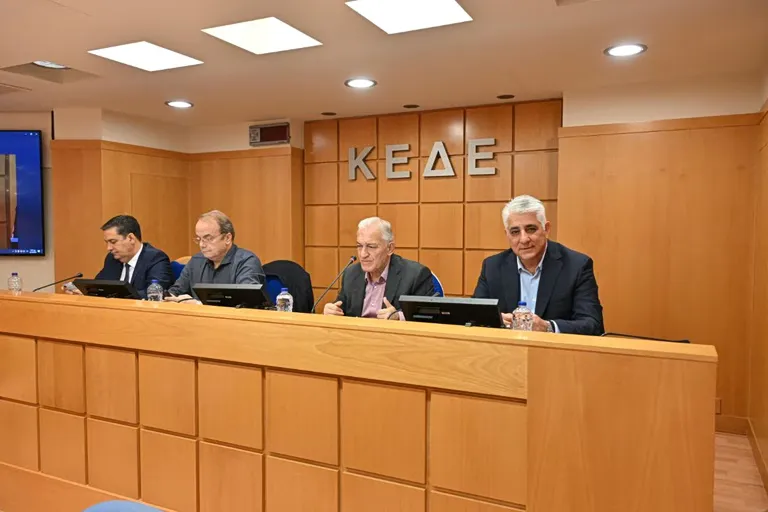
Why is KEDE demanding a significant reduction in energy costs for municipalities?
KEDE is highlighting a massive disparity between the electricity rates paid by local authorities and those paid by large-scale industrial consumers. Currently, municipalities are facing electricity charges of approximately €0.24 per kilowatt-hour (kWh), whereas large consumers benefit from rates as low as €0.06 per kWh. This imbalance places an unsustainable burden on municipal budgets, diverting funds away from essential citizen services.
Lazaros Kyrizoglou, President of KEDE, has presented a specific proposal to address this crisis. He argues that if the cost for municipalities could be lowered to €0.10 per kWh, the total savings for local government would reach approximately €240 million. This reduction is viewed as a critical step toward restoring fiscal balance to local administrations.
Negotiations with the Ministry of Environment and Energy
The issue has already been escalated to the highest levels of the Greek government. Following meetings with the Minister of Environment and Energy, Stavros Papastavrou, and the Ministry of National Economy and Finance, KEDE is working to establish a sustainable framework for electricity billing. The agenda includes addressing surcharges caused by unpaid electricity bills and regulating outstanding municipal debts to prevent further budgetary erosion.
How will the 2027 State Budget affect local government resources?
The projected 2027 State Budget indicates a concerning trend for local authorities despite overall economic growth. While the draft budget anticipates a 2.3% growth rate with a GDP of €274.6 billion, the financial benefits are not reaching the municipal level. In fact, KEDE reports that total transfers to Local Government Organizations (LGOs) are expected to drop from €6.575 billion in 2026 to €5.905 billion in 2027.
This €670 million reduction occurs at a time when municipalities are struggling with increased operational, salary, and energy expenses. Furthermore, the projected surplus for local authorities is set to shrink drastically, falling from €183 million to just €41 million. Investment spending is also expected to decline from €2.378 billion to €1.710 billion, limiting the ability of municipalities to fund long-term development projects.
What is the gap between actual costs and legal funding requirements?
KEDE is leveraging existing legal frameworks to argue that current funding levels are insufficient to meet the actual functional needs of municipalities. The organization cites Article 259 of the "Kallikratis" program, as incorporated into Article 434 of the new Local Government Code, to justify its claims for higher resource allocation.
According to KEDE's detailed studies, the actual functional cost for municipalities is estimated at €5.5 billion. However, based on the calculation of Central Autonomous Resources (KAP) and relevant tax metrics, the legal entitlement should reach approximately €9.67 billion. The organization intends to use this €4.17 billion discrepancy as a primary point of contention during upcoming budget negotiations.
What strategic actions is KEDE taking to secure these funds?
KEDE is preparing an intensive lobbying campaign aimed at both the government and parliamentary political leadership. As the 2027 State Budget is set to be submitted to Parliament in November 2026, the Executive Committee of KEDE will engage in high-level meetings with the President of the Parliament and all political parties to present a unified front.
The organization emphasizes that economic autonomy is not merely a request but a prerequisite for municipalities to fulfill their social, developmental, and environmental missions. Kyrizoglou has stated that if dialogue fails to produce the necessary results, KEDE is prepared to move toward "struggle-based mobilizations" to ensure that the rights of local authorities and their citizens are protected.
What role does the recent €140 million injection play?
The recent provision of €140 million in extraordinary funding to municipalities serves as a temporary relief rather than a permanent solution. KEDE notes that this injection was the direct result of their intensive advocacy and is expected to be deployed immediately to address urgent needs.
While this amount provides much-needed breathing room, KEDE leaders warn that extraordinary funds cannot substitute for permanent, adequate, and institutionally secured funding. The goal remains the establishment of a predictable financial framework that accounts for the growing and continuous needs of local administrations.
Key takeaways
- KEDE seeks to reduce municipal electricity costs from €0.24 to €0.10 per kWh to save €240 million.
- Total transfers to local authorities are projected to decrease by €670 million in 2027.
- KEDE claims legal entitlement to €9.67 billion in resources, far exceeding current projections.
- The 2027 budget shows a significant drop in municipal investment spending to €1.710 billion.
- KEDE is prepared to organize mobilizations if budget negotiations fail to secure necessary funds.
Frequently asked questions
What is the main cause of the municipal budget crisis?
The crisis is driven by a combination of high energy costs, rising operational and salary expenses, and a projected €670 million decrease in state transfers for 2027. This creates a gap between the actual cost of running services and the available revenue.
How much could municipalities save on electricity?
By lowering the electricity rate from the current €0.24 per kWh to €0.10 per kWh, KEDE estimates that local governments could achieve total savings of approximately €240 million annually.
Why is the 2027 budget a concern for KEDE?
The 2027 budget is concerning because, despite national GDP growth, transfers to municipalities are expected to fall from €6.575 billion to €5.905 billion, significantly reducing local financial capacity.
What legal basis does KEDE use for its demands?
KEDE relies on Article 434 of the new Local Government Code and the "Kallikratis" framework to argue that Central Autonomous Resources (KAP) should total €9.67 billion to meet functional needs.
Will KEDE take direct action if demands are not met?
Yes, KEDE President Lazaros Kyrizoglou has indicated that if negotiations with the government and political parties do not secure the required funding, the organization will proceed with "struggle-based mobilizations."
Conclusion
The tension between the Greek central government and local authorities is intensifying as the 2027 budget approaches. KEDE's demands highlight a critical disconnect: while the national economy shows signs of growth, the municipal structures responsible for essential services are facing a significant contraction in resources. By focusing on energy cost disparities and the legal mandates for autonomous resources, KEDE is positioning itself for a major confrontation. The outcome of these negotiations will determine whether Greek municipalities can maintain their social and environmental roles or if they will be forced into further austerity.