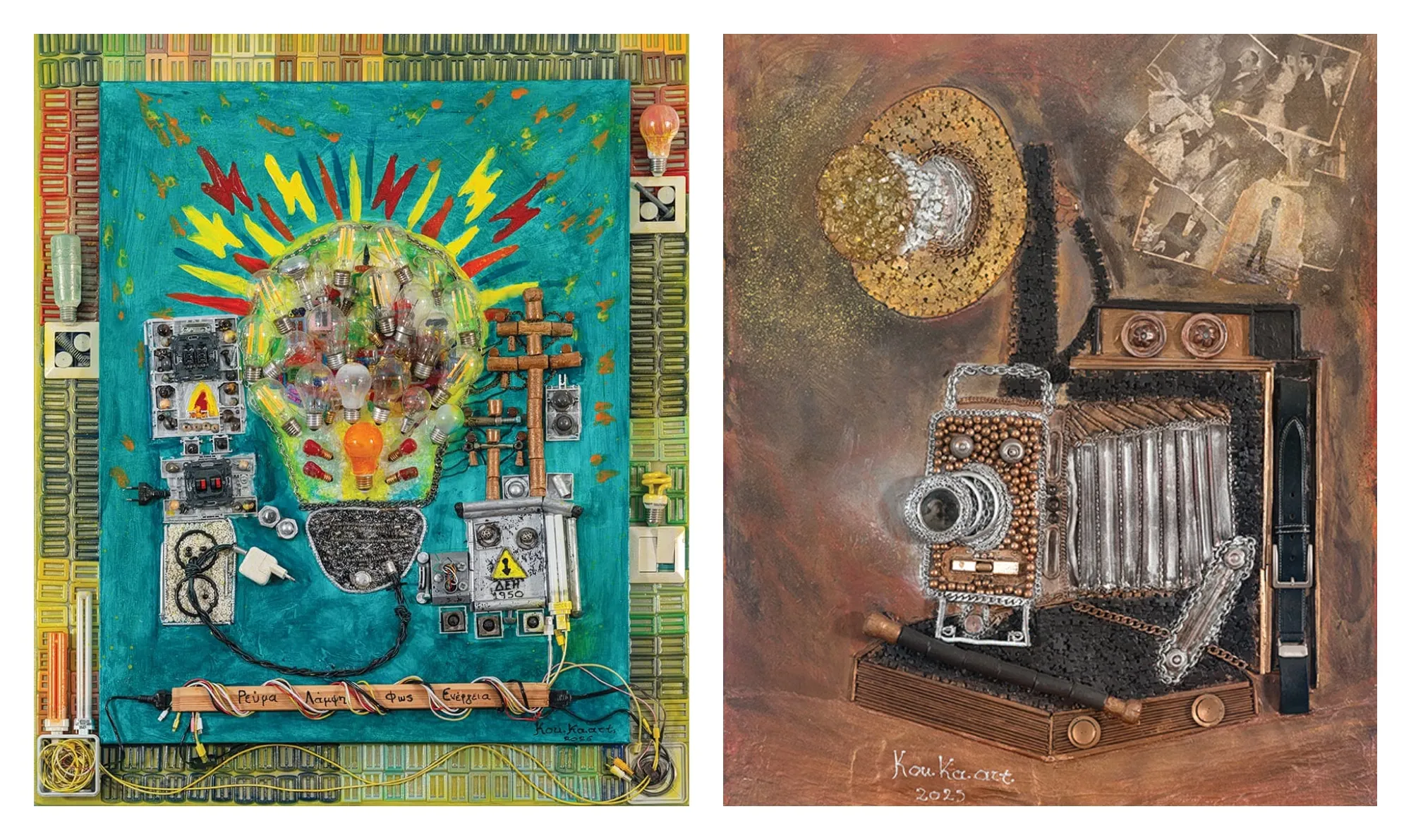
What defines the artistic approach of Kou.Ka.art?
The artistic identity of Kou.Ka.art is rooted in the practice of "trash art," where discarded objects are stripped of their original utility to serve new narrative purposes. By combining elements of painting and sculpture with a theatrical sensibility, the duo creates immersive three-dimensional works. These pieces often resemble stage sets, bridging the gap between fine art and performance environments.
Since establishing their collaborative practice in 2020, the artists have focused on the transformation of mundane materials. Their repertoire of mediums includes:
- Industrial metal fragments
- Plastic waste and debris
- Paper and cardboard
- Textiles and fabrics
This method allows the artists to engage in a dialogue about the lifecycle of objects, moving from functional tools to aesthetic symbols. Through this process, they highlight the "poetry of the useless," finding beauty in what society has deemed obsolete or broken.
How do the artists interpret the concept of memory and waste?
Kou.Ka.art uses recycled materials as vessels for collective and personal memory. According to the exhibition curator, Manos Stefanidis, the artists function as "dream collectors," gathering items from landfills or nostalgic, dusty shops to breathe new life into them. This process is not merely about recycling; it is an attempt to rescue the soul of an object from the void of disposal.
The works serve as a form of social commentary, prompting viewers to reflect on consumption patterns and the inevitability of decay. By elevating trash to the status of art, the duo asks profound questions about what we leave behind. The curator suggests that their work occupies a space between Pop Art and folk art, or perhaps between theatrical models and the "readymade" tradition that has influenced Western art for over a century.
The philosophical dimension of the "readymade"
The use of found objects connects Kou.Ka.art to a long lineage of artistic movements. By taking an object out of its functional context, they force the viewer to confront its form, texture, and history. This approach challenges the traditional definition of value, suggesting that beauty can be found in the most unexpected and discarded places. The works often evoke a sense of nostalgia, asking where the icons of our past—whether they be cultural figures or childhood toys—eventually reside once they are no longer loved or needed.
Who are the creators behind the Kou.Ka.art duo?
The duo consists of two women with diverse professional backgrounds that inform their multidisciplinary approach. Angeliki Kouna is a visual artist whose work is deeply influenced by her long-standing career in the public sector. Having worked for forty years at the former OAED (Manpower Employment Organization), she brings a structured perspective to her creative endeavors. Her academic background includes studies in Greek Culture at the Hellenic Open University, alongside postgraduate studies in Environmental Communication and Health Promotion at the University of West Attica.
Konstantina Katinou complements this expertise with her background in performing arts and literature. She is a visual artist, a teacher of theatrical training, and an accomplished playwright. In 2023, she published her debut fairy tale, "The Green Dossier," through Dianoia Publications. Like Kouna, Katinou is an alumna of the "IASMOS" Higher School of Drama (V. Diamantopoulos) and holds degrees in Greek Culture and Environmental Communication from the Hellenic Open University and the University of West Attica, respectively.
What is the exhibition history and impact of their work?
Kou.Ka.art has maintained a consistent presence in the Greek art scene through various group and themed exhibitions. Their work has moved from local galleries to significant cultural institutions, often focusing on themes of environmentalism and cultural icons. Their portfolio demonstrates a growing recognition of their ability to blend social critique with aesthetic appeal.
A timeline of their notable participations includes:
Their work frequently references legendary figures such as Maria Callas and Melina Mercouri, using these cultural icons to explore themes of fame, disappearance, and the passage of time. This intersection of pop culture and trash art allows them to engage a wide audience, from art historians to those interested in environmental sustainability.
FAQ: Kou.Ka.art and Trash Art
What is the main theme of the Kou.Ka.art exhibition?
The exhibition focuses on the intersection of contemporary trash art and theatrical scenography. It uses recycled materials like metal and plastic to create 3D sculptures that explore themes of memory, social consumption, and the beauty found in discarded objects.
Who are the members of the Kou.Ka.art team?
The team is composed of two artists: Angeliki Kouna, an expert in environmental communication and visual arts, and Konstantina Katinou, a playwright and theatrical educator. Both women bring diverse academic and professional backgrounds to their collaborative work.
What is "trash art"?
Trash art is a contemporary art movement that utilizes discarded materials and waste as the primary medium. Instead of traditional materials, artists use items like plastic, metal, and fabric to create new, meaningful compositions that comment on consumption and ecology.
Where can I see their work?
The duo frequently participates in exhibitions across Greece, including venues in Glyfada, Syros, Ilion, and Kolonaki. Their recent works have been showcased in municipal galleries, museums, and theatrical collaborations.
What materials do they use for their sculptures?
The artists use a variety of everyday and industrial materials, including metal, plastic, paper, and textiles. These items are stripped of their original function to be repurposed into narrative and aesthetic three-dimensional structures.
Key takeaways
- Kou.Ka.art is a Greek artistic duo specializing in contemporary trash art and 3D sculptures.
- The artists repurpose industrial waste, including metal and plastic, into narrative works.
- Their creative process blends painting, sculpture, and theatrical scenography.
- Exhibitions often explore themes of memory, consumption, and ecological awareness.
- The duo has participated in significant exhibitions from 2022 through 2025.
Synthesis and perspective
Kou.Ka.art represents a compelling intersection of environmental activism and fine art. By transforming the detritus of modern consumerism into objects of contemplation, Angeliki Kouna and Konstantina Katinou do more than just recycle; they perform a cultural rescue of the forgotten. Their work challenges the viewer to reconsider the value of the "useless" and to find a deeper connection to the material world. As global discussions regarding sustainability and waste continue to intensify, the duo's ability to weave social commentary into aesthetically rich, theatrical narratives ensures their relevance in the contemporary international art dialogue.
| Year | Exhibition / Collaboration | Notable Work(s) |
|---|---|---|
| 2022 | "SAVE THE PLANET" | "The Trap" and "The Remains" |
| 2023 | "Women's Overstimulation" | "Maria Callas / The Piano" |
| 2023 | Museum of National Resistance (Ilion) | "Sewing Machine / Raving Bones" |
| 2023 | Athens Theatres Collaboration | "Maria Callas / The Piano" |
| 2024 | French Hall (Kolonaki) | "Melina Mercouri / Moonlight Sonata" |
| 2024 | Syros Exhibition | "Marilyn Monroe" and "The Heart" |
| 2025 | Palaio Faliro Municipality | "Nostalgia" |