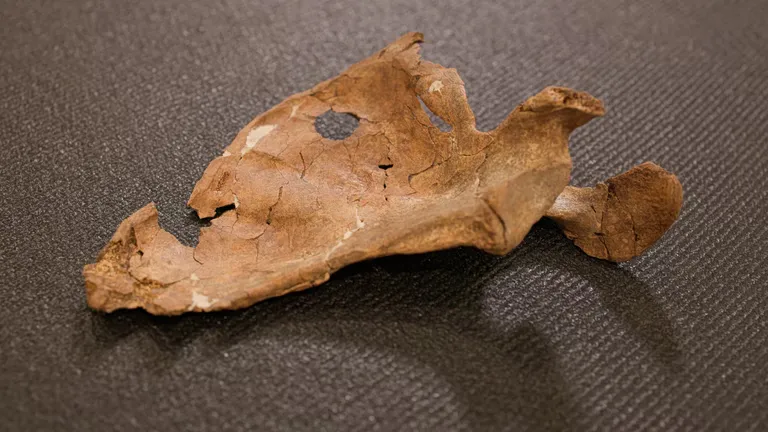
What does the discovery reveal about Neanderthal violence?
The discovery of a Neanderthal shoulder blade featuring a distinct circular hole offers a profound glimpse into the violent history of our ancient relatives. According to archaeologists from Cambridge University who led the excavation, this wound was not a random injury but was specifically caused by a wooden spear with a sharpened tip. This finding is monumental because it may represent the earliest known instance of lethal violence involving a wooden spear within the entire fossil record of the human species.
The nature of the wound provides specific details about the mechanics of this ancient encounter. The spear did not merely graze the individual; it penetrated the left thoracic cavity from the front, traveling through the body and causing extensive internal damage. The force required to drive such a weapon through the torso is significant, suggesting a high-impact event. This discovery provides the first tangible evidence that sharpened wooden spears were being utilized for lethal purposes in the prehistoric Middle East, marking a significant milestone in the evolution of weaponry and interpersonal conflict.
Where was the Neanderthal fossil found?
The remains were unearthed in the massive Shanidar Cave, a site located at the foothills of the mountains in Iraqi Kurdistan. This location is globally recognized as one of the most critical archaeological sites for the study of Neanderthals. The cave has served as a repository for human history, with several Neanderthal individuals identified there who lived between 50,000 and 75,000 years ago.
The specific remains, which researchers have named "Shanidar A," were found preserved under approximately seven and a half meters of rock and sediment. This deep burial is likely what allowed the left shoulder blade to remain almost entirely intact for roughly 75,000 years. The geological context of the Shanidar Cave provides a stable environment that has protected these fossils, allowing scientists to reconstruct the lives and deaths of these ancient people with unprecedented detail.
What does the injury suggest about Neanderthal interactions?
While some might initially suggest that the death could have been a tragic accident occurring during a hunt, the physical evidence points toward a more sinister possibility. Researchers have analyzed the position of the wound and the immense force necessary to pierce the entire body, leading them to conclude that the injury was likely an intentional, lethal strike directed toward the heart. This distinction is crucial, as it shifts the narrative from accidental death to purposeful, organized violence.
The trajectory of the spear—entering the front of the left thoracic cavity and exiting through the shoulder blade—indicates a direct and powerful strike. This level of precision and force suggests a confrontation that was both deliberate and fatal. Whether these encounters were the result of territorial disputes, social conflicts, or other forms of group aggression remains a subject of intense study, but the evidence clearly points toward a capacity for targeted, lethal violence among Neanderthal groups.
How does this discovery impact our understanding of Neanderthal life?
Beyond the evidence of violence, the Shanidar A remains provide a surprising counter-narrative regarding Neanderthal social structures. The skeleton shows signs of a severe facial injury that occurred at least one year prior to the individual's death. This suggests that the Neanderthal survived a significant trauma, which implies they were likely part of a community capable of providing long-term care and support. Such social bonds are essential for survival in harsh prehistoric environments.
This duality—the capacity for extreme violence and the capacity for compassionate care—paints a much more complex picture of Neanderthal existence. It challenges the outdated perception of Neanderthals as purely instinctual survivors. Instead, the evidence suggests a species with sophisticated social dynamics, capable of both organized conflict and communal nurturing. The ability to care for an injured member for a year indicates a level of social cohesion that is a hallmark of complex societies.
What other findings were associated with the Neanderthal remains?
The excavation of the Shanidar A site yielded more than just the pivotal shoulder blade. The assemblage of remains included a nearly complete right hand, two left ribs, a section of a right rib, and seven teeth. These additional elements allow for a more holistic reconstruction of the individual, who is estimated to have been approximately 45 years old at the time of their violent death.
The dental remains provided particularly interesting clues regarding the individual's health and history. Scientists identified a significant accumulation of calcified dental plaque (calculus) along the exposed root of one tooth. This finding is linked to the aforementioned facial injury; the presence of the plaque suggests that the tooth remained in the mouth for a considerable period following the trauma to the front of the face. This reinforces the theory that the individual lived for a significant time after their initial injury, further supporting the idea of a social group that provided sustained care for its members.
FAQ: Neanderthal Spear Violence
What is the significance of the Shanidar Cave discovery?
The discovery provides the earliest known evidence of lethal violence using sharpened wooden spears among Neanderthals, offering a new perspective on prehistoric weaponry and conflict.
How old are the Neanderthal remains found in Shanidar Cave?
The remains of the individual, known as Shanidar A, date back approximately 75,000 years.
What does the spear wound indicate about Neanderthal society?
The wound suggests that Neanderthals were capable of intentional, lethal violence, potentially indicating social or territorial conflicts.
How does this discovery change our view of Neanderthals?
It reveals a complex social structure that included both the capacity for targeted violence and the capacity for communal care for the injured.
What other injuries were found on the Neanderthal remains?
The remains showed evidence of a serious facial injury sustained at least a year before death, suggesting the individual received social support.
Key takeaways
- The Shanidar Cave discovery reveals the earliest evidence of Neanderthal spear violence.
- The injury suggests intentional, lethal violence rather than a simple hunting accident.
- The discovery highlights the complexity of Neanderthal life, showing both conflict and social care.
- Findings include a nearly complete right hand, ribs, and teeth, helping reconstruct the individual's life.
- The individual was approximately 45 years old when they died.
Conclusion
The discovery of the Shanidar A remains offers a groundbreaking window into the prehistoric world. By uncovering evidence of both lethal spear-driven violence and the long-term care of injured individuals, archaeologists have moved closer to understanding the true nature of Neanderthal sociality. These findings suggest a species that was far more complex than previously thought, possessing the tools for organized combat and the social structures required for communal support. As more evidence is gathered from sites like Shanidar Cave, our understanding of the dawn of human conflict and cooperation continues to evolve.