Strategic Considerations for Souda Bay Deployment
The strategic deployment of military assets is a complex process, often influenced by a myriad of geopolitical factors, regional stability, and national security interests. Recent discussions surrounding the potential transfer of a Patriot missile battery to Souda Bay in Crete underscore these intricate considerations. While details remain sparse, the mere contemplation of such a move highlights a heightened awareness of evolving security landscapes and the imperative to bolster defensive postures in key geographical locations.
Souda Bay, situated on the island of Crete, holds significant strategic importance due to its geographical location at the crossroads of Europe, Asia, and Africa. It serves as a critical hub for naval and air operations, providing access to the Eastern Mediterranean, the Black Sea, and the Suez Canal. Its existing infrastructure, including a deep-water port and an airbase, makes it an ideal candidate for hosting advanced defense systems. The potential addition of a Patriot battery would further solidify its role as a linchpin in regional security architecture, offering enhanced air and missile defense capabilities.
The Patriot Missile System: A Closer Look
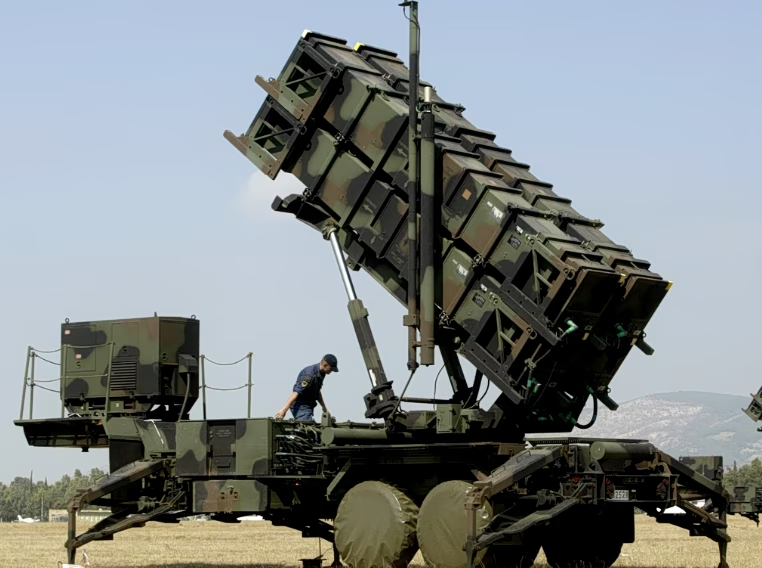
The Patriot missile system, developed by Raytheon, is a sophisticated surface-to-air missile (SAM) system renowned for its ability to intercept tactical ballistic missiles, cruise missiles, and advanced aircraft. Its deployment provides a robust shield against various aerial threats, offering both defensive and deterrent capabilities. Each Patriot battery typically consists of a radar set for detection and tracking, a control station for command and communication, a power generation unit, and multiple missile launchers. The system's modular design allows for flexibility in deployment and integration with existing defense networks.
The operational effectiveness of the Patriot system has been demonstrated in numerous conflicts and exercises globally. Its advanced radar technology can simultaneously track multiple targets, while its interceptor missiles, such as the PAC-2 and PAC-3 variants, are designed to engage threats with high precision. The PAC-3 missile, in particular, utilizes a 'hit-to-kill' technology, directly impacting and destroying incoming threats, thereby minimizing collateral damage. This capability is crucial in densely populated or strategically sensitive areas where even fragments of an intercepted missile could pose risks.
Geopolitical Context and Regional Security
The discussions regarding a Patriot deployment in Souda Bay cannot be viewed in isolation. They are intrinsically linked to broader geopolitical developments and regional security concerns. The Eastern Mediterranean has become an increasingly volatile region, characterized by competing interests, maritime disputes, and the presence of various state and non-state actors. The potential for escalation in certain areas necessitates a proactive approach to defense planning and resource allocation.
While specific triggers for these discussions are not publicly detailed, it is reasonable to infer that they are part of a larger strategy to enhance collective security and deter potential aggressors. The presence of advanced air defense systems in a critical location like Souda Bay sends a clear message about commitment to regional stability and the protection of strategic assets. It also provides reassurance to allies and partners in the area, reinforcing collaborative defense efforts.
Implications for International Cooperation
Any deployment of a significant military asset like a Patriot battery often involves complex bilateral or multilateral agreements. Such a move would likely be a result of close coordination and cooperation between the host nation and the deploying entity, reflecting shared security objectives. It could also entail logistical support, training programs, and intelligence sharing, further deepening military ties and interoperability.
The decision to place a Patriot battery in Souda Bay would also have implications for regional power dynamics. It could be perceived as a balancing force, contributing to a more stable security environment by raising the costs and risks for any potential aggressor. Furthermore, it could facilitate joint exercises and training opportunities, allowing allied forces to enhance their readiness and refine their collective defense strategies. This kind of advanced military cooperation is vital for maintaining peace and deterring conflict in complex geopolitical landscapes.
Economic and Logistical Considerations
Deploying and maintaining a Patriot missile battery involves substantial economic and logistical considerations. The initial acquisition cost of such a system is significant, and ongoing operational expenses, including maintenance, personnel training, and spare parts, can be considerable. However, these costs are often weighed against the strategic value and the potential cost of inaction in the face of escalating threats.
Logistically, the transfer and installation of a Patriot battery require careful planning and execution. This includes ensuring the availability of suitable infrastructure, securing supply lines for fuel and munitions, and providing adequate housing and support facilities for military personnel. The complex nature of the system also necessitates highly trained technicians and operators, underscoring the importance of specialized training programs and expertise.
Public Perception and Diplomacy
Beyond military and strategic considerations, the deployment of advanced defense systems also involves navigating public perception and diplomatic sensitivities. Ensuring transparency and clear communication about the purpose and defensive nature of such deployments can help mitigate concerns and foster public support. Diplomatic efforts are crucial in explaining the rationale behind such decisions to regional stakeholders and international partners, preventing misunderstandings and promoting a shared understanding of security objectives.
Ultimately, the discussions surrounding the potential deployment of a Patriot battery to Souda Bay reflect a proactive and adaptive approach to defense planning in a rapidly changing world. It underscores the ongoing need for nations to assess their security requirements, leverage advanced technologies, and engage in robust international cooperation to safeguard their interests and promote regional stability. The decision, if finalized, would represent a significant enhancement of defensive capabilities in a strategically vital area, contributing to a broader framework of collective security.