EU Parliamentarians Seek Clarity on Sinai Monastery Ownership
Four prominent Members of the European Parliament (MEPs) representing the Greek political party PASOK have formally requested that the European Union adopt a clear position concerning the ownership status of the Holy Monastery of Saint Catherine in Sinai. This appeal comes at a critical juncture, specifically in anticipation of a forthcoming hearing scheduled for August 23rd before the Egyptian Court of Cassation, which is expected to address the intricate details of the monastery's proprietary rights. The intervention underscores the perceived urgency and the profound historical, cultural, and religious significance of the site, not only for Orthodox Christianity but for global heritage.
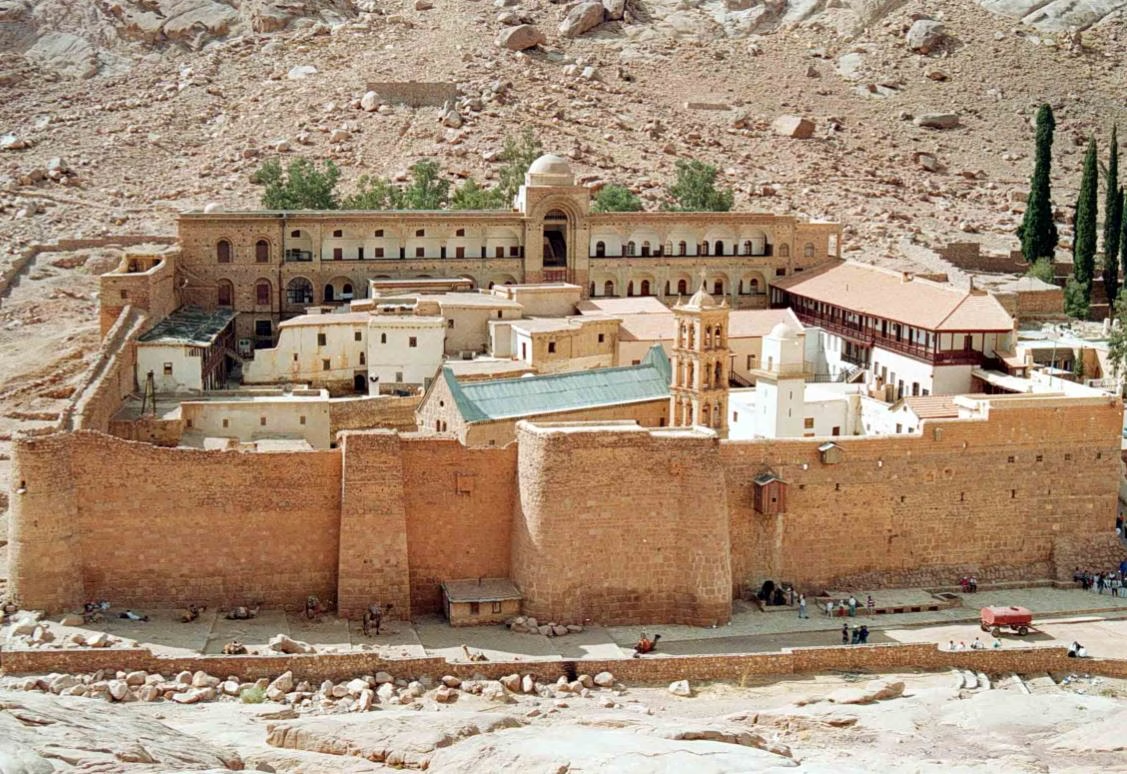
The Holy Monastery of Saint Catherine, nestled at the foot of Mount Sinai in Egypt, holds an unparalleled position as one of the oldest continuously operating Christian monasteries in the world. Its origins trace back to the 4th century, with its current structure largely attributed to the Byzantine Emperor Justinian I in the 6th century. The monastery is a UNESCO World Heritage site, recognized for its exceptional architecture, its invaluable collection of icons, manuscripts, and liturgical objects, and its enduring role as a center of religious pilgrimage and scholarly activity. Its library, in particular, houses a treasure trove of ancient texts, including some of the earliest surviving biblical manuscripts, making it an indispensable resource for theological and historical research.
The current legal entanglement centers on a dispute regarding the ownership of certain lands and properties that have historically been associated with the monastery. While the exact specifics of the contested assets have not been widely publicized, such disputes often involve claims of historical use, traditional boundaries, and the interpretation of land deeds or decrees issued over centuries. The fact that the case has reached Egypt's highest appellate court, the Court of Cassation, indicates the complexity and the deep-seated nature of the disagreement, suggesting that lower court rulings have been challenged or that the legal questions involved are of significant constitutional or interpretative weight.
The PASOK MEPs' decision to involve the European Union highlights several key considerations. Firstly, it reflects a belief that the EU, as a major international actor and a strong proponent of cultural heritage preservation and religious freedom, has a vested interest and a moral obligation to engage with such issues. The monastery, while located outside the geographical boundaries of the EU, is undeniably part of a broader European and global cultural tapestry, particularly given its historical ties to Byzantine Christianity, which profoundly influenced European civilization. Secondly, the intervention could be seen as an attempt to leverage the EU's diplomatic weight to ensure a fair and transparent legal process, thereby safeguarding the monastery's long-term stability and its ability to continue its religious and cultural mission without undue external pressure.
Historically, the monastery has enjoyed a unique status, often navigating complex geopolitical landscapes under various rulers, from Byzantine emperors to Mamluk sultans and Ottoman caliphs, and eventually under Egyptian sovereignty. Its survival and flourishing through millennia of change are a testament to its resilience and the respect it has often commanded from diverse authorities. However, modern legal frameworks and land regulations can sometimes challenge historical arrangements, leading to contemporary disputes. The monastery's unique status as an autocephalous Eastern Orthodox Church, directly answerable to the Patriarchate of Jerusalem, further complicates its legal and administrative standing.
The MEPs' call for an EU position could manifest in several ways. It might involve a formal statement from the European External Action Service (EEAS) or the European Commission, expressing concern and urging a just resolution. It could also entail diplomatic engagement with Egyptian authorities, emphasizing the international significance of the monastery and the importance of upholding its historical rights. Furthermore, the EU could offer technical or legal assistance, or even facilitate dialogue between the parties involved, should such an approach be deemed constructive. The overarching goal would be to ensure that any judicial outcome respects the monastery's historical integrity, its religious autonomy, and its status as a world heritage site.
The upcoming court hearing on August 23rd is therefore highly anticipated, as its outcome could have significant implications for the monastery's future. A definitive ruling on the property status could either resolve long-standing ambiguities or, conversely, introduce new challenges. The involvement of European Parliamentarians at this critical juncture signifies the international community's growing awareness and concern for the preservation of this irreplaceable cultural and religious monument. Their proactive stance underscores the idea that certain heritage sites transcend national borders and warrant collective international attention and protection.
The broader context of such interventions often includes considerations of religious freedom and the rights of minority communities. While the specific details of the dispute are legal and property-related, the underlying concerns can often touch upon the ability of religious institutions to operate freely and maintain their historical patrimony. For the Holy Monastery of Saint Catherine, an institution that has withstood the test of time and countless historical shifts, the current legal challenge represents another significant moment in its long and storied existence. The international community, spurred by the actions of these MEPs, will undoubtedly be watching the proceedings closely, hoping for a resolution that upholds justice and preserves a vital piece of human history.