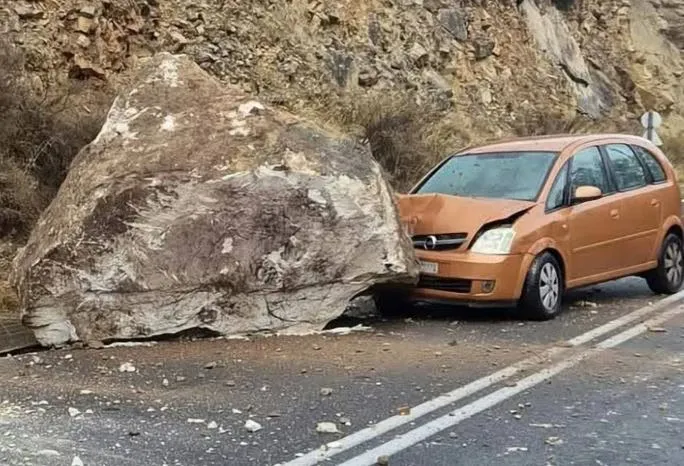
How did the Ierapetra rockfall incident unfold?
The incident occurred when a large rock detached from a steep slope and plummeted onto the road in the Fermas area of Ierapetra. Manolis Lathourakis, the driver at the center of the event, described the moment as instantaneous and terrifying. He noted that the rock appeared suddenly in his line of sight, leaving him with almost no time to react other than to slam on his brakes.
Lathourakis emphasized that the timing was critical. He managed to bring his vehicle to a halt just fractions of a second before the boulder reached the exact spot where his car was positioned. He noted that while he was traveling at a low speed, the sheer scale of the rock made the encounter life-threatening. He remarked to ERT News that the true dimensions of the boulder are difficult to capture in photographs, suggesting it was significantly larger than it appears in visual media, describing it as a "huge thing" that the camera fails to fully represent.
The role of bystander warnings
According to the driver, he was not solely reliant on his own vision to avoid the catastrophe. He stated that the voices of people in the vicinity, who witnessed the rock breaking loose from the heights, served as a vital early warning system. These shouts allowed him to process the danger and react to the sudden obstruction on the road. "I was saved by the voices that people made when they saw the rock breaking loose from up high," Lathourakis explained, noting that these auditory cues were essential in those split seconds before he applied the brakes.
What was the impact on the tourists following the vehicle?
The sudden appearance of the boulder and the subsequent emergency braking caused significant distress among the motorists following Lathourakis. Behind his vehicle, a convoy of four to five cars carrying tourists was traveling along the same stretch of road. When Lathourakis exited his vehicle following the near-miss, the tourists were reportedly in a state of panic.
Lathourakis described the scene as chaotic, noting that the tourists "went crazy" when they saw him emerge from the car. The suddenness of the geological event and the sight of a massive rock blocking the road left the onlookers unsure of how to react. This secondary impact highlights how localized geological hazards can create immediate safety risks and psychological distress for entire groups of travelers in a matter of seconds.
Why did the driver survive the encounter?
Survival in the Ierapetra rockfall incident was attributed to a combination of cautious driving and recent environmental cues. Lathourakis noted that he was driving at a low speed, which provided the necessary reaction time to stop the vehicle before the rock made contact. He mentioned that he had actually hit the rock—not with the car's body, but by the rock falling right in front of him—and that his low speed was a deciding factor in his survival.
Furthermore, the driver was already in a state of heightened awareness due to recent activity in the area. Approximately 50 meters prior to the incident, a landslide had already occurred, which had prompted drivers in the area to proceed with increased caution. Lathourakis mentioned that while the presence of loose rocks was visible and they were driving carefully, they did not believe such a massive event would occur at that exact moment.
What are the recurring geological risks in the Ierapetra region?
The area surrounding Ierapetra is known for its susceptibility to landslides and rockfalls, often triggered by intense weather conditions. Lathourakis pointed out that these geological instabilities are a recurring theme in the region, necessitating constant vigilance from both residents and visitors. He stressed the importance of respecting local weather patterns and the potential for flash floods and landslides.
The driver also drew parallels to past tragedies to underscore the gravity of the situation. He specifically referenced a fatal incident involving a Slovenian woman in Agia Fotia that occurred three to four years ago. By mentioning these previous accidents, he highlighted that while he was lucky, the geological hazards in Crete can be lethal for those caught unprepared by the elements. He concluded that people must respect the weather and the potential for such natural phenomena.
Frequently asked questions
Who was involved in the Ierapetra rockfall incident?
The primary individual involved was Manolis Lathourakis, a driver from Ierapetra. He was driving a vehicle in the Fermas area when a large rock fell in front of him. He was aided by the warnings of bystanders who saw the rock detaching.
How did the driver avoid hitting the rock?
The driver avoided the rock by driving at a low speed and applying his brakes immediately upon seeing the boulder. He managed to stop the car just a fraction of a second before the rock landed in his path.
Was anyone else in danger during the event?
Yes, a convoy of four to five vehicles carrying tourists was traveling directly behind Lathourakis. The suddenness of the rockfall and the driver's emergency stop caused significant panic among the tourists in the following cars.
Is this a common occurrence in Crete?
The driver indicated that landslides and rockfalls are known to happen in this specific area. He noted that another landslide had occurred just 50 meters away only minutes before the main incident.
What previous accidents were mentioned?
Lathourakis referred to a tragic accident involving a Slovenian woman in Agia Fotia that took place three to four years ago, using it as a reminder of the region's dangers.
Key takeaways
- Manolis Lathourakis survived a massive rockfall in Ierapetra by braking just seconds before impact.
- The driver credited his survival to low driving speeds and auditory warnings from bystanders.
- A convoy of four to five tourist vehicles experienced panic following the near-miss.
- A smaller landslide had occurred approximately 50 meters from the site shortly before the incident.
- The region is prone to geological hazards triggered by intense weather and heavy rainfall.
Conclusion
The near-miss in Ierapetra serves as a stark reminder of the unpredictable nature of geological hazards in mountainous coastal regions. While Manolis Lathourakis escaped unharmed due to cautious driving and timely warnings, the incident highlights the ongoing risks posed by landslides in Crete. The presence of recent geological activity in the Fermas area suggests that environmental conditions remain volatile. For travelers and locals alike, respecting weather warnings and maintaining low speeds in known high-risk zones remains the most effective way to mitigate the dangers of such sudden natural events.