What were the key outcomes of the $4 billion defense agreement?
The primary achievement of the visit was the formalization of defense procurement deals totaling $4 billion through the Foreign Military Sales (FMS) framework. These agreements are designed to support Greece's long-term defense planning and enhance interoperability between the Hellenic Armed Forces and the United States. According to the Joint Statement, the funding is specifically earmarked for critical hardware, including missiles and bombs, necessary for next-generation aerial warfare and the maintenance of existing capabilities.
This massive investment underscores a deepening military bond. By utilizing the FMS program, the two nations aim to ensure that Greek defense infrastructure remains compatible with American standards, a necessity in an increasingly volatile global landscape. The scale of the deal reflects the strategic importance the US places on the Eastern Mediterranean as a theater of operational readiness.
F-35 and F-16 Modernization Details
A significant portion of the agreement focuses on the upcoming transition to fifth-generation fighter technology. The Hellenic Air Force is scheduled to begin receiving F-35 aircraft in November 2029, and the current deal provides for the missiles and bombs required to operate these advanced platforms. This ensures that when the aircraft arrive, the necessary munitions infrastructure will already be in place.
Furthermore, the pact includes a comprehensive upgrade program for 37 existing F-16 fighter jets. This dual-track approach—preparing for the future with the F-35 while modernizing the current fleet—ensures that Greece maintains a high level of readiness and technological parity in the Mediterranean theater. The modernization of the F-16s serves as a bridge, maintaining combat effectiveness during the transition period to the fifth-generation era.
How is Greece positioned as a regional security provider?
Greece has transitioned from a recipient of security to an active provider of regional stability, according to statements made by Greek Foreign Minister Giorgos Gerapetritis. The Minister highlighted that Greece's geopolitical position and advanced defense systems allow it to export security to neighbors, including Cyprus, Bulgaria, and several Gulf nations. This shift is underscored by the strategic importance of US military hubs in Souda and Alexandroupoli, which serve as vital nodes for US operations moving both north and south.
During high-level discussions, the Greek leadership expressed a willingness to support international maritime security, specifically mentioning the potential for naval assistance in the Strait of Hormuz. However, this support remains conditional on the existence of a sustainable peace process and favorable circumstances. The Greek government maintains that its ongoing operations in the Red Sea, the Mediterranean, and the Indian Ocean are designed to complement, rather than replace, existing American initiatives. Gerapetritis emphasized that Greece's ability to act as a "security provider" is a direct result of its developed defense systems and its unique geographic location.
What role do energy corridors play in the US-Greece relationship?
Energy security and the expansion of transit routes were central themes of the diplomatic talks. The US Secretary of State expressed total commitment to the development of energy corridors, specifically focusing on the potential for the Vertical Corridor to facilitate the transport of American Liquefied Natural Gas (LNG) to Central Europe. This move is intended to bolster European energy independence and strengthen the economic ties between the US and the Mediterranean.
While the US expressed strong support for the Greece-Cyprus electricity interconnection project, Rubio noted that such energy ventures often navigate complex geopolitical waters. He suggested that certain issues involving energy interconnections involve "delicate situations" regarding other unnamed countries. The diplomatic preference, according to the US Secretary, is to resolve these sensitive regional matters through private diplomatic channels rather than public confrontation. This highlights the tension between the desire for rapid energy integration and the necessity of maintaining regional diplomatic stability.
Why was the Pnyx speech viewed as politically significant?
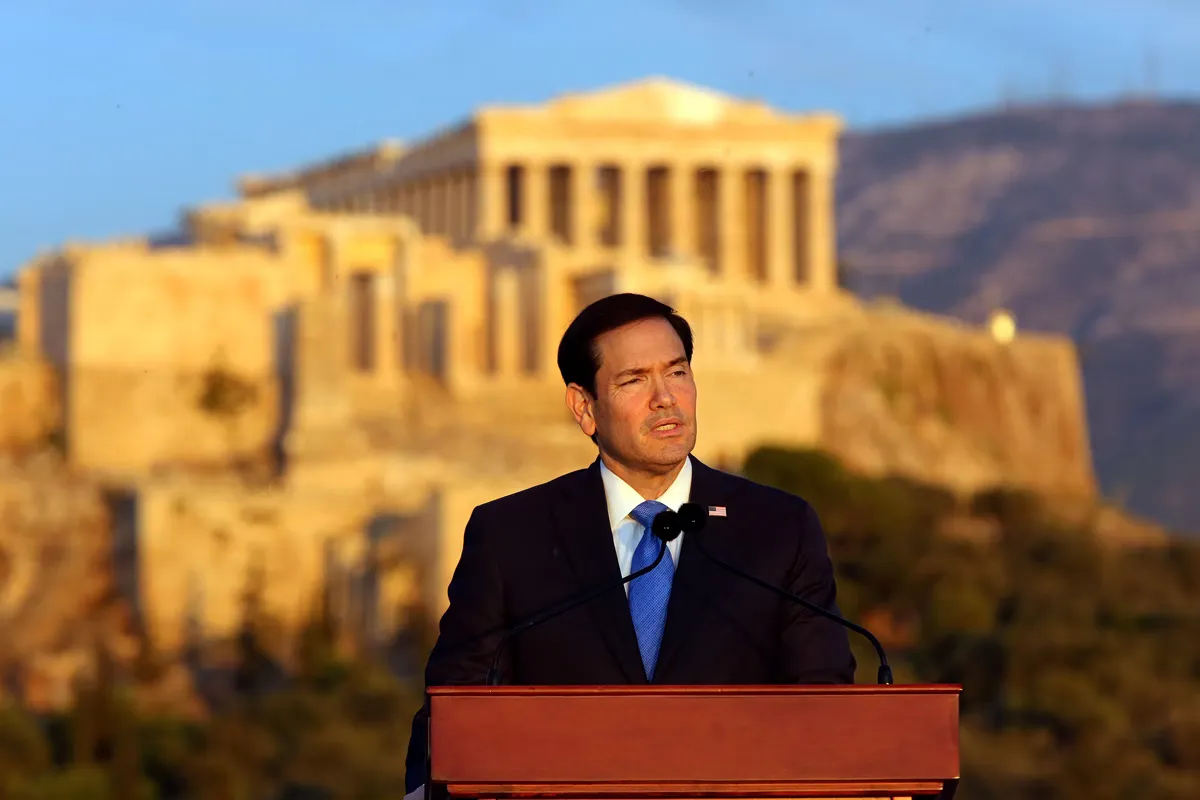
The address delivered by Marco Rubio at the Pnyx, set against the backdrop of the Acropolis, was noted by international observers for its heavy ideological tone. While ostensibly a diplomatic speech, the content drew parallels between ancient Greek values—heroism, honor, and duty—and contemporary American political agendas. This framing led several international media outlets to analyze the speech through the lens of US domestic politics rather than purely bilateral diplomacy.
The speech was not merely a recitation of diplomatic platitudes; it was a call for Western nations to adopt a more robust defense posture. Rubio urged Europe to follow the Greek example in taking greater responsibility for its own security. By using the symbolic setting of ancient Athens, Rubio connected the historical foundations of Western civilization to the modern-day necessity of strength and duty, a move that resonated with his political identity in the United States.
Media reactions to the Pnyx address
The reception of the speech varied significantly among global press agencies, reflecting its perceived dual purpose. The Washington Post suggested that the address resembled the rhetoric of a politician seeking to inherit the MAGA movement, rather than a standard diplomatic statement. This interpretation views the speech as a tool for domestic political positioning within the Republican Party.
Similarly, the Associated Press pointed to the highly produced nature of the event—noting the use of professional camera crews and cranes—as evidence that the speech functioned more like a presidential campaign rally than a routine State Department engagement. The AP noted that the decision by the State Department to hire a local television crew to capture the speech from multiple angles, including via crane, added to the impression of a high-production political event. These observations reflect the perception of Rubio as a rising figure within the Republican Party, potentially positioned for future leadership roles in the US, including the presidency.
What was notably absent from the official bilateral discussions?
Despite the depth of the strategic dialogue, there was a conspicuous absence of any mention of Turkey in the official statements from both the Greek and American delegations. While the discussions covered vast territories including the Red Sea and the Gulf, the specific bilateral tensions between Athens and Ankara were not addressed in the public-facing portions of the visit. Not even the word "Turkey" was used in the official capacities.
This omission suggests a strategic focus on broader regional stability, energy corridors, and the global security architecture rather than addressing localized Aegean disputes. By avoiding the topic, the delegations maintained a focus on the positive, constructive elements of the US-Greece partnership, such as the $4 billion defense deal and energy cooperation, while leaving more contentious regional issues to be handled through other channels.
Key takeaways
- A $4 billion defense deal was signed to support Greek F-35 and F-16 programs.
- Greece is increasingly recognized as a security provider for Cyprus, Bulgaria, and the Gulf.
- The US supports the Vertical Corridor to transport American LNG to Central Europe.
- Strategic military hubs in Souda and Alexandroupoli remain vital for US regional presence.
- The Pnyx speech was characterized by international media as having significant US political undertones.
FAQ: Marco Rubio Greece visit
What is the purpose of the $4 billion defense agreement?
The agreement, conducted via Foreign Military Sales, aims to support Greece's long-term defense strategy. It specifically funds munitions for the F-35 jets arriving in 2029 and provides for the upgrade of 37 existing F-16 fighter aircraft to ensure regional interoperability.
How does Greece contribute to regional maritime security?
Greece participates in operations in the Red Sea, the Mediterranean, and the Indian Ocean. Additionally, Athens has expressed readiness to provide naval assistance in the Strait of Hormuz, provided that international law is respected and a viable peace process is in place.
What energy projects were discussed during the visit?
Discussions centered on the Vertical Corridor for transporting US LNG to Central Europe and the Greece-Cyprus electricity interconnection. The US expressed support for these projects while noting they involve delicate geopolitical considerations with other regional actors.
Why was the speech at the Pnyx controversial?
The speech was viewed as controversial because international media outlets, such as the Washington Post, noted its ideological tone. Critics suggested the address felt more like a US political campaign rally than a standard diplomatic speech, given its emphasis on specific political movements.
What is the significance of Souda and Alexandroupoli?
Souda and Alexandroupoli are critical strategic locations where US and Greek security interests intersect. These sites serve as essential hubs for the deployment of American military forces throughout the Mediterranean and toward the north and south of the region.
Conclusion
The visit of Marco Rubio to Greece marks a significant deepening of the US-Greece strategic partnership, characterized by massive military investment and shared energy ambitions. By securing $4 billion in defense contracts and emphasizing the importance of energy corridors like the Vertical Corridor, the two nations have reinforced their roles in the Mediterranean security architecture. While the diplomatic focus remained on broader regional stability and energy independence, the political undertones of the visit and the strategic importance of Greek military hubs suggest that the relationship will continue to evolve as a cornerstone of Western interests in a volatile global landscape.