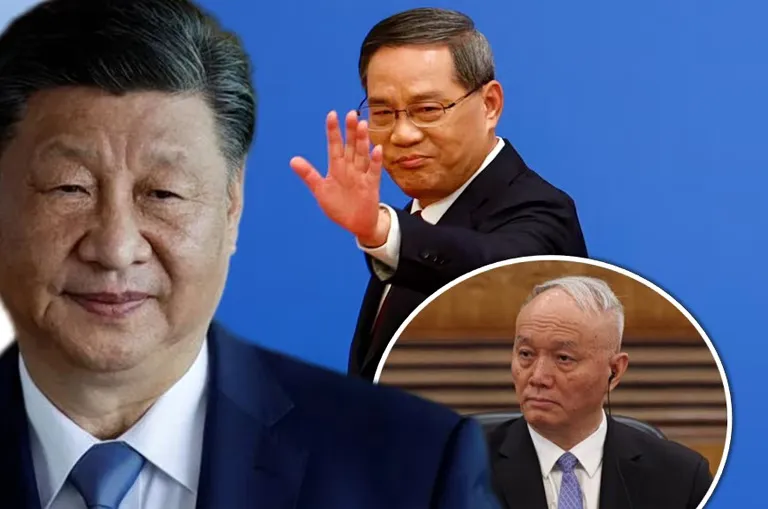
How does the Xi Jinping power structure actually function?
The Xi Jinping power structure operates through a sophisticated division of labor rather than a simple autocracy. Although President Xi holds immense central authority, he cannot personally manage the vast machinery of the Chinese state or the massive Chinese Communist Party (CCP) alone. According to Chinese analyst Deng Youyuan, the system necessitates close, highly competent collaborators to ensure stability and execution.
This governance model is currently anchored by what Youyuan describes as a 'central triad.' This group is composed of Xi Jinping, Premier Li Qiang, who holds the official second position in the hierarchy, and Cai Qi, a member of the Politburo Standing Committee. Together, they define the political direction of the country. While Li Qiang oversees government and administrative matters, Cai Qi manages the internal mechanisms of the Party. This division ensures that the two most critical pillars of Chinese governance—the state and the Party—are managed by specialists who are directly aligned with Xi's vision.
The necessity of administrative deputies
The sheer scale of the Chinese bureaucracy makes total personal management by a single leader impossible. Even with the consolidation of power seen in recent years, the effectiveness of the central leadership depends on the ability of deputies to translate high-level policy into granular administrative action. This requires a level of trust that is cultivated over decades of service within both regional and central administrations.
What are the historical parallels to the current leadership?
The current leadership arrangement draws historical comparisons to the power dynamics of the Mao Zedong era, though the nature of that power is fundamentally different. Analysts often look to the relationships between Mao Zedong, military leader Lin Biao, and Mao's wife, Jiang Qing, to understand Chinese power struggles. However, Youyuan emphasizes that these analogies should be used to understand the framework of power rather than to predict identical outcomes.
The differences between the historical figures and the current 'triad' are significant. Lin Biao possessed independent political capital through his military achievements and deep connections within the armed forces. Jiang Qing derived her influence from her unique status as Mao's spouse and the political network she built during the Cultural Revolution. Neither could exercise power without Mao, yet both maintained degrees of autonomy that the current deputies do not possess.
In contrast, both Li Qiang and Cai Qi owe their political ascent entirely to the trust they have cultivated with Xi Jinping. Unlike Lin Biao, neither possesses an independent political base, and unlike Jiang Qing, they lack familial ties to the top leader. Consequently, the interests of the current triad are more closely aligned with Xi's central authority, making it much harder for either deputy to create an independent center of power that could challenge the presidency.
How do Li Qiang and Cai Qi differ in their roles?
Li Qiang and Cai Qi remains distinct in their functional utility to the President, preventing any single deputy from monopolizing power. Xi Jinping has carefully distributed responsibilities to ensure that both men are indispensable while remaining subordinate. While both operate under Xi's authority, their specific domains provide them with different types of influence.
Cai Qi serves primarily as the chief administrator of the Party mechanism that surrounds the supreme leader. His role is vital for maintaining Xi's personal control over the Party's internal workings. However, his influence is highly dependent on his proximity to Xi and his ability to manage the political apparatus effectively. He does not possess the broad administrative governance powers held by the Premier.
Li Qiang, through his position as Premier and his oversight of the State Council, manages the actual governance of the nation. This role gives him a different dimension of power rooted in the state's administrative and economic functions. The distinction is clear: Cai Qi secures the Party, while Li Qiang manages the State. This functional separation is a deliberate strategy by Xi to maintain a balance of power among his most trusted lieutenants.
The importance of the State Council
The State Council, headed by the Premier, acts as the executive arm of the government. Because it manages the complex implementation of national policy, the Premier holds a unique position that is difficult to replicate within the Party structure alone. This ensures that the economic and social stability of the country remains under the purview of a specialist who is also a political loyalist.
Why is the economy the deciding factor for political survival?
The economic stability of China is the primary variable that will determine which members of the leadership remain in power after the 2027 Party Congress. As China faces a prolonged crisis in the property market, rising local government debt, and weak domestic demand, the ability to deliver economic results becomes a matter of political survival. President Xi's long-term strategic ambitions are entirely dependent on a functional and growing economy.
According to Youyuan, Li Qiang holds a distinct advantage in the context of political longevity due to his economic mandate. Xi has entrusted the State Council to Li because he is a long-term collaborator with extensive experience in managing regional economies. For the central leadership, Li is seen as someone who is both politically reliable and capable of delivering the necessary economic results to sustain the regime's legitimacy.
While Cai Qi is essential for maintaining political control, the existential threats facing China are increasingly economic and external. The ongoing strategic pressure from the United States and the need to navigate internal financial crises mean that the 'economic deputy' may hold more leverage in the long run. If the economy falters, the pressure on the leadership to prioritize economic management over pure political discipline will increase.
What is the outlook for the 2027 Party Congress?
The 21st Party Congress in 2027 will serve as a critical test for the current structure of Chinese power. It is highly unlikely that both Li Qiang and Cai Qi will remain on the Politburo Standing Committee, as Xi Jinping will likely need to create space to promote a new generation of loyalists and collaborators. The question is not whether the structure will change, but who will be chosen to inhabit the new roles.
The decision will likely be driven by the functional needs of the state. While Cai Qi is older and holds a vital role in Party discipline, Li Qiang's role in economic management provides a different kind of necessity. The transition will likely reflect Xi's ongoing effort to balance the need for absolute political loyalty with the practical requirement for competent economic administration. The survival of the current 'triad' model depends on whether the leadership can successfully navigate the transition without creating the very power centers they seek to avoid.
Frequently asked questions
Who are the two most important deputies to Xi Jinping?
The two most important deputies are Premier Li Qiang and Cai Qi, a member of the Politburo Standing Committee. Li Qiang is responsible for the government and economic administration via the State Council, while Cai Qi manages the internal mechanisms and personnel of the Chinese Communist Party.
How does the current leadership differ from the Mao era?
Unlike the Mao era, where figures like Lin Biao held independent military power, the current deputies, Li Qiang and Cai Qi, lack independent political capital. Their authority is derived entirely from the trust and mandate granted to them by Xi Jinping, making them less likely to form rival power centers.
Why is the 2027 Party Congress significant?
The 2027 Congress will be a turning point because it will determine whether the current leadership structure is maintained or if Xi Jinping will promote new subordinates. It will also test the leadership's ability to manage China's economic challenges while maintaining political stability.
Does Li Qiang have more power than Cai Qi?
The two men hold different types of power. Cai Qi has significant influence over the Party's internal workings and political discipline, which is vital for Xi's control. Li Qiang holds broader administrative and economic authority through the State Council, which is essential for national governance.
What economic challenges affect the leadership's stability?
The leadership faces several critical economic issues, including a crisis in the real estate market, significant debt held by local governments, and sluggish domestic consumer demand. These factors are crucial because economic performance directly impacts the political legitimacy of the central government.
Key takeaways
- The 'central triad' consists of Xi Jinping, Li Qiang, and Cai Qi.
- Li Qiang manages government and economic affairs, while Cai Qi manages Party mechanisms.
- Current deputies lack the independent political capital seen in historical figures like Lin Biao.
- Economic stability is the primary factor influencing the survival of leadership members.
- The 2027 Party Congress will test the continuity of this power structure.
Conclusion
The Xi Jinping power structure is defined by a strategic division between Party discipline and state administration. While the relationship between Xi, Li Qiang, and Cai Qi resembles historical power triads, it is fundamentally more centralized and less prone to the independent factionalism of the past. The stability of this arrangement hinges on the leadership's ability to manage China's complex economic headwinds. As the 2027 Party Congress approaches, the functional necessity of economic management may prove just as important as political loyalty in determining the next generation of China's top leadership.