Why does Santiago Peña remain President despite his resignation?
Santiago Peña remains the de facto head of state because the Paraguayan Parliament was unable to reach a quorum to formally accept or reject his resignation on Thursday afternoon. Under the current legal framework, a resignation cannot be processed without a specific parliamentary vote, a requirement that was not met due to the absence of enough lawmakers. This legislative failure has created a unique constitutional vacuum where the President has declared his intent to leave, yet legally retains all executive powers.
Gustavo Leite, a deputy from the Colorado Party—the same right-wing party to which Peña belongs—summarized the situation by stating that Peña remains President "from a technical standpoint" because the legislature could not officially acknowledge the departure. This technicality means that while the political intent to resign has been signaled, the legal reality of the presidency remains unchanged until the parliamentary machinery can function effectively.
The role of parliamentary quorum in executive transitions
In the Paraguayan political system, the transition of power is not merely a matter of executive decree but requires strict adherence to legislative protocols. A quorum is the minimum number of members required to be present to make the proceedings of a meeting valid. Without this minimum threshold, no votes can be cast, and no official decisions regarding the presidency can be ratified. This has resulted in a stalemate where the country is governed by a leader who has publicly renounced his position but remains legally empowered to exercise authority.
What triggered the political crisis in Paraguay?
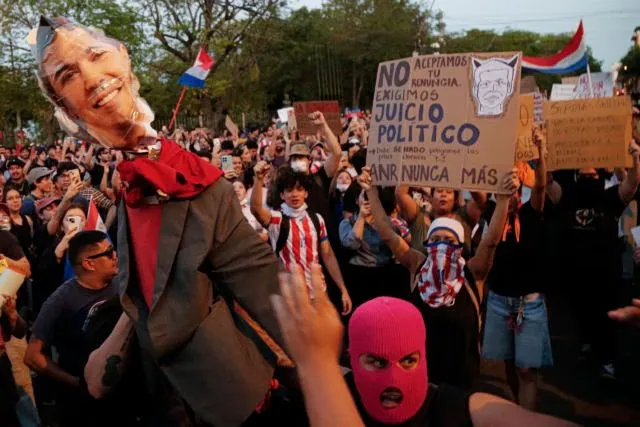
The primary catalyst for this instability is a severe financial scandal involving Ueno Bank, which has triggered widespread public unrest and political fallout. The bank was recently placed under the receivership of the Central Bank of Paraguay, a move that effectively froze the assets of approximately 3 million Paraguayans. This sudden loss of access to personal and business funds has caused significant economic distress and fueled massive demonstrations in the capital, Asunción.
The scale of the Ueno Bank crisis is unprecedented in its impact on the civilian population. As the bank fell under central bank administration, the resulting liquidity freeze meant that millions of citizens were suddenly unable to conduct basic transactions, pay bills, or access their savings. This economic shock directly implicated the administration of Santiago Peña, leading to accusations of negligence or involvement that prompted his initial announcement of resignation.
Impact of the Ueno Bank collapse on the citizenry
The social consequences of the banking crisis have been immediate and profound. With nearly a third of the population facing financial paralysis, the atmosphere in Asunción has become increasingly volatile. Protests have erupted in response to the perceived failure of state institutions to protect the banking sector and, by extension, the life savings of the people. The crisis has moved beyond a mere financial issue, evolving into a fundamental question of trust in the Paraguayan state and its regulatory oversight.
How will the Senate impeachment process proceed?
Santiago Peña intends to exercise his right to a legal defense as the Senate prepares to conduct an impeachment trial. Following the deputies' approval of the impeachment process, the case has moved to the Senate, where the formal charges will be presented and debated. The President has stated his intention to "appear" and defend his actions against the allegations stemming from the banking scandal and the subsequent political turmoil.
Senator Derlis Maidana provided insight into the immediate timeline, noting that the committee responsible for announcing the formal charges was expected to be finalized on Friday night. This committee is tasked with outlining the specific legal and constitutional grounds for the impeachment. The first hearing is anticipated to take place imminently, as the legislative body attempts to resolve the crisis that has paralyzed the executive branch.
The legal distinction between resignation and impeachment
The current situation in Paraguay involves two distinct legal tracks: the attempted resignation and the impeachment proceedings. While the resignation was a response to the banking scandal, the impeachment is a formal constitutional mechanism used by the legislature to remove an official for misconduct. Because the resignation could not be legally processed due to the lack of quorum, the impeachment process remains the primary legal avenue through which the presidency may be formally vacated.
What are the implications for Paraguayan stability?
The intersection of a banking collapse, a failed resignation, and an impending impeachment trial has placed Paraguay in a state of extreme political uncertainty. Constitutional experts consulted by international media have highlighted that the country is currently operating under a "de facto" leadership model, where the legal status of the President does not align with his stated political position. This misalignment creates a risk of further civil unrest if the legislative process does not move swiftly to resolve the impasse.
The stability of the nation depends on whether the Senate can successfully conduct the trial and whether the central bank can resolve the Ueno Bank crisis. Until a clear legal successor is identified or the current President is either reinstated or removed through formal channels, the executive authority of the country remains in a state of suspension. The eyes of the international community are now focused on Asunción to see if the democratic institutions can navigate this period of profound institutional crisis.
FAQ: Santiago Peña and the Paraguayan Crisis
Why is Santiago Peña still the President?
Santiago Peña remains President because the Paraguayan Parliament could not reach a quorum to vote on his resignation. Legally, a resignation is not effective until it is formally processed by the legislature. Due to the lack of sufficient members present, the vote could not take place, leaving him in power technically.
What is the Ueno Bank scandal?
The Ueno Bank scandal involves the bank being placed under the receivership of the Central Bank of Paraguay. This action resulted in nearly 3 million citizens losing access to their funds. The resulting financial chaos and public outcry served as the primary driver for the current political crisis and Peña's resignation attempt.
What are the next steps in the impeachment trial?
The next steps involve the Senate's impeachment trial, where a designated committee will announce formal charges against the President. Santiago Peña has expressed his intention to appear before the Senate to exercise his right to a legal defense against the allegations brought forward by the legislature.
How many people are affected by the banking crisis?
Approximately 3 million Paraguayans have been affected by the banking crisis. The intervention of the Central Bank regarding Ueno Bank caused a widespread freeze on accounts, preventing a significant portion of the population from accessing their money and causing massive social and economic disruption.
Is the resignation of Santiago Peña official?
While Santiago Peña announced his intention to resign, the resignation is not yet legally official. Because the Parliament failed to reach a quorum to accept the resignation, he remains the de facto and technical head of state until the legislative body can formally complete the necessary voting procedures.
Key takeaways
- Santiago Peña remains President due to a parliamentary lack of quorum.
- The Ueno Bank scandal has frozen funds for 3 million citizens.
- A Senate impeachment trial is being prepared to address the crisis.
- The President intends to defend himself during the legal proceedings.
Conclusion
The political landscape in Paraguay has entered a period of unprecedented complexity. The dual reality of a President who has resigned but remains legally in power creates a constitutional tension that threatens national stability. As the Senate prepares to move forward with impeachment proceedings, the resolution of the Ueno Bank crisis remains equally critical to restoring public trust. The outcome of these legal and legislative battles will determine whether Paraguay can successfully navigate this institutional crisis or if the country will face prolonged periods of political and economic volatility.