Why is there a significant funding gap for Greek municipalities?
The primary driver of the current fiscal tension is a massive discrepancy between the actual cost of providing local services and the resources allocated by the central government. According to a comprehensive study conducted by KEDE in collaboration with the Hellenic Association of Local Authorities (EETTAA) and Ministry of Interior officials, the cost of municipal operations for 2025 is estimated at €5.34 billion.
In contrast, the funding provided through Central Autonomous Resources (KAR) is projected to reach €3.040 billion in 2026. This creates a structural financing gap of approximately €2.3 billion. KEDE leadership argues that this deficit prevents municipalities from fulfilling their mandates effectively and maintaining essential infrastructure.
The historical context of municipal funding
To understand the current crisis, one must look at the historical trajectory of Central Autonomous Resources. While the 2026 figure of €3.040 billion represents an increase from the €1.8 billion recorded in 2019, it remains significantly lower than the levels seen in 2009. During that year, KAR amounted to €3.5 billion, despite the fact that the operational costs of municipalities were substantially lower then than they are today. This indicates that while nominal funding has risen, it has failed to keep pace with the inflation of service requirements and the expanding scope of municipal responsibilities.
How does Greek municipal spending compare to European averages?
Greek municipalities operate under a significantly tighter fiscal constraint compared to their European counterparts. The KEDE study highlights a stark divergence in terms of Gross Domestic Product (GDP) allocation. Currently, municipal expenditures in Greece account for only 4.01% of the national GDP.
When compared to the European average, which stands at 11.27%, it becomes evident that Greek local authorities are functioning with a fraction of the resources available to other EU member states. This disparity is a central pillar of the argument for reform, as KEDE suggests that the current level of investment is insufficient to support a modern, decentralized administrative structure.
What are the eight economic demands presented by KEDE?
Lazaros Kyrizoglou, President of KEDE and Mayor of Ampelokipoi-Menemeni, has formalized eight specific economic demands that have already been submitted to the Prime Minister. These demands aim to secure the financial autonomy necessary for municipalities to act as robust pillars of the state rather than dependent entities.
The demands are structured to provide both immediate relief and long-term stability. Key components include:
- Increased KAR Allocation: An immediate rise in Central Autonomous Resources to cover operational costs, with a target of allocating 7% of net state budget revenues within five years.
- GDP Target: A long-term strategic goal to reach a level where 8% of the national GDP is directed toward local government.
- Infrastructure and Employment: The implementation of a new development program for local infrastructure and a three-year recruitment plan to address staffing shortages.
- Cost Offsetting: Coverage for additional salary burdens imposed by the central government and specific provisions for mountainous and island municipalities.
- Energy and Environment: A reduction in energy costs, the reinstatement of energy offsetting, and increased funding for recycling, water supply, and sewage systems.
- Administrative Reform: The abolition of the burial fee and the return of previously collected resources, alongside the establishment of a permanent mechanism for costing municipal responsibilities.
The principle of "no new duties without resources"
A recurring theme in the KEDE presentation is the refusal to accept new responsibilities from the central government without the corresponding transfer of human and financial capital. Kyrizoglou emphasized that decentralization remains incomplete as long as municipalities are tasked with more duties while being denied the necessary tools to execute them. This stance is intended to prevent the erosion of local service quality and to protect households and businesses from the indirect costs of municipal insolvency.
What is the impact of insufficient decentralization on Greek society?
The lack of true administrative and financial autonomy for municipalities has direct consequences for the citizens they serve. When local governments lack the funds to manage water, waste, and infrastructure, the burden often falls on the residents through increased local taxes or a decline in public service standards.
KEDE's position is that municipalities should not have to constantly petition central ministers for the "obvious" resources required to function. The goal of the proposed reforms is to ensure that local authorities can respond to citizen needs autonomously. By securing a stable percentage of the GDP and the state budget, municipalities could move from a state of constant fiscal crisis to one of proactive local development, reducing the need for emergency interventions from the central government.
FAQ: KEDE funding for Greek municipalities
What is the current funding gap for Greek municipalities?
The funding gap is estimated at approximately €2.3 billion. While the cost of municipal operations for 2025 is projected at €5.34 billion, the Central Autonomous Resources (KAR) for 2026 are expected to be only €3.040 billion.
What is KEDE's long-term goal for municipal funding?
KEDE aims to secure a long-term allocation where 8% of the national GDP is dedicated to local government. In the medium term, they seek to increase the share of net state budget revenues to 7% within a five-year period.
How does Greek municipal spending compare to the EU?
Greek municipal spending is significantly lower than the European average. Municipalities in Greece account for 4.01% of the national GDP, whereas the average across Europe is 11.27%.
What are the main economic demands of KEDE?
The eight demands include increasing KAR to cover operational costs, implementing a three-year recruitment plan, funding local infrastructure, addressing energy costs, and establishing a permanent mechanism to cost new municipal responsibilities.
Why does KEDE oppose new municipal responsibilities?
KEDE opposes new responsibilities that are not accompanied by adequate financial and human resources. The organization maintains that decentralization cannot be achieved if municipalities are forced to take on more tasks without the means to fulfill them.
Key takeaways
- Municipal operational costs for 2025 are estimated at €5.34 billion, creating a €2.3 billion gap.
- KEDE seeks to increase municipal funding to 8% of the national GDP long-term.
- Current Greek municipal spending is 4.01% of GDP, far below the 11.27% EU average.
- The organization demands a three-year recruitment plan and increased resources for island and mountain municipalities.
The path toward administrative autonomy
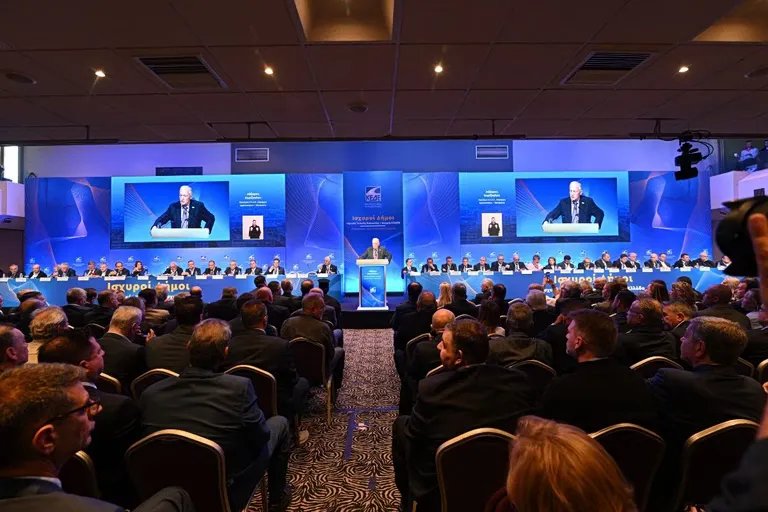
The discussions in Kalamata underscore a critical turning point for Greek local governance. The data provided by KEDE suggests that the current model of decentralization is fiscally unsustainable, characterized by a widening gap between responsibilities and resources. For municipalities to function as effective agents of development rather than mere administrative extensions of the state, a fundamental shift in how the central government allocates wealth is required. Achieving the proposed targets of 7% of state revenues and 8% of GDP would not only stabilize local services but also provide the structural foundation necessary for a truly decentralized and resilient Greek administration.