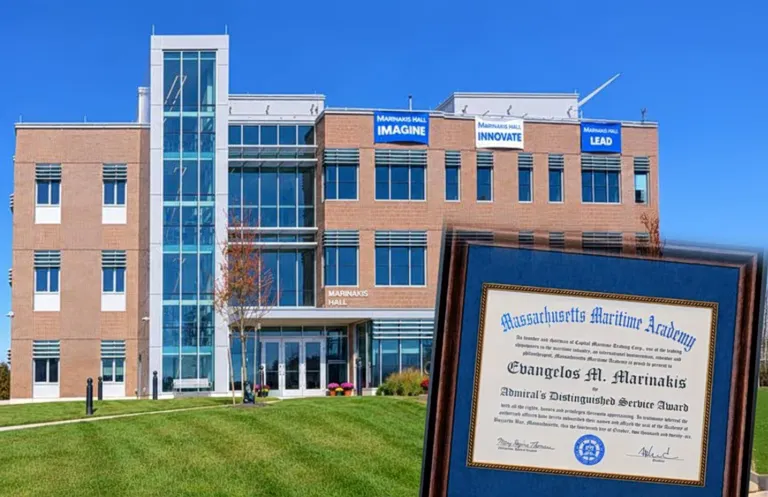
The Massachusetts Maritime Academy has officially inaugurated the Miltiadis Marinakis STEM center, a state-of-the-art facility designed to advance maritime technological education. Located at Buzzards Bay in Cape Cod, the 4,000-square-meter building was funded through a donation from Vangelis Marinakis, founder and president of Capital Maritime & Trading Corp. The facility integrates advanced laboratories for robotics, automation, and various sciences to prepare the next generation of maritime professionals. This article examines the technical capabilities of the new center, the evolving curriculum of the Academy, and the impact of private philanthropy on maritime training.
What are the technical capabilities of the new STEM center?
The Miltiadis Marinakis Hall provides 4,000 square meters of specialized educational space dedicated to Science, Technology, Engineering, and Mathematics (STEM). The facility is designed to serve the entire student body, regardless of their specific major, ensuring a foundational level of technical literacy across all maritime disciplines.
The building houses several highly specialized environments, including:
- A construction laboratory and a dedicated makerspace.
- An operations and control systems laboratory.
- An electronics laboratory.
- Specialized laboratories for biology, physics, and chemistry.
These facilities represent a significant upgrade in the Academy's ability to provide hands-on technical training. By centralizing these resources, the Academy can foster an interdisciplinary approach to maritime education, where students from different backgrounds interact within the same high-tech environments.
Advanced control and automation training
A key component of the new center is the operations and control systems laboratory. This space was developed specifically in response to feedback from the Academy's industry advisory council. According to Professor Mark Waylen, head of the Academy's engineering directions, the council identified a critical need for increased instruction in automation several years ago. As a result, the Academy is now expanding its curriculum to include advanced courses in automated control, programming, and robotics to meet modern industry standards.
How is the Massachusetts Maritime Academy evolving its curriculum?
The Academy is significantly expanding its academic scope beyond its traditional foundations. For much of its history, from 1891 until the early 1990s, the institution focused almost exclusively on two core disciplines: maritime transportation for Coast Guard officer certification and marine engineering for engineer certification.
Since the 1990s, the institution has diversified to include fields where its alumni already hold professional roles. This expansion covers several critical sectors of the modern blue economy:
- Energy systems.
- Port operations.
- Emergency management.
- Marine sciences.
Vice Admiral Francis McDonall, President of the Academy, noted during the inauguration that the new STEM center is a vital addition that allows the campus to implement educational advancements that were previously impossible due to a lack of dedicated infrastructure. The introduction of new directions, such as nuclear energy studies, further demonstrates the institution's commitment to staying at the forefront of maritime technological shifts.
What defines the educational philosophy of the Academy?
The Academy's pedagogical approach is built upon three distinct pillars designed to ensure high employability and leadership readiness. These pillars include rigorous academic studies, a practical component involving six months of real-world training on an educational vessel, and a structured leadership framework.
The institution maintains a disciplined environment that prepares students for the rigors of the maritime industry. While only 10% to 15% of the student body pursues a military career, the Academy applies a disciplined model to 100% of its students. This focus on discipline is intended to translate directly into professional leadership skills once they enter the workforce.
The student body currently consists of approximately 1,600 to 1,700 undergraduates. While about 50% of these students remain in the original maritime transportation and marine engineering tracks, the growing diversity of the student body reflects the institution's broader mission. The Academy also places a strong emphasis on the role of midshipmen as a "leadership laboratory," where they practice decision-making and management in a controlled yet demanding setting.
How does the Academy support graduate employment?
The Academy maintains an exceptionally high level of graduate absorption through intensive industry engagement. During the autumn and spring semesters, the campus hosts large-scale career exhibitions that attract over 150 organizations. These events bring more than 500 recruitment executives to the campus, offering over 1,000 job opportunities in both maritime and land-based sectors.
These recruitment drives target approximately 350 graduating seniors each year. Vice Admiral McDonall emphasized that the institution's return on investment is among the highest in the country, driven by the intense work ethic of the students and the direct connection to industry needs. This connection is evidenced by the fact that the new control systems laboratory was created specifically to address the technical requirements voiced by the maritime industry's representative council.
What is the impact of increasing female participation?
The Academy has seen a significant rise in the number of women entering maritime professions. Over the last decade, female enrollment has doubled from single-digit percentages. This progress follows a long historical struggle; women were effectively excluded from such institutions until a landmark legal decision in 1977 allowed the first female class to enroll.
Currently, women represent a growing segment of the student body, with approximately 80 women in every incoming class of 400 students. This increase in participation is not limited to entry-level roles; female graduates are increasingly moving into leadership positions within the industry. The Academy's success in this area is highlighted by the fact that the first female engineer on the institution's new training vessel is an alumna of the Academy.
Frequently asked questions
Who funded the new Miltiadis Marinakis STEM center?
The center was funded through a significant donation from Vangelis Marinakis, the founder and president of Capital Maritime & Trading Corp. His contribution enabled the construction of the 4,000-square-meter facility, which now bears his name as the Miltiadis Marinakis Hall.
What specific subjects are taught in the new facility?
The center supports a wide range of STEM subjects, including robotics, automated control, programming, electronics, biology, physics, and chemistry. These facilities are intended to serve all students at the Academy to ensure a broad technical foundation.
How many students attend the Massachusetts Maritime Academy?
The Academy currently has an undergraduate population of approximately 1,600 to 1,700 students. These students are spread across various specialties, including traditional maritime roles and newer fields like energy systems and marine sciences.
Is the Academy a military school?
While the Academy provides a disciplined environment similar to a military institution, it is not strictly a military school. Only about 10% to 15% of students intend to pursue military careers, though the discipline practiced is applied to all students to enhance employability.
How does the Academy ensure students find jobs?
The Academy hosts major career fairs twice a year, attracting over 150 companies and 500 recruiters. These events offer over 1,000 positions annually, providing a direct pipeline from the classroom to maritime and land-based professional roles.
Key takeaways
- The Miltiadis Marinakis STEM center provides 4,000 square meters of advanced maritime laboratory space.
- Funding for the new facility was provided by Vangelis Marinakis of Capital Maritime & Trading Corp.
- The Academy is expanding its curriculum into robotics, automation, and potential nuclear energy studies.
- Female enrollment has doubled over the last decade, reaching approximately 80 women per class.
- The institution hosts career fairs offering over 1,000 jobs to approximately 350 graduates annually.
The future of maritime technical education
The inauguration of the Miltiadis Marinakis Hall marks a pivotal moment for the Massachusetts Maritime Academy, bridging historical tradition with the technological demands of the future. By integrating advanced STEM facilities with a curriculum that responds directly to industry feedback, the Academy is positioning itself as a global leader in maritime training. The combination of private philanthropy and institutional adaptation ensures that the next generation of mariners will be equipped to navigate an increasingly automated and complex global maritime landscape.