Pavlopoulos Praises the Legacy of Saint Kosmas of Aetolia
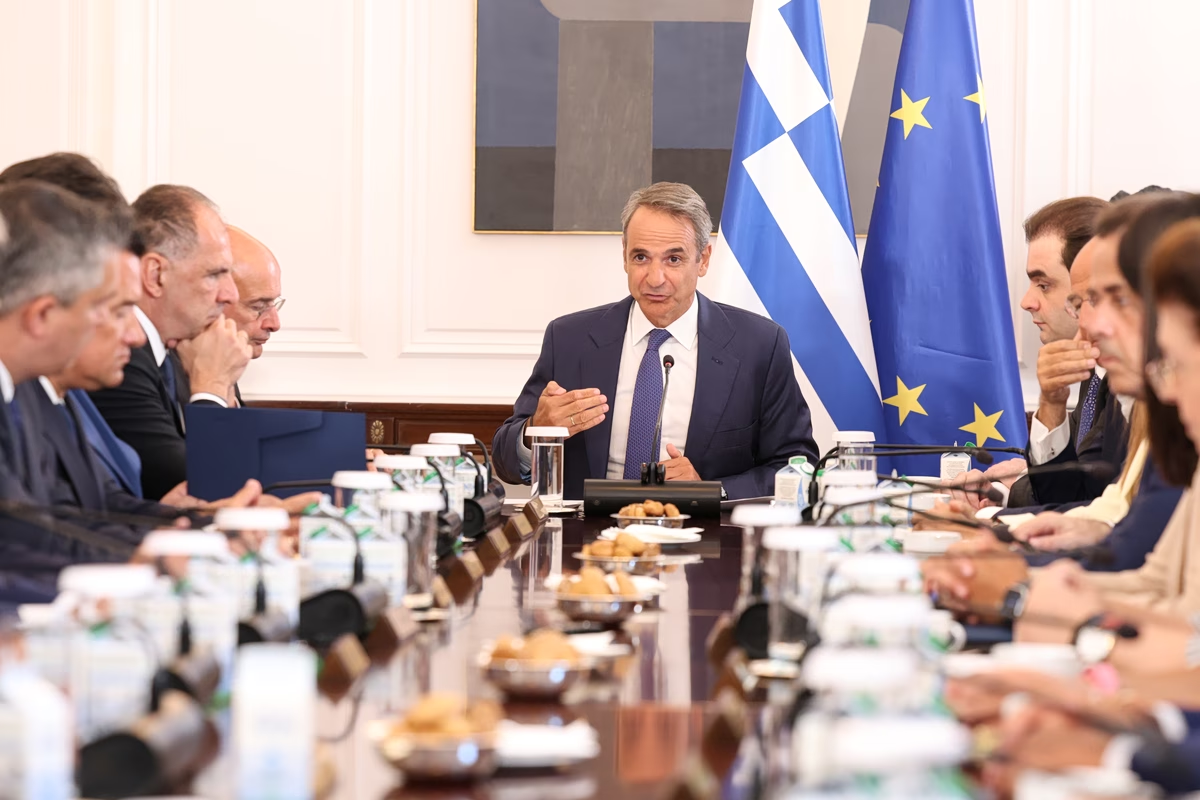
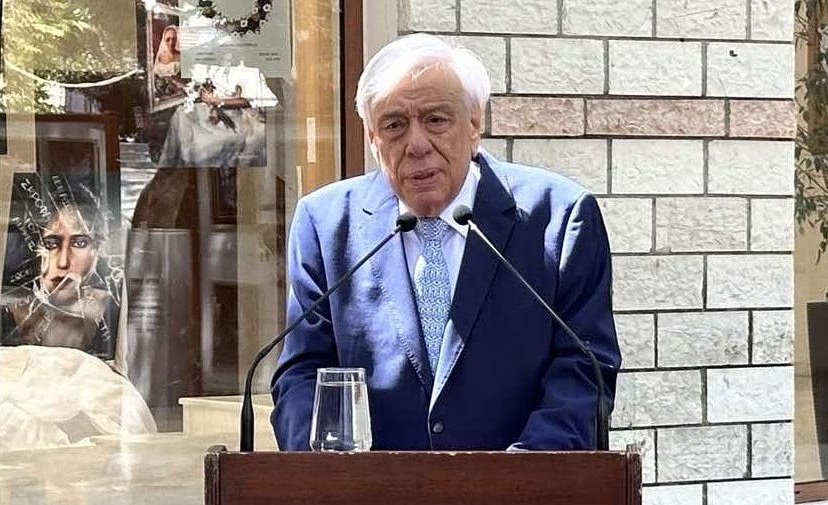
Former President of the Hellenic Republic, Prokopis Pavlopoulos, delivered remarks honoring Saint Kosmas of Aetolia, one of the most revered spiritual figures in Greek Orthodox tradition. Pavlopoulos emphasized the saint's monumental contributions to Christian teaching and described his life and work as a timeless model worthy of study and emulation by contemporary society.
The former president's comments came as part of a broader recognition of Saint Kosmas's enduring significance — not only within the Greek Orthodox Church but also in the wider cultural and educational landscape of the Greek nation. Pavlopoulos underscored that the saint's legacy transcends purely religious boundaries, touching upon questions of identity, community, and moral responsibility that remain deeply relevant today.
Who Was Saint Kosmas of Aetolia?
Saint Kosmas of Aetolia, also known as Kosmas the Aitolian or Equal-to-the-Apostles, was an 18th-century Greek Orthodox monk, missionary, and educator. Born around 1714 in the Aetolia region of central Greece, he dedicated much of his life to traveling across Greek-speaking territories and beyond, establishing schools and churches in villages and communities that had little access to formal education or religious instruction.
His missionary journeys took him throughout mainland Greece, the Ionian Islands, Macedonia, Epirus, and as far as Albania and parts of the broader Ottoman-controlled Balkans. Everywhere he traveled, Kosmas preached in the vernacular Greek language, ensuring that his teachings were accessible to ordinary people rather than confined to learned ecclesiastical circles.
Among his most enduring contributions was his tireless effort to promote Greek-language education at a time when Greek cultural and religious identity faced significant pressures under Ottoman rule. He is credited with founding or supporting the establishment of hundreds of schools, making him a central figure in the intellectual and spiritual revival of the Greek-speaking world during the period leading up to the Greek War of Independence.
A Spiritual and Educational Pioneer
Pavlopoulos specifically highlighted the saint's role as a spiritual giant whose influence extended well beyond liturgical practice. Saint Kosmas is remembered for his moral teachings, his emphasis on communal solidarity, and his insistence that education and faith were inseparable pillars of a dignified human life.
His preaching often addressed practical social issues of his time, including economic justice, the importance of honesty in trade, and the moral responsibilities of individuals toward their communities. This combination of spiritual guidance and civic awareness made him a uniquely impactful figure in 18th-century Greek society.
Saint Kosmas of Aetolia represents a towering intellectual and spiritual presence whose contributions to Christian teaching and Greek education continue to resonate across the centuries.
Pavlopoulos's remarks reflect a longstanding tradition in Greek public discourse of invoking historical religious figures as touchstones for national identity and values. Saint Kosmas, in particular, occupies a special place in this tradition due to the breadth of his activities and the democratic spirit of his mission — a mission aimed at empowering the most marginalized members of society through knowledge and faith.
Martyrdom and Canonization
Saint Kosmas was martyred in 1779 in what is now Albania, under circumstances that remain a subject of historical debate. He was hanged, with various accounts attributing his execution to Ottoman authorities or to other local interests threatened by his growing influence and the communities he was building.
He was canonized as a saint by the Ecumenical Patriarchate of Constantinople in 1961 and is venerated in the Greek Orthodox Church as Equal-to-the-Apostles — a title reserved for those whose missionary work is considered comparable in significance to that of the original apostles of Christianity. His feast day is celebrated on August 24th each year, a date that continues to draw commemorative events and reflections throughout Greece and the Greek diaspora.
Contemporary Relevance
The attention given to Saint Kosmas of Aetolia by a former head of state speaks to the continuing resonance of his legacy in modern Greek society. His story is frequently invoked in discussions about the relationship between faith and education, the preservation of cultural identity, and the responsibilities of individuals to serve their communities.
In recent years, his life has been the subject of renewed academic interest, with historians and theologians examining his work in the context of Enlightenment-era thought and its intersection with Orthodox Christian tradition. Some scholars argue that Kosmas represented a uniquely Greek synthesis of religious devotion and humanist educational values, anticipating the broader intellectual currents that would eventually fuel the Greek national revival of the early 19th century.
- Saint Kosmas founded or supported hundreds of schools across Greek-speaking territories.
- He preached in vernacular Greek to make his teachings accessible to ordinary people.
- He was martyred in 1779 and canonized by the Ecumenical Patriarchate in 1961.
- His feast day is observed on August 24th each year.
- He holds the title Equal-to-the-Apostles in the Greek Orthodox Church.
Pavlopoulos's tribute serves as a reminder of how historical religious figures can continue to shape public discourse and national consciousness long after their lifetimes. Whether viewed through a purely religious lens or a broader cultural and historical one, the life and work of Saint Kosmas of Aetolia remain a subject of significant importance to Greece and to the wider Orthodox Christian world.
As commemorations mark another anniversary of his feast day, figures across Greek public life continue to reflect on what his example offers to a contemporary society navigating complex questions of identity, education, and moral purpose.