Government Tensions Surface Ahead of Thessaloniki International Fair
The annual Thessaloniki International Fair (TIF), one of Greece's most politically significant events, has once again become the backdrop for sharp exchanges between the ruling New Democracy party and opposition forces. This year, however, the friction began even before the main speeches took place, following a scheduling development that caught government officials off guard and sparked a notable public reaction from a senior cabinet member.
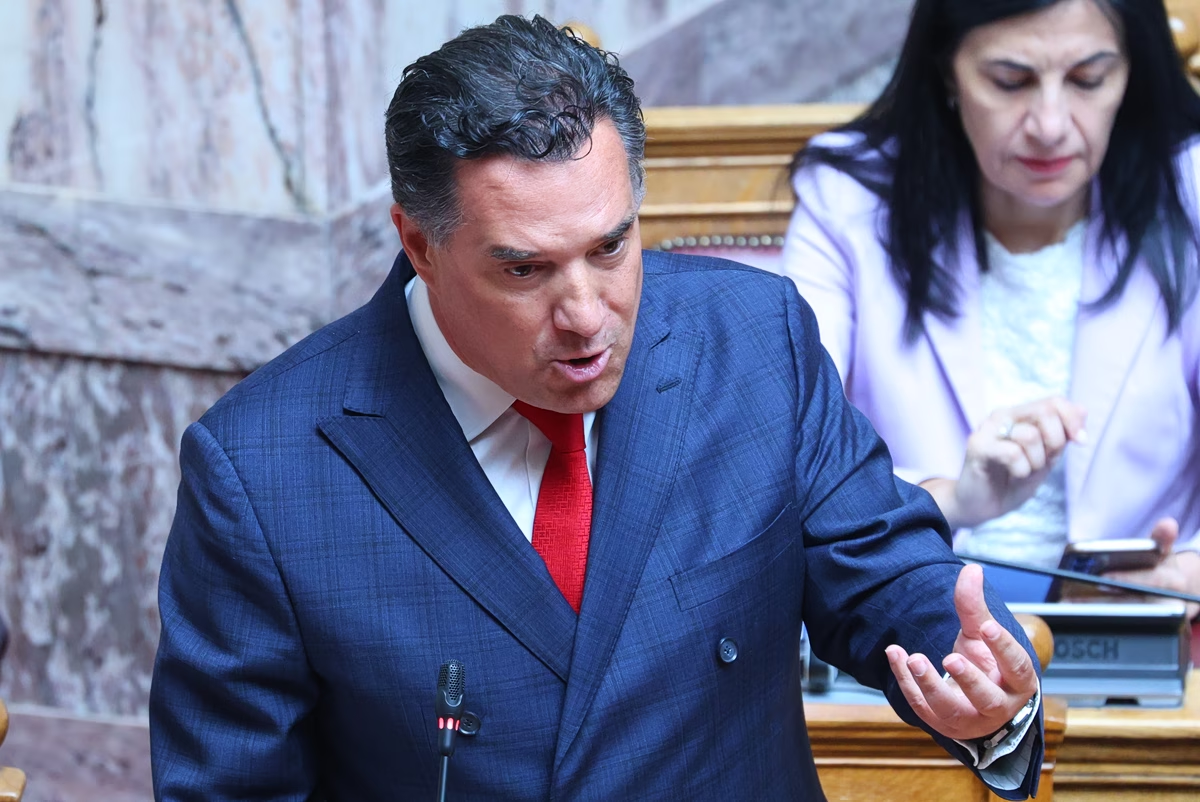
Health Minister Adonis Georgiadis made no effort to conceal his irritation after former Prime Minister and SYRIZA leader Alexis Tsipras managed to appear at the fair venue ahead of Prime Minister Kyriakos Mitsotakis. The sequence of appearances, which disrupted what had been expected to be the government's carefully orchestrated communications rollout at the event, appeared to touch a nerve within ruling party circles, with Georgiadis serving as one of the most vocal voices expressing displeasure.
A Scheduling Incident With Political Consequences
The issue at the center of the controversy involves the Greek Police (ELAS) and how the scheduling of various political figures' arrivals and movements at the fair was managed. According to reports, the sequencing of events allowed Tsipras to appear publicly before Mitsotakis, effectively breaking what the government had sought to maintain as a communications monopoly in the lead-up to the prime minister's keynote address — traditionally the most anticipated political moment of the Thessaloniki fair each year.
The TIF speech by the sitting prime minister is widely regarded as a key opportunity to set the political and economic agenda for the coming year. Governments typically invest significant effort in controlling the narrative surrounding this moment, making any disruption to that strategy a source of considerable sensitivity within ruling party ranks.
Georgiadis Takes Aim at Tsipras
Speaking publicly on the matter, Georgiadis did not hold back his criticism of Tsipras, using pointed language to characterize the former prime minister's behavior. His remarks suggested that the scheduling incident was not viewed within government circles as a mere logistical coincidence, but rather as a deliberate maneuver aimed at undermining the ruling party's grip on the pre-fair media narrative.
The minister's comments reflected a broader frustration within the government over what officials perceive as ongoing attempts by opposition figures to disrupt or overshadow the administration's flagship annual communications moment.
Georgiadis also took the opportunity to comment on the current state of PASOK and its leader Nikos Androulakis, suggesting that the center-left party and its head were failing to generate meaningful political momentum. His remarks were widely interpreted as an attempt to draw contrasts between what the government views as a fragmented and ineffective opposition landscape and its own position heading into the fair.
The Broader Political Context
The episode highlights the degree to which the Thessaloniki International Fair remains a fiercely contested political arena in Greece. Far from being simply a trade and business exhibition, the fair has for decades served as a critical platform where party leaders unveil policy proposals, court voters, and attempt to define the political conversation for the months ahead.
For opposition parties, the fair presents one of the few occasions where they can gain comparable media exposure to the prime minister, whose speech dominates coverage. This dynamic creates an incentive for opposition leaders to seek visibility in the surrounding days and to position themselves prominently in public consciousness before and after the government's main address.
For the ruling party, maintaining control over the timing and sequence of political appearances at the event is seen as part of a broader strategy to ensure that the prime minister's message reaches the public without being diluted or preceded by competing narratives from rival political figures.
Reactions and Political Fallout
The public spat between Georgiadis and the broader context surrounding Tsipras' appearance is unlikely to be the last word on the matter. Greek political observers noted that the minister's unusually sharp language pointed to a level of sensitivity within the government that could invite further scrutiny of how the fair's logistics were handled and who bears responsibility for the sequencing of events.
Opposition voices, meanwhile, are expected to use the government's reaction as evidence of what they describe as an overreaching desire to control public spaces and political narratives in ways that go beyond what would normally be expected in a healthy democratic environment. The debate over who gets to appear when and where at a major national event touches on questions of media access, political fairness, and institutional neutrality that resonate well beyond the specifics of this particular incident.
Looking Ahead
As the Thessaloniki International Fair continues, attention will inevitably shift toward the substance of the various policy announcements and speeches delivered by party leaders. Prime Minister Mitsotakis is expected to outline key government priorities in areas ranging from economic policy and investment to social welfare and digital transformation.
Opposition leaders, including both Tsipras and Androulakis, will seek to articulate alternative visions and to capitalize on any perceived weaknesses in the government's record or proposals. The public dispute over scheduling and appearances, while generating significant short-term media attention, will likely give way to a more substantive policy debate as the fair progresses.
What the episode does underscore, however, is that the competition for political visibility and narrative control in Greece remains intense, and that even seemingly procedural questions — such as the order in which political figures appear at a public event — can quickly become flashpoints in a highly charged and competitive political environment. The reactions from senior government figures like Georgiadis suggest that the stakes around the Thessaloniki fair are perceived as high enough to warrant unusually candid and emotionally charged public responses, even when that candor may itself become part of the story.