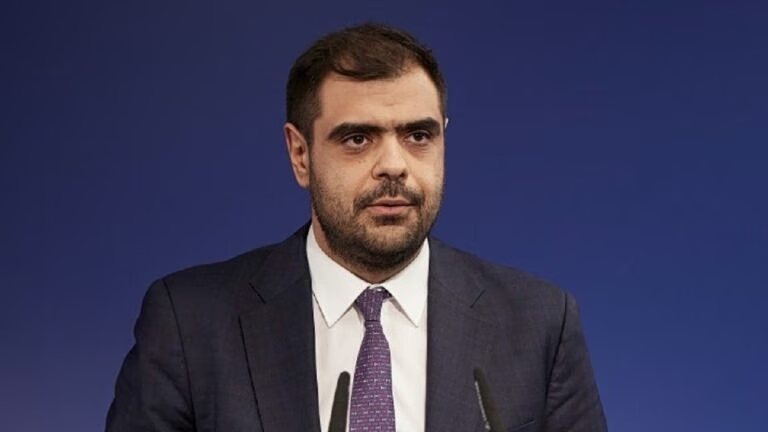
Marinakis Targets Tsipras in Latest Political Skirmish Before Thessaloniki Fair
Greek government spokesperson Pavlos Marinakis has renewed his public offensive against former Prime Minister Alexis Tsipras in what appears to be a recurring pattern of political friction between the ruling New Democracy party and the former SYRIZA leader. The latest episode was reportedly sparked by the announcement that the president of the Hellenic Police union, known as ELAS, is scheduled to address attendees at the Thessaloniki International Trade Fair before Prime Minister Kyriakos Mitsotakis takes the stage.
The Thessaloniki International Trade Fair, commonly referred to as ΔΕΘ or DEF, is one of Greece's most significant annual political and economic events. It traditionally serves as a platform where political leaders outline their visions and policy priorities, making the order and selection of speakers a matter of symbolic and practical importance. The scheduling decision appears to have irritated Marinakis, providing the occasion for yet another public rebuke directed at Tsipras.
A Pattern of Repeated Confrontations
This latest incident is far from an isolated occurrence. Over recent months, Marinakis has repeatedly used his role as the government's official voice to single out Tsipras for criticism, a pattern that political observers have begun to note with increasing interest. Critics of this approach argue that for a sitting government spokesperson, the frequency of these attacks on an opposition figure who no longer leads his party raises questions about the administration's political strategy.
Alexis Tsipras served as Prime Minister of Greece from 2015 to 2019, leading the left-wing SYRIZA party through a turbulent period that included contentious bailout negotiations with international creditors. Although he stepped down from the leadership of SYRIZA following the party's significant electoral defeat in the 2023 national elections, Tsipras remains an active and prominent voice in Greek public life and continues to attract considerable attention from both supporters and political opponents.
The Thessaloniki Fair as Political Battleground
The Thessaloniki International Trade Fair has long functioned as more than a commercial exhibition. For decades, it has served as a de facto political arena where party leaders, government officials, and influential figures from business and civil society converge each September. Prime ministerial addresses at the fair are closely followed events that often set the tone for the political season ahead, and the order of speakers can carry symbolic weight in terms of perceived prominence and legitimacy.
The involvement of the Hellenic Police union's leadership in this year's program and the question of their placement in the running order appears to have touched a nerve within government circles. While the specific details of Marinakis's remarks were not fully elaborated in available reports, the spokesperson's reaction suggests that the scheduling was interpreted as carrying broader political connotations rather than being a straightforward logistical arrangement.
Opposition Reactions and Political Context
The broader political context in Greece is one of ongoing tension between the ruling center-right New Democracy government and various opposition parties. SYRIZA itself has been undergoing an internal transformation since its 2023 election loss, with new leadership now at the helm of the party. Despite this, Tsipras continues to engage with public debate and remains a focal point for government criticism, a dynamic that some analysts interpret as an indication of the enduring influence he holds over a segment of the Greek electorate.
Opposition figures and political commentators have at various times questioned the rationale behind Marinakis's repeated focus on Tsipras, suggesting that directing sustained attention toward a former leader who no longer holds an official party position may inadvertently amplify his political relevance rather than diminish it. Others, however, view the government's stance as a calculated effort to keep a clear narrative boundary between its own record and that of the previous SYRIZA administration.
Spokesperson's Role and Political Communication
Government spokespersons in Greece, as in many parliamentary democracies, occupy a dual function. They serve both as official communicators of government policy and decisions, and as political actors who articulate the ruling party's broader messaging. The line between these two roles can sometimes become blurred, particularly when spokespeople engage in direct attacks on opposition personalities rather than focusing primarily on policy communication.
Marinakis's tenure as government spokesperson has been marked by an assertive communication style, frequently involving pointed criticism of political opponents. His recurrent targeting of Tsipras, however, has stood out as particularly notable given the frequency and apparent personal intensity of the exchanges, leading some observers to describe the phenomenon as something closer to a personal fixation than standard political discourse.
Looking Ahead to the Trade Fair
As the Thessaloniki International Trade Fair approaches, attention will inevitably focus on the speeches and public appearances of key political figures, including Prime Minister Mitsotakis. The annual event offers the government an opportunity to present its achievements and outline future plans before a broad national audience, and it equally provides opposition figures with a platform to challenge the administration's record.
Whether the controversy surrounding the speaker order will have any lasting impact on the political atmosphere at this year's fair remains to be seen. What is clear is that the lead-up to the event has already generated political noise, with Marinakis's latest remarks ensuring that the dynamic between the government and Tsipras remains in the public conversation.
Greek political observers will be watching closely to see whether the trade fair serves as an occasion for further confrontations or whether the focus will shift to substantive policy debates on issues such as the economy, public security, and social affairs — topics that consistently rank among the top concerns of Greek citizens heading into the autumn political season.