Mitsotakis Sets the Stage for a Pre-Election Push
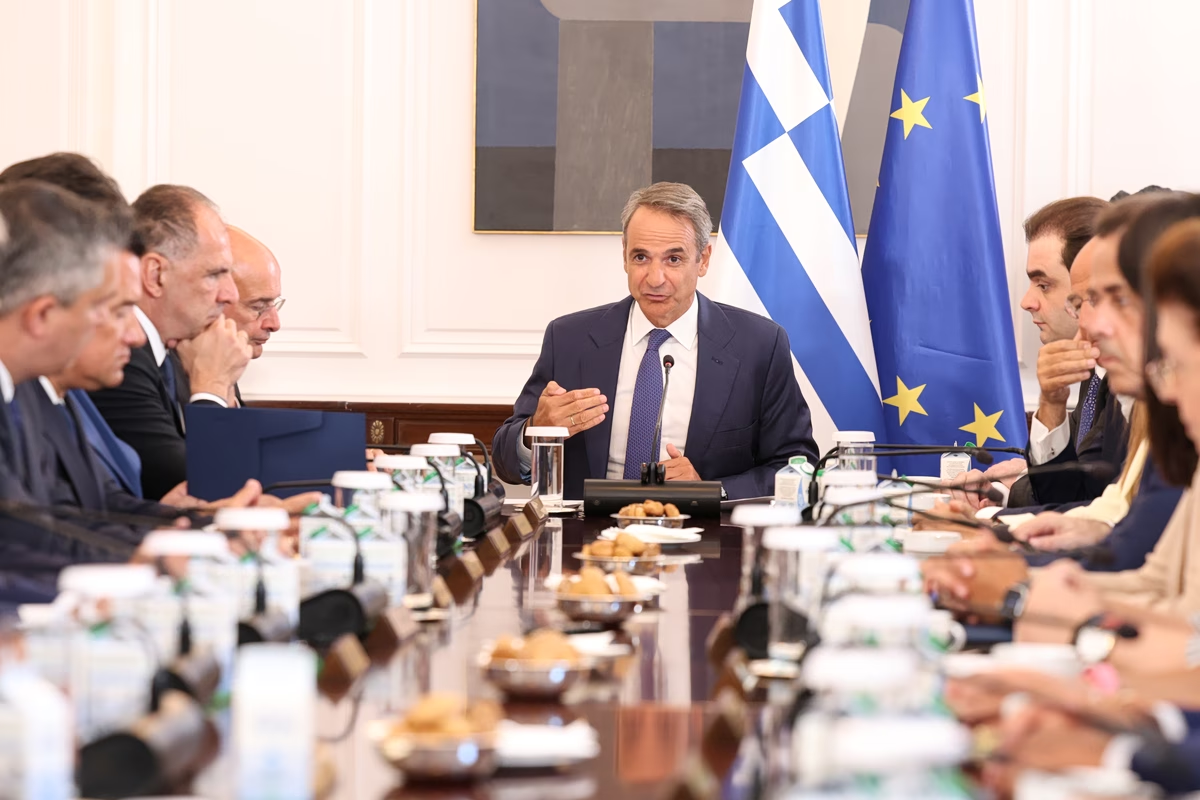
Greek Prime Minister Kyriakos Mitsotakis appears to be carefully constructing a political narrative that is expected to carry his party through to the next general election. Speaking at a recent cabinet meeting that carried a distinctly pre-electoral tone, the Prime Minister sought to frame his government's achievements as the only viable path toward sustainable development for Greece, while simultaneously sharpening his rhetoric against the opposition.
The meeting, which observers noted felt more like a campaign launch than a routine governmental session, underscored how Mitsotakis is increasingly focused on public messaging as much as policy delivery. With the Thessaloniki International Fair on the horizon, the timing of his remarks is widely seen as deliberate and strategically calculated.
Government Record Presented as a Development Blueprint
At the heart of Mitsotakis's address was an effort to cast his administration's record in the most favorable light possible. The Prime Minister framed a series of policy decisions and economic outcomes as evidence that his government had steered Greece along the correct path — one that he argued no alternative political force would have been capable of maintaining.
This kind of retrospective self-assessment is a common feature of administrations approaching an electoral cycle, but analysts noted that the tone was notably assertive. Rather than simply listing accomplishments, Mitsotakis appeared keen to make a broader ideological argument: that the choices made under his leadership were not merely successful, but were, in fact, the only rational and responsible options available to Greece.
Critics and opposition figures were quick to push back against this framing, arguing that the rosy portrayal of the government's performance glosses over persistent challenges facing Greek society, including cost-of-living pressures, housing affordability, and ongoing concerns about institutional transparency and the rule of law.
Thessaloniki Fair to Serve as Platform for 2030 Roadmap
One of the most significant announcements to emerge from the cabinet session was a preview of what Mitsotakis intends to unveil at the upcoming Thessaloniki International Fair. The Prime Minister signaled that the event — traditionally one of the most important platforms for Greek political and economic announcements — will be used to present a comprehensive roadmap outlining his vision for Greece through to 2030.
This forward-looking framework is expected to encompass a range of policy areas, potentially including infrastructure investment, digital transformation, green energy transition, and social welfare reforms. By anchoring his messaging to a long-term vision rather than short-term fixes, Mitsotakis appears to be positioning himself and his party as the stewards of Greece's future, not merely managers of its present.
The Thessaloniki Fair has historically served as a key moment for Greek prime ministers to set the political agenda for the year ahead. Using it to launch a multi-year plan is a strategic move that allows the ruling party to shift the conversation away from criticisms of the past and toward aspirations for what comes next.
Fresh Signals Toward Turkey
Beyond domestic politics, Mitsotakis also took the opportunity to send a new message in the direction of Turkey. While details of the specific content of this signal remain limited, the fact that the Prime Minister chose to address the Greek-Turkish relationship within the context of a cabinet meeting with strong pre-electoral undertones is itself notable.
Relations between Greece and Turkey have long been a sensitive and politically consequential issue for Greek governments. Any movement — whether toward greater dialogue or a firmer stance — carries both diplomatic and domestic political implications. Mitsotakis's decision to revisit this topic at this juncture suggests that foreign policy, and the Greek-Turkish dynamic in particular, may also feature prominently in the governing party's electoral messaging going forward.
Opposition Comes Under Fire
Alongside his defense of the government's record, Mitsotakis directed pointed criticism at the opposition. This offensive posture is consistent with a broader shift in the governing party's communications strategy, which has increasingly moved from a defensive mode — responding to criticism — to a more aggressive one that seeks to discredit alternative political platforms.
The Prime Minister's attacks on the opposition served a dual purpose: reinforcing the idea that only his party is equipped to lead Greece forward, while simultaneously seeking to raise doubts about the credibility and competence of rival political forces. This two-pronged approach — praising one's own record while undermining the competition — is a classic electoral playbook move that signals the government is now firmly in campaign mode.
Political Context and Electoral Outlook
Greece is not immediately facing a scheduled election, but political cycles in the country have a tendency to accelerate, and the current atmosphere suggests that both the ruling party and the opposition are already positioning themselves accordingly. The combination of retrospective justification, a forward-looking policy vision, and intensified attacks on political rivals paints a clear picture of a government that is thinking well beyond the next few months.
For Mitsotakis personally, the coming period represents both an opportunity and a challenge. His administration has overseen a period of notable economic recovery and has benefited from Greece's improved standing in international financial markets. At the same time, governance controversies, social inequality concerns, and the political aftershocks of several high-profile incidents have kept domestic tensions elevated.
The Road Ahead
As the Thessaloniki International Fair approaches, all eyes will be on how the Prime Minister chooses to frame Greece's future. The unveiling of a roadmap to 2030 will be closely scrutinized — not only by political opponents looking for weaknesses to exploit, but also by citizens and investors seeking clarity about the direction of economic and social policy.
What is already clear is that Mitsotakis has made a deliberate choice to shift into a higher political gear. Whether the narrative he is building will prove persuasive to a broad enough segment of the Greek electorate remains to be seen. But the groundwork for that effort is unmistakably being laid, one cabinet meeting and one carefully crafted speech at a time.