Diamantopoulou Draws a Clear Line After Aide's Controversial Comments
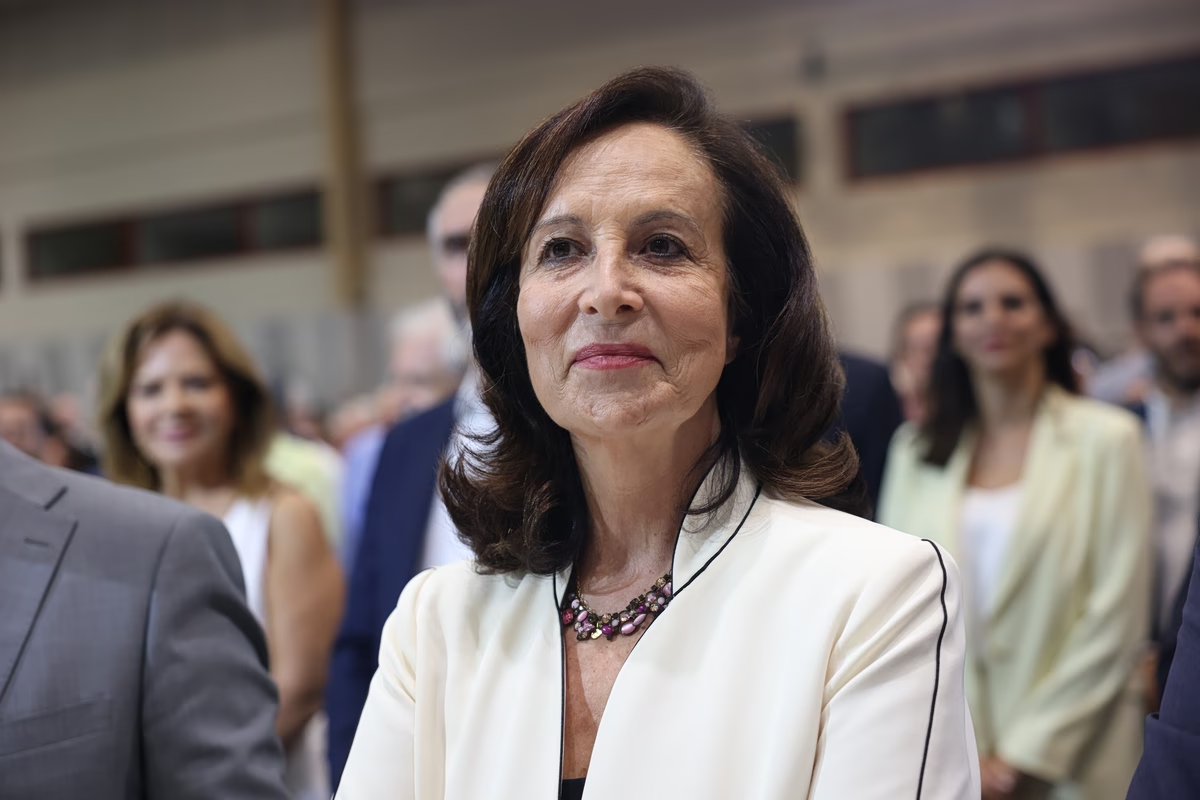
Anna Diamantopoulou, a prominent figure in the Greek center-left political landscape, moved swiftly to publicly distance herself from remarks made by one of her close associates, Lousko, who had directed sharp criticism toward Haris Doukas. In a firm and carefully worded statement, Diamantopoulou made clear that no one within her circle is authorized to speak on her behalf without her explicit consent.
"No one speaks in my name," she stated plainly, leaving little room for ambiguity about where she stands in relation to the controversy that had been stirred by Lousko's comments. The statement was widely interpreted as a direct repudiation of her associate's conduct, effectively withdrawing any implied endorsement of his words or actions.
A Focus on Political Goals Amid Internal Tensions
Rather than dwelling on the internal friction that the episode had exposed, Diamantopoulou chose to redirect attention toward what she described as the central mission of her political effort. "Our goal is political change and the defeat of New Democracy," she emphasized, framing the broader objective as something that should not be overshadowed by interpersonal disputes or unauthorized commentary from those around her.
The statement reflects a deliberate attempt to keep her political project on track, particularly at a time when internal cohesion and message discipline are considered essential. By addressing the matter head-on and refusing to allow the controversy to fester, she signaled a preference for clarity and accountability within her own ranks.
Who Are the Key Figures Involved?
Haris Doukas is a well-known political figure in Greece, and any criticism directed at him from within competing political camps tends to attract significant attention. The fact that Lousko, operating in proximity to Diamantopoulou's political circle, made remarks that were deemed provocative enough to warrant a public disavowal underscores the sensitivity of intra-party and inter-party dynamics in the current Greek political environment.
Diamantopoulou herself has long been associated with reform-oriented politics in Greece. A former minister and European Commissioner, she has been working to carve out a distinct political identity that appeals to voters disillusioned with both the ruling center-right and the traditional center-left. Her decision to publicly rebuke the tone set by Lousko suggests she is intent on maintaining a certain standard of political discourse around her campaign and public image.
The Significance of the Disavowal
Public disavowals of this nature are relatively uncommon in Greek politics, where political teams often close ranks even when internal disagreements arise. The fact that Diamantopoulou chose to address the situation openly rather than quietly managing it behind the scenes speaks to her broader communication strategy, which appears to prioritize transparency and directness.
Political analysts have noted that such moments can be double-edged. On one hand, they demonstrate leadership and the willingness to hold those in one's orbit accountable. On the other hand, they can inadvertently highlight internal divisions or raise questions about the vetting and management of political associates.
Opposition to New Democracy Remains Central
Despite the controversy, Diamantopoulou was quick to reaffirm that her overarching political purpose has not changed. Her emphasis on defeating New Democracy — the ruling center-right party led by Prime Minister Kyriakos Mitsotakis — signals that she views the upcoming political period as a critical window for the opposition to present a credible and unified alternative.
Her positioning places her in a competitive space alongside other center-left and progressive voices in Greece who are all vying for relevance in a political landscape that has seen significant shifts in recent years. By keeping the focus on defeating the ruling party rather than engaging in internal squabbles, she appears to be attempting to project the image of a composed and strategically focused leader.
Implications for Her Political Campaign
The episode serves as a reminder of the challenges that political figures face when managing their public image in an era of rapid information dissemination. A single set of remarks from an associate can quickly spiral into a news cycle that distracts from a carefully crafted political message. Diamantopoulou's prompt response suggests an awareness of this dynamic and a desire to control the narrative before it could do further damage.
Her statement also carries an implicit warning to others in her circle: public comments that deviate from the agreed-upon political line or that cross certain boundaries of decorum will not be tolerated or endorsed. This kind of internal discipline, when communicated publicly, can help to reassure supporters and potential voters that the political operation is being run with a level of seriousness and professionalism.
Broader Context: Greek Politics at a Crossroads
Greece continues to navigate a complex political environment in which the major parties are engaged in a sustained battle for public trust. New Democracy has faced its own challenges on multiple fronts, from economic pressures to governance controversies, while the opposition remains fragmented and searching for a figure or coalition capable of mounting a serious electoral challenge.
In this context, moments like the one involving Lousko and Doukas, while seemingly minor in isolation, can take on outsized importance. They become tests of a political figure's character, judgment, and ability to lead. Diamantopoulou's handling of the situation — swift, clear, and refocused on the larger political mission — will likely be assessed by observers as an indicator of how she might handle more significant challenges should she advance further in the political arena.
Whether this episode ultimately strengthens or complicates her standing remains to be seen, but her response has at minimum demonstrated a willingness to confront uncomfortable situations directly rather than allowing them to define her political narrative on someone else's terms.