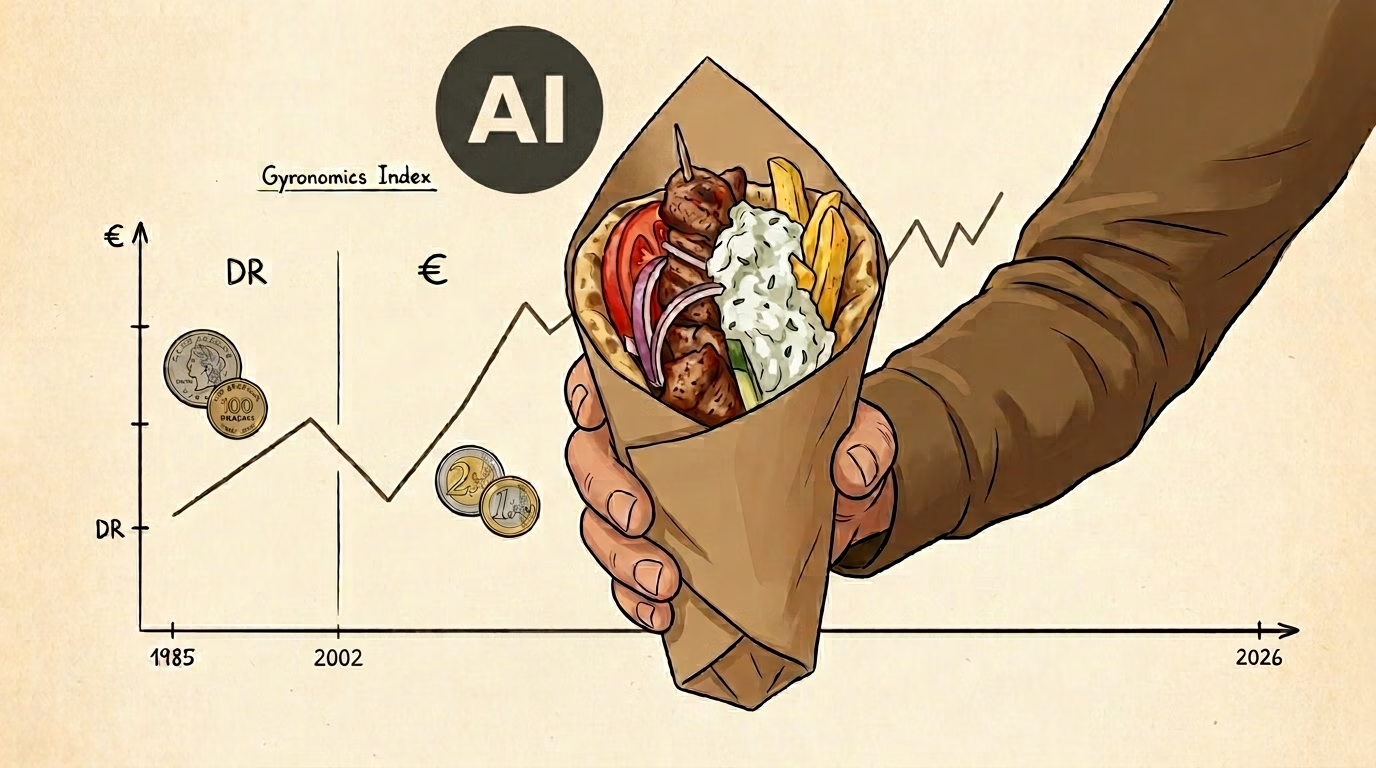
Forget Gold and Bitcoin — Greece Has the Gyro Index
Economic indicators come in many forms. There are consumer price indexes, GDP growth rates, currency exchange benchmarks, and inflation trackers. But a new concept emerging from Greece is taking a decidedly more appetizing approach to measuring economic reality. Known as Gyronomics, this data-driven — and admittedly tongue-in-cheek — application proposes using the price of a pita gyro as a standard unit for measuring purchasing power across Greece.
While the idea carries a sense of humor, it draws on a well-established economic principle popularized decades ago by one of the world's most recognized fast-food items. The result is a uniquely Greek lens through which to examine wages, inflation, and consumer affordability.
The Big Mac Index: A Brief Background
To understand Gyronomics, it helps to first understand its inspiration. The Big Mac Index was introduced by The Economist magazine in 1986 as an informal way of assessing whether currencies are trading at appropriate levels relative to one another. The premise is straightforward: since a Big Mac hamburger is sold in dozens of countries using largely the same recipe and ingredients, its price in local currency can be used to compare how far money stretches in different economies.
Over time, the index evolved beyond a lighthearted editorial gimmick into a genuinely useful tool referenced by economists and financial analysts worldwide. It has been used to illustrate concepts such as purchasing power parity (PPP), currency overvaluation or undervaluation, and the relative cost of living across different countries.
Gyronomics applies this same foundational logic — but replaces the American burger with one of Greece's most iconic and widely consumed street foods: the pita gyro.
Why the Pita Gyro?
The choice of the pita gyro as the central unit of measurement is not arbitrary. As a staple of Greek street food culture, the gyro is consumed across virtually all demographics and geographic regions of the country. It is sold in small neighborhood shops and large urban eateries alike, making it one of the most consistently priced and universally accessible food items in the Greek market.
Much like the Big Mac, the pita gyro requires a combination of ingredients — meat, bread, vegetables, sauces, and spices — whose prices are themselves subject to broader market forces including energy costs, supply chain conditions, agricultural output, and import expenses. As a result, the price of a single gyro acts as a composite snapshot of multiple economic pressures at once.
When the cost of a gyro rises significantly in a short period of time, it reflects real-world inflation touching everyday consumers. When regional price differences emerge, they can point to disparities in local purchasing power, tourism-driven pricing, or variations in operational costs between urban and rural areas.
What Gyronomics Actually Measures
The Gyronomics application collects and analyzes price data for pita gyros from different locations across Greece. By comparing these prices over time and across regions, it aims to offer a ground-level view of how inflation is affecting ordinary consumers — particularly those for whom a gyro represents a routine, affordable meal.
The concept taps into an economic framework known as purchasing power parity, which essentially asks: how much of a given product can a person buy with their income? If wages stagnate while gyro prices climb, purchasing power declines. If gyro prices remain stable while salaries increase, consumers are effectively better off than official statistics might immediately suggest.
In this way, Gyronomics serves not only as a price tracker but also as an informal indicator of how well — or how poorly — everyday Greeks are managing their financial lives relative to the cost of a basic, familiar food item.
The Economic Context Behind the Concept
Greece has experienced significant economic turbulence over the past decade and a half. Following a severe sovereign debt crisis that began around 2010, the country underwent years of austerity measures, wage cuts, pension reductions, and structural reforms. More recently, like much of Europe, Greece has contended with rising energy prices, post-pandemic supply chain disruptions, and persistent inflationary pressure on consumer goods.
Within this context, tracking the price of everyday items like the gyro takes on added significance. Official inflation statistics, while important, can sometimes feel abstract or disconnected from lived experience. A tool that translates economic change into the price of a familiar food item makes those shifts tangible and relatable for a wider audience.
The gyro, priced at just a few euros in most Greek establishments, has itself seen notable price increases in recent years — a reflection of rising costs for meat, fuel used in transportation and cooking, and the broader inflationary environment. These changes have not gone unnoticed by consumers, and Gyronomics seeks to document and contextualize them.
Humor as a Vehicle for Economic Literacy
One of the more notable aspects of Gyronomics is its deliberate use of humor and cultural familiarity to engage people with economic concepts that might otherwise feel inaccessible. By anchoring the discussion in something as universally loved as the pita gyro, the tool lowers the barrier to entry for people who might otherwise tune out conversations about purchasing power parity or consumer price indexes.
This approach reflects a broader trend in economic communication, where accessible metaphors and everyday comparisons are increasingly used to help general audiences make sense of complex financial data. When people understand that their money buys fewer gyros than it did two years ago, the concept of declining purchasing power becomes immediate and concrete rather than theoretical.
A Lighthearted Indicator With Serious Implications
While Gyronomics is presented with a wink, the underlying questions it raises are entirely serious. How is inflation affecting the average Greek household? Are wages keeping pace with the rising cost of everyday essentials? Do price differences between cities and islands reflect exploitation of tourists, or genuine differences in operating costs?
These are questions that economists, policymakers, and consumers all have a stake in answering. The fact that Gyronomics frames them through the lens of a beloved street food does not diminish their importance — if anything, it may make more people willing to engage with them.
Whether Gyronomics will evolve into a widely recognized economic tool or remain a culturally resonant novelty remains to be seen. But as a concept, it captures something genuine about the relationship between food prices and financial well-being — and it does so in a way that feels unmistakably, and deliciously, Greek.