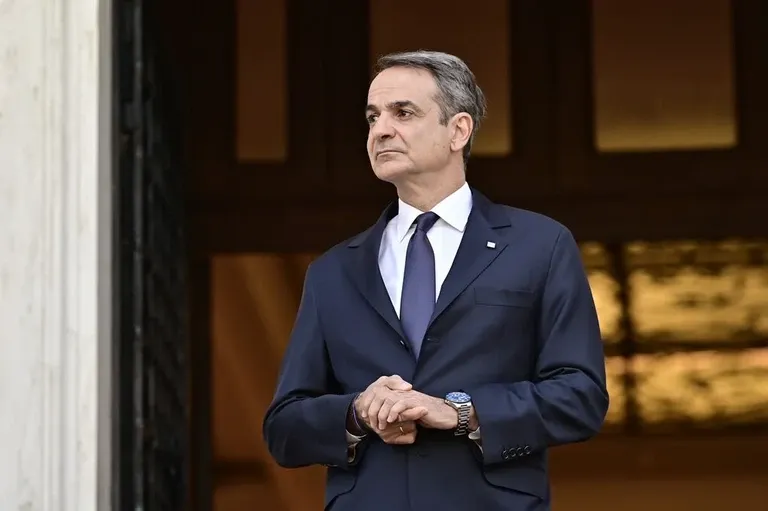
Kyriakos Mitsotakis has declared that his tenure as Prime Minister of Greece will coincide with his departure from Parliament. "The moment my career as Prime Minister ends, my parliamentary path will also end," stated the leader of New Democracy. This decision marks a departure from the political trajectory of his father, Konstantinos Mitsotakis, and sets a specific benchmark for his leadership, with Mitsotakis identifying a 25% electoral threshold as the minimum required to maintain his position and continue his political influence.
A definitive end to his parliamentary career
Kyriakos Mitsotakis has formally linked the conclusion of his role as Prime Minister to his exit from the Hellenic Parliament. By stating that his parliamentary journey will end simultaneously with his premiership, he has established a clear boundary for his future political involvement. This move is seen by analysts as a strategic distinction from several of his predecessors and contemporaries in Greek politics.
The announcement has prompted various interpretations regarding his relationship with other political figures. Some observers viewed the statement as a subtle critique of former Prime Ministers, such as Antonis Samaras, who remains in Parliament, or Kostas Karamanlis, who withdrew from the legislature in 2023. It also stands in contrast to Alexis Tsipras, who resigned his parliamentary seat in 2025 and is currently seeking re-entry through a new political party.
Furthermore, this decision represents a break from the traditional path taken by his father, Konstantinos Mitsotakis, who maintained his seat in Parliament until 2004. By choosing to step away from the legislature entirely upon leaving office, Mitsotakis is signaling a different approach to political legacy and post-premiership life.
Political precedents and interpretations
The Prime Minister's statement does not exist in a vacuum, as it touches upon the varying ways Greek leaders have managed their transitions of power. While government officials have clarified that the remarks were a personal declaration of intent rather than a jab at predecessors, the timing and phrasing have fueled political debate. The distinction between staying in the legislature to influence policy or leaving to pursue other roles remains a central theme in the current political discourse.
The 25% threshold for New Democracy leadership
Kyriakos Mitsotakis has identified a 25% electoral result as the benchmark for his continued leadership of the New Democracy party. He stated that if the party were to receive less than this percentage, it would constitute a poor electoral result, and he would not hesitate to accept responsibility for the outcome. This threshold serves as a self-imposed metric for political accountability and party success.
This metric provides a clear indicator of how the Prime Minister views the legitimacy of his leadership in relation to voter support. By setting a specific figure, he has provided a measurable standard for both his supporters and his critics to evaluate the performance of his administration and his command over the party base.
| Metric | Value/Threshold | Context |
|---|---|---|
| Leadership Accountability | 25% electoral support | Minimum required to avoid taking responsibility for a "bad result" |
| Political Stance | Exit from Parliament | To occur simultaneously with the end of premiership |
Shifting tactics in political rhetoric
The Prime Minister is currently transitioning his communication strategy, moving away from highly polarized attacks toward a more moderated tone. This shift follows a period where he utilized sharp rhetoric against Alexis Tsipras, including allegations regarding the "extortion of secretaries" during the 2019 Penal Code reforms. Recognizing that such aggressive tactics could produce a "boomerang effect," Mitsotakis is attempting to lower the political temperature.
This change in tone is particularly evident in his response to recent controversial statements made by fellow party member and Health Minister Adonis Georgiadis. Georgiadis had made unproven allegations regarding "insider trading" involving Alexis Tsipras. While Mitsotakis did not explicitly disavow Georgiadis's comments, he sought to distance the official party position from such individual rhetoric.
"We are a party with many officials; everyone has their own way of expressing themselves," Mitsotakis noted, adding that the party strives for a level of homogeneity in its political discourse. He expressed a desire to avoid what he termed a "cockfight" between himself and Tsipras, suggesting that such personal disputes do not serve the interests of the Greek citizens.
Managing internal party diversity
The Prime Minister's approach to managing internal dissent and varying rhetorical styles is a delicate balancing act. By acknowledging that individual members may succumb to the temptation of aggressive speech, he is attempting to maintain party unity without alienating the more hardline elements of his base. This strategy aims to preserve the official party line while providing a buffer against the fallout of individual outbursts.
Addressing criticisms regarding tax evasion enforcement
Kyriakos Mitsotakis has defended his administration against internal and external criticisms concerning the timing of high-profile tax evasion investigations. Critics have questioned why it took seven years of governance for significant cases involving "big fish" to come to light. The Prime Minister countered this by asserting that the systematic effort to combat tax evasion began significantly earlier than the current period of high-profile results.
He argued that the first four-year term was occupied by different types of challenges, and that the current momentum is the result of work initiated years ago. According to Mitsotakis, these efforts have yielded tangible results, specifically citing an increase of 9 billion euros in revenue over the four-year period due to the intensified fight against tax evasion.
This defense seeks to reframe the narrative from one of delayed action to one of long-term, systematic progress. By providing a specific figure—9 billion euros—he attempts to ground his claims in economic reality rather than political rhetoric, aiming to prove that the administration's structural changes are finally producing measurable outcomes.
Reflections on a seven-year premiership
After seven and a half years in office, Kyriakos Mitsotakis expressed a sense of personal liberation regarding his role. He stated that he feels he has achieved significant milestones and has successfully elevated Greece to a higher international and domestic level. "I believe I have achieved many things, I believe that I have taken Greece to a level and raised it," he remarked.
This sense of accomplishment comes at a time when internal criticism regarding the administration's conduct is intensifying. Despite the rising political pressure, the Prime Minister appears focused on his legacy and the perceived upward trajectory of the country under his leadership. His comments suggest a leader who is looking toward the conclusion of his tenure with a sense of completed objectives, even as the political landscape remains highly contested.