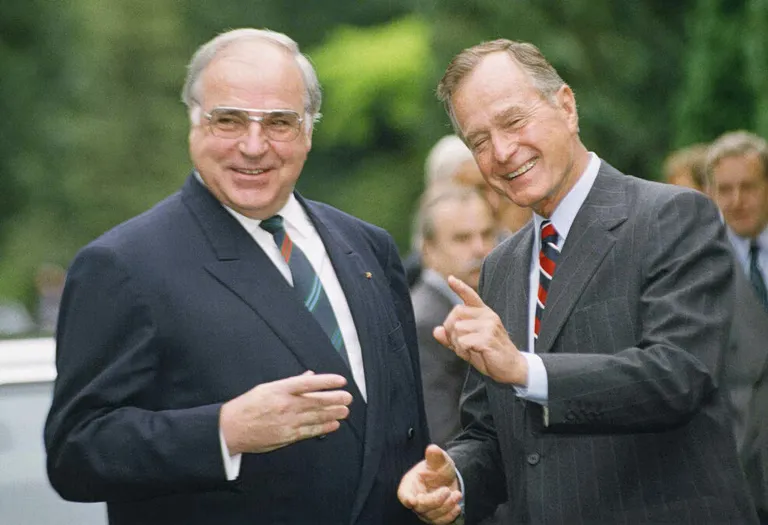
A White House declassified document has revealed a 1992 conversation between German Chancellor Helmut Kohl and US President George H.W. Bush regarding the name dispute involving the former Yugoslav Republic of Macedonia (FYROM). The transcript shows Kohl expressing a desire to assist Greek Prime Minister Konstantinos Mitsotakis on the naming issue, with President Bush affirming that Mitsotakis was "very important." This historical record provides insight into the geopolitical alignments and the strategic prioritization of stability in the Balkans during the early 1990s.
Geopolitical alignments in the 1992 Balkan negotiations
The declassified White House document details a high-level dialogue held on March 21, 1992, between German Chancellor Helmut Kohl and US President George H.W. Bush, with US Secretary of State James Baker present. The conversation centered on the diplomatic challenges posed by the independence of former Yugoslav republics and the specific naming dispute between Greece and the newly independent Macedonia. According to the transcript, the leaders discussed the timing of international recognition for various Balkan states while navigating the complexities of the Greek position.
During the exchange, President Bush noted that he had spoken with Prime Minister Konstantinos Mitsotakis, stating that they could not afford to delay too much time. Bush indicated a plan to proceed with the recognition of Slovenia and Croatia in early April, followed by Bosnia, while suggesting that the international community would then need to engage with the Greeks to resolve the Macedonian naming issue. This sequence highlights the strategic order in which the United States intended to manage the rapid disintegration of Yugoslavia.
The role of international mediation
The dialogue also included insights into the diplomatic efforts being made by other European nations. Secretary of State James Baker noted that Portugal was actively attempting to mediate a settlement and was examining the naming issue. While Kohl expressed a desire to assist Mitsotakis, he noted the necessity of not delaying the broader regional stabilization process for an extended period. The primary objective shared by the leaders was the stabilization of the Mitsotakis government, which Bush described as being "very important" to the regional order.
The strategic divergence in European recognition policies
The document provides historical context for the divergent paths taken by European powers regarding the recognition of Balkan states. While the Bantendeer Committee had established criteria for the recognition of former Yugoslav republics, the actual implementation of these recommendations varied significantly due to political pressures. Macedonian analysts and historians have characterized the actions of major powers during this period as an example of "realpolitik," where political expediency often outweighed the formal criteria set by international committees.
The tension between formal diplomatic processes and rapid political action is evident in how different nations approached the recognition of sovereignty. While some sought a consensus-based approach through the European Community, others acted with greater autonomy to secure specific geopolitical outcomes. This period was marked by a focus on conflict zones, which some critics argue led to the marginalization of the peaceful self-determination process sought by the Macedonian population.
| Entity/Person | Role in 1992 Context | Stated Position/Action |
|---|---|---|
| Helmut Kohl | German Chancellor | Expressed intent to assist Mitsotakis on the naming issue. |
| George H.W. Bush | US President | Emphasized the importance of the Mitsotakis government. |
| James Baker | US Secretary of State | |
| Konstantinos Mitsotakis | Greek Prime Minister | Engaged in discussions regarding the Macedonian name. |
| Bantendeer Committee | Established criteria for recognition of Yugoslav republics. |
Historical criticisms of German diplomatic maneuvers
The declassified records have fueled long-standing criticisms regarding Germany's role in the recognition of Balkan states. Macedonian political analysts point to the period of 1991 and 1992 as a time when European diplomacy, largely influenced by German interests, yielded to Greek demands, thereby delaying the official recognition of Macedonia. This delay is often cited as a significant hurdle in the country's early years of independence.
According to reports from the Macedonian news outlet mkd.mk, former diplomat Risto Nikovski has argued that Germany effectively obstructed the international recognition of Macedonia. Nikovski highlights several key points regarding the German approach:
- Germany bypassed the consensus of the European Community, which held that there should not be individual recognition of the Yugoslav republics.
- Berlin took the initiative to recognize Slovenia and Croatia on December 23, 1991, despite the existence of the Bantendeer Committee's recommendations.
- The unilateral recognition of these states was seen by some as undermining the committee's findings, which had suggested Macedonia and Slovenia for recognition.
These actions were viewed by critics as a demonstration of newly unified Germany's growing power, often at the expense of the stability and recognition of other emerging states in the region.
The legacy of the "realpolitik" approach in the Balkans
The debate over the "realpolitik" of the early 1990s continues to influence how the history of the Balkan conflicts is interpreted. The declassified transcript serves as a primary source for those arguing that the diplomatic decisions made by the US and Germany were driven more by the need to stabilize specific governments and regions than by a strict adherence to international legal frameworks. The emphasis on the importance of the Mitsotakis administration suggests that maintaining the status quo in Greece was a high priority for Washington and Berlin.
The consequences of these decisions are still felt in the long-term diplomatic relations between Greece and North Macedonia. The delay in recognition, which lasted for decades until the Prespa Agreement, is frequently linked back to the strategic decisions documented in these 1992 conversations. For historians, the document clarifies the intent of the era's most powerful leaders: to manage the collapse of Yugoslavia through a lens of regional stability and the preservation of key strategic alliances.