Casualties Mount on Both Sides as Drone Warfare Escalates
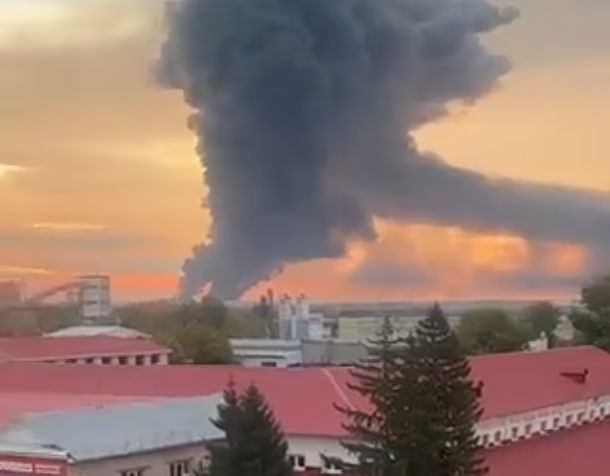
The ongoing conflict between Russia and Ukraine has taken another deadly turn, with at least six people reported killed in Russia following a series of Ukrainian drone strikes. Civilians are said to be among the victims, raising fresh concerns about the human cost of an air campaign that has steadily grown in scale and reach over recent months.
Officials and local authorities in the affected Russian regions confirmed the fatalities, though the exact locations and circumstances of the strikes were still being assessed at the time of the reports. Emergency services were deployed to the impacted areas, and authorities indicated that additional injuries had also been recorded alongside the confirmed deaths.
A Pattern of Escalating Cross-Border Strikes
The latest strikes are part of a broader pattern of mutual aerial bombardment that has characterized this phase of the conflict. Ukraine has increasingly relied on long-range drone technology to carry out strikes deep inside Russian territory, targeting infrastructure, military installations, and logistical hubs. Russia, in turn, has continued its own extensive missile and drone campaign against Ukrainian cities and energy infrastructure.
This tit-for-tat dynamic has placed civilian populations on both sides at heightened risk. Reports from Ukraine have similarly documented ongoing casualties resulting from Russian aerial attacks, with residential areas, hospitals, and power stations among the targets regularly struck by Russian forces.
The Role of Drone Technology in Modern Warfare
Unmanned aerial vehicles have become a defining feature of the Russia-Ukraine war, reshaping the battlefield in significant ways. Both sides have deployed drones ranging from commercially available consumer models repurposed for military use to sophisticated long-range strike systems capable of traveling hundreds of kilometers to their targets.
Ukraine's drone program, in particular, has expanded dramatically since the early stages of the conflict. Ukrainian-made and internationally supplied drones have allowed Kyiv to project force beyond the front lines, striking targets that would otherwise be inaccessible given Russia's significant advantages in conventional air power. These strikes are seen by Ukrainian military planners as a means of disrupting Russian supply chains and degrading the enemy's capacity to sustain its offensive operations.
Russia, meanwhile, has deployed its own arsenal of drones, including Iranian-supplied Shahed-series loitering munitions, which have been used extensively in large-scale overnight attacks on Ukrainian urban centers. Both governments have accused the other of deliberately targeting civilians, allegations that have been a persistent source of international condemnation throughout the war.
Civilian Impact and Humanitarian Concerns
The confirmation that civilians are among those killed in the latest Russian strikes has drawn renewed attention to the humanitarian dimensions of the conflict. Aid organizations and human rights groups have repeatedly warned that escalating aerial warfare endangers non-combatants on both sides of the border, and have called on all parties to take greater precautions to protect civilian lives.
In Russia, communities near the Ukrainian border have lived under the threat of drone attacks for an extended period, with some areas experiencing disruptions to daily life, evacuations, and damage to local infrastructure. Russian authorities have at various points declared states of emergency in border regions and imposed temporary airspace restrictions in response to ongoing drone threats.
In Ukraine, the situation for civilians has been particularly dire, with large-scale Russian missile strikes having caused widespread destruction to the national power grid. Millions of Ukrainians have faced prolonged periods without electricity, heating, and running water, particularly during the winter months, as a direct result of sustained attacks on energy infrastructure.
International Reactions and Diplomatic Context
The international community continues to monitor the escalation with concern. Western governments that have supported Ukraine with military aid and economic assistance have generally refrained from commenting specifically on individual Ukrainian strikes inside Russian territory, though some have noted that under international law, Ukraine retains the right to defend itself, including by striking military targets on enemy soil.
Russia has consistently condemned the drone attacks as acts of terrorism and has used them to justify its own continued military campaign. Moscow has also sought to draw international attention to what it describes as Western complicity in Ukrainian strikes, arguing that weapons and technology supplied by NATO countries are being used to attack Russian civilians.
Diplomatic efforts to bring about a ceasefire or negotiated settlement have made little visible progress. Multiple international mediators have attempted to facilitate dialogue between the parties, but fundamental disagreements over territorial control, sovereignty, and security guarantees have prevented any substantive breakthrough. Both sides have signaled a willingness to continue fighting, and military analysts have suggested that the conflict is unlikely to reach a resolution in the near term.
Looking Ahead
As the conflict enters yet another phase of intensified aerial activity, the prospects for de-escalation remain uncertain. Military analysts note that drone warfare, by its nature, can be difficult to contain once both sides have developed significant capabilities and established patterns of retaliatory strikes. The risk of further civilian casualties on both sides remains high, and the humanitarian situation in Ukraine in particular continues to deteriorate.
International organizations, including the United Nations, have repeatedly called for an immediate cessation of hostilities and for the protection of civilian infrastructure in line with international humanitarian law. Whether those calls will be heeded amid the current escalatory cycle remains an open question, as both Russia and Ukraine show no immediate signs of stepping back from their respective aerial campaigns.
The deaths reported in Russia represent only the latest chapter in a conflict that has already claimed tens of thousands of lives and displaced millions of people since Russia launched its full-scale invasion of Ukraine in February 2022. With no end in sight, the toll on human life on both sides continues to mount.