Legal distinctions between cable laying and sovereign rights
The fundamental legal principle governing the Great Sea Interconnector (GSI) is that cable laying and preliminary seabed surveys constitute a freedom of the high seas. Petros Liakouras, a professor of International Law at the University of Piraeus, emphasizes that these activities are protected under Article 79 of the 1982 UN Convention on the Law of the Sea (UNCLOS), which functions as customary international law. This means that the process of connecting Greece and Cyprus via an electrical cable is legally distinct from the sovereign rights a coastal state holds over its seabed resources.
While a coastal state possesses sovereign rights regarding the exploration and exploitation of natural resources on its continental shelf, these rights do not extend to prohibiting the laying of submarine cables. The primary obligation of a vessel conducting such research or cable laying is to ensure it does not interfere with the existing research or exploitation activities of the coastal state. Conversely, while a coastal state may take reasonable measures to protect its interests, it cannot legally block the laying of the cable itself.
The hierarchy of maritime rights
To understand the friction in the Eastern Mediterranean, one must distinguish between different maritime regimes. The following table outlines the distinction between cable laying and sovereign exploitation rights as described by Liakouras:
| Activity Type | Legal Status | Requirement for Coastal State Consent |
|---|---|---|
| Submarine Cable Laying | Freedom of the high seas (UNCLOS Art. 79) | No permission or consent required |
| Seabed Resource Exploration | Sovereign right of the coastal state | Requires state authorization |
| Marine Scientific Research | Subject to coastal state jurisdiction | Requires specific regulatory compliance |
Liakouras notes that even in areas where the continental shelf is disputed or undefined, the freedom to lay cables remains intact. The absence of a permit from a coastal state does not diminish that state's sovereign rights, nor does the legality of the cable laying depend on the delimitation of maritime boundaries.
The controversy surrounding the Kasos incident and Turkish intervention
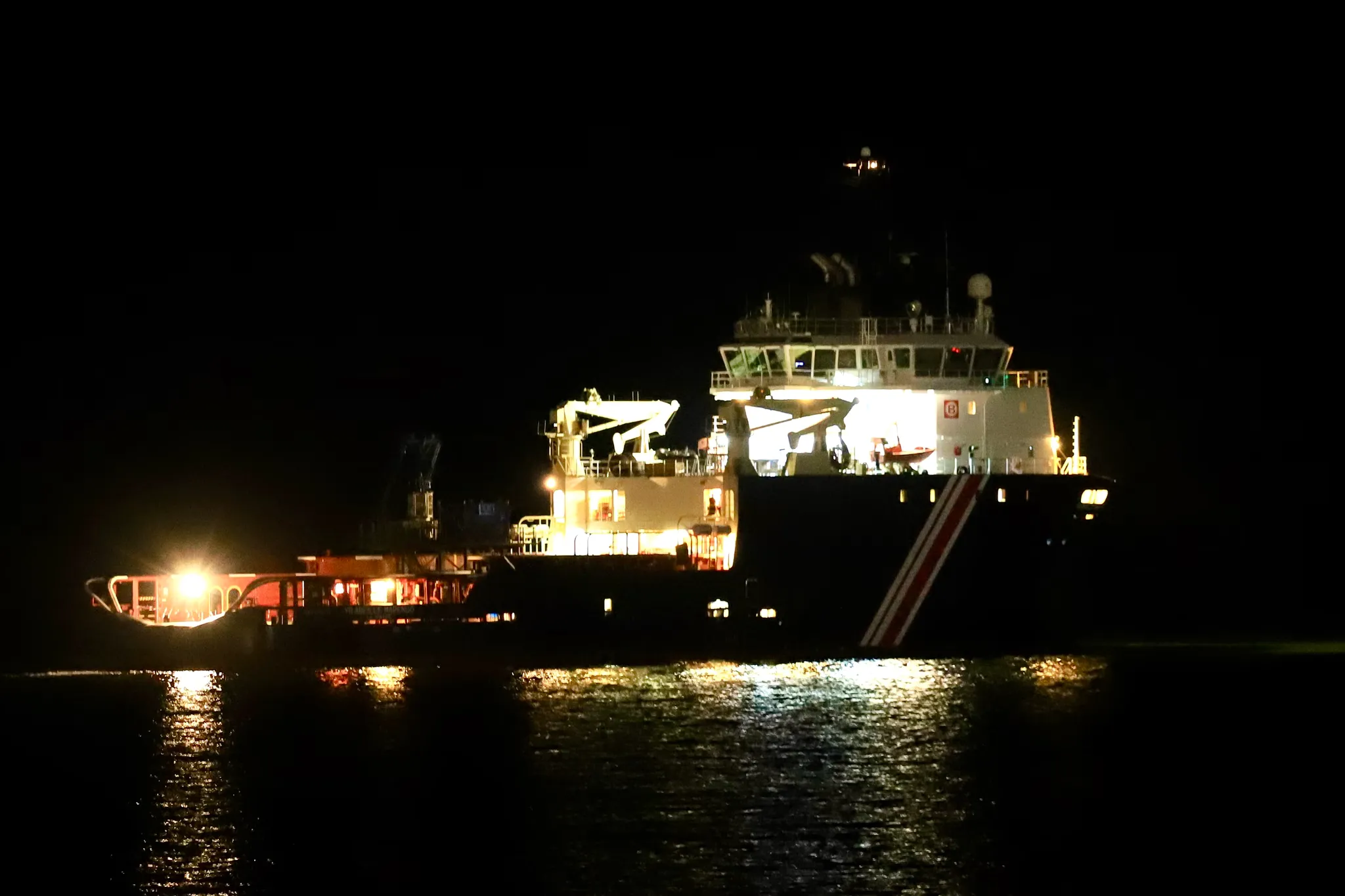
The legal complexity of the GSI project has been exacerbated by political disputes, most notably the incident near Kasos in July 2024. During this episode, Turkey deployed six frigates to interrupt seabed research, claiming that an Italian research vessel, the Ievoli Relume, was operating on the Turkish continental shelf without authorization. Turkey insisted that prior notification and approval were required for such activities.
Liakouras argues that the Greek response to the Kasos incident, while intended to defend national interests, relied on a flawed legal premise. Instead of asserting the freedom of cable laying and research under international law, Greece argued that the research was taking place within a continental shelf already delimited by an agreement with Egypt. According to Liakouras, this approach created a negative precedent by shifting the argument toward maritime delimitation rather than the inherent rights of cable installation.
By focusing on the Egyptian-Greek delimitation, the debate was inadvertently moved into the realm of sovereign rights over the seabed. This allowed Turkey to frame the issue as a violation of its purported continental shelf, even though the research in question did not involve the exploitation of natural resources. Liakouras suggests that had Greece strictly invoked the freedom of the high seas, the legal standing for the GSI would have been much harder for Turkey to contest.
Diplomatic solutions and the role of French communication
Recent developments involving French diplomatic communication have provided a temporary workaround for the technical challenges facing the GSI project. A recent diplomatic statement from France has been characterized by Liakouras as an unnecessary "diplomatic solution" that, while serving a practical purpose, falls outside the strict framework of maritime law.
The French communication served as a way to allow a French vessel to proceed with its research without causing immediate legal or political friction for the contractor, Meridian. Liakouras views this as a diplomatic maneuver to protect the project's progress and the interests of the contracting company, rather than a requirement dictated by international law. He maintains that the Greek government was correct in refusing to formally notify Ankara, thereby preserving legal formalities and avoiding the implication that Turkey has a right to grant permission.
Impact of Turkish demands on regional stability
Turkey has consistently demanded notification and authorization for any activity in the Aegean and Eastern Mediterranean. These demands have led to several instances of tension:
- July 2024: Intervention near Kasos regarding the Turkish-Libyan memorandum area.
- February 2025: Demands for permits in non-delimited areas north of Crete.
- The Vernes Protocol (1976): Turkey has invoked this protocol to demand restraint in activities on the continental shelf.
Liakouras points out that Turkey's insistence on these protocols is an attempt to control activities that are, by international law, freedoms of the sea. This creates a cycle of obstructions in areas where maritime boundaries are either disputed or overlapping, directly impacting the timeline and security of energy projects like the GSI.
The Great Sea Interconnector (GSI) project scope
The Great Sea Interconnector is a massive infrastructure project designed to link the electrical grids of Greece and Cyprus, with long-term potential to connect to Israel. The project is supported by European Union funding and is viewed as a critical component of regional energy security and the green transition.
Despite its importance, the project has faced significant delays. Liakouras traces these delays back to 2004, when Turkish intervention first sought to disrupt seabed research. The GSI is not merely a technical endeavor but a geopolitical one, where the laying of a cable becomes a tool for asserting or challenging maritime claims. Because the cable traverses various sections of the seabed—some of which are subject to overlapping claims between Greece, Cyprus, and Turkey—the legal distinction between "cable laying" and "resource exploitation" remains the most vital defense for the project's continuity.