A Phone Call That Changed Everything
On a quiet morning in October 2024, author Julie Summers received an unexpected phone call at her home in Oxford. The message on the other end of the line was startling: a boot containing the skeletal remains of a human foot had been discovered high on the north face of Mount Everest. For Summers, this was not simply breaking news — it was deeply personal, and it reopened a chapter of history that had remained frozen in uncertainty for nearly a hundred years.
The discovery immediately set off a chain of investigations, conversations, and careful analysis among mountaineering historians, forensic specialists, and the descendants of climbers who vanished on the world's highest peak during the early twentieth century. What followed was an effort to piece together the identity of the individual whose remains lay preserved by the mountain's extreme cold and altitude for decades.
The North Face and Its Long History of Mystery
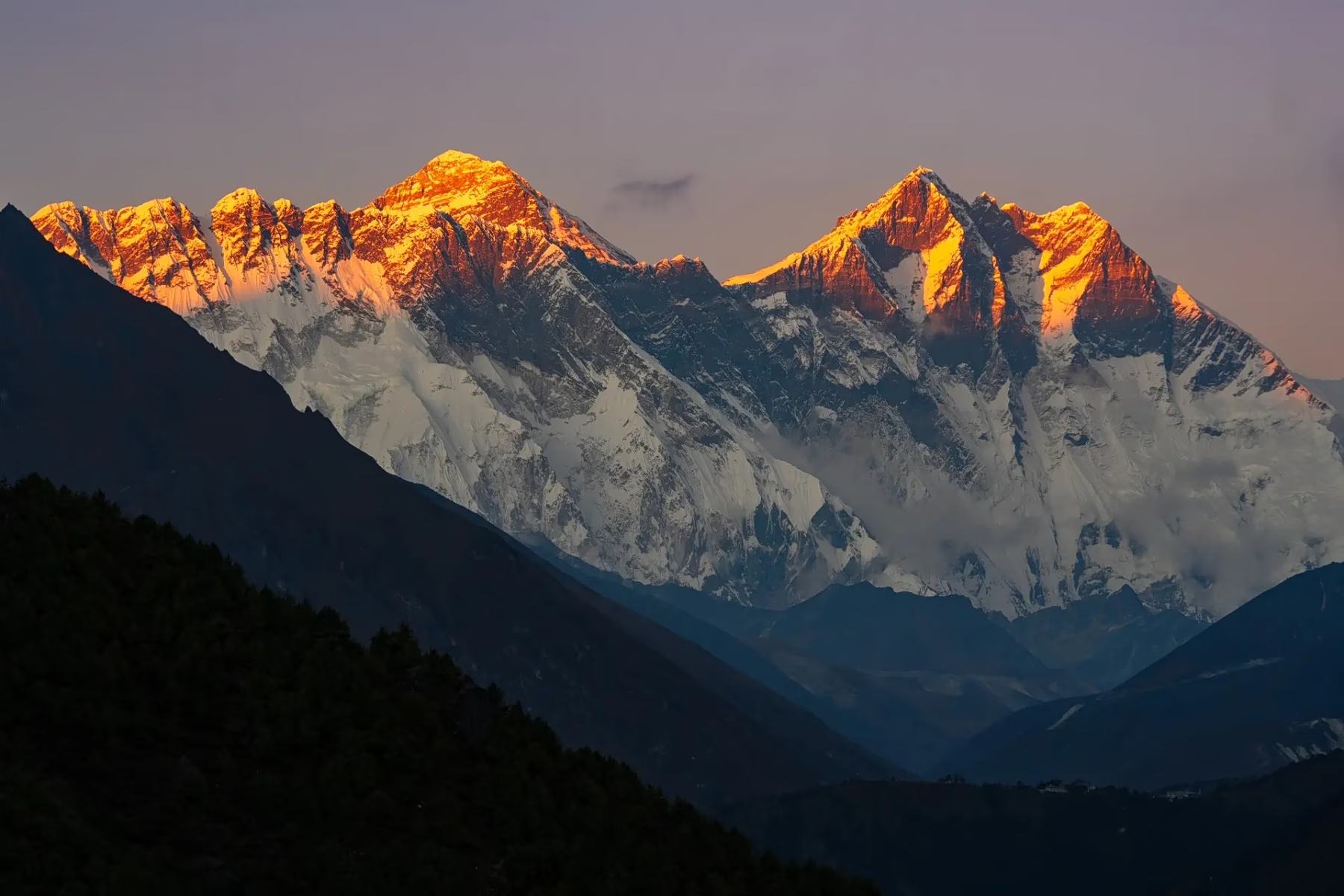
Mount Everest's north face has long been associated with some of the most haunting episodes in the history of exploration. The high-altitude terrain, brutal weather conditions, and sheer inaccessibility of its upper slopes have meant that many climbers who perished there were never recovered. The mountain, in effect, became a graveyard suspended above the clouds — its freezing temperatures and glacial movements capable of preserving and simultaneously concealing human remains for extraordinary lengths of time.
The boot and its grim contents were found at an elevation where only a handful of expeditions had ever operated during the early decades of Everest climbing. This geographical detail immediately narrowed the field of possible identities and pointed investigators toward a specific era of mountaineering — the pioneering British expeditions of the 1920s, which included some of the most celebrated and tragic attempts to reach the summit before it was first officially conquered in 1953.
Echoes of the 1920s Expeditions
The 1920s represented a golden age of Himalayan exploration, characterized by extraordinary ambition and inadequate equipment by modern standards. British climbers, driven by a post-World War One sense of national purpose and adventure, repeatedly attempted to scale Everest via its northern approaches through Tibet. Several of these expeditions ended in death, with climbers lost to avalanches, falls, exposure, or exhaustion at extreme altitude.
Among the most famous of these tragedies was the disappearance of George Mallory and Andrew Irvine in June 1924. The two men were last seen ascending toward the summit before clouds obscured them from view. Whether they reached the top before perishing remains one of the great unanswered questions of exploration history. Mallory's body was eventually found in 1999 by a search expedition, but Irvine's remains were never conclusively located — a fact that has fueled speculation and investigation ever since.
The 2024 discovery renewed questions about Irvine in particular. Researchers and historians began examining whether the boot and its contents could be connected to him or to any other climber from that era whose fate remained unknown.
Forensic Analysis and the Challenge of Identification
Identifying human remains recovered from high-altitude environments presents significant scientific challenges. Decades of exposure to ultraviolet radiation, freeze-thaw cycles, and physical displacement by moving ice and snow can degrade biological material considerably, even when the cold preserves it in ways that would be impossible at lower elevations.
Specialists involved in examining the recovered material faced the task of determining not only who the individual might have been, but also approximately when they died and under what circumstances. Clothing and equipment offer important clues, as mountaineering gear evolved considerably between different expeditions of the early twentieth century. The style, construction, and materials of a boot, for instance, can help date a find to within a specific decade or even a particular expedition.
DNA analysis, when viable biological material is available, can potentially match recovered remains to living descendants of missing climbers. However, such testing requires well-preserved cellular material, which is not always available depending on the condition of the remains. Investigators must often combine multiple lines of evidence — physical, historical, and biological — to reach a credible conclusion.
The Human Dimension of an Extraordinary Find
Beyond the scientific and historical dimensions of the discovery, the find carries profound emotional weight for the families of climbers who were lost on Everest generations ago. For descendants still living, the possibility that a long-missing ancestor has finally been located after nearly a century brings a complicated mixture of closure, grief, and renewed connection to a story that has been passed down through family histories.
Julie Summers, whose own family connection to the early Everest expeditions made the phone call she received particularly significant, represents one thread in this broader human story. Writers, historians, and researchers who have dedicated years to studying these expeditions found themselves once again drawn into a mystery that refuses to fully resolve itself, even as new evidence emerges from the mountain's slowly shifting ice.
Everest as Keeper of Secrets
The 2024 discovery serves as a reminder that Mount Everest continues to hold within its glaciers and snowfields the physical remnants of its own history. As climate change accelerates the melting of high-altitude ice across the Himalayas, it is increasingly likely that additional remains, equipment, and artifacts from past expeditions will be exposed. Scientists and mountaineering organizations have noted that this process, while providing new historical information, also raises complex ethical questions about how such discoveries should be handled.
Should remains be recovered and returned to families, or left in place out of respect for those who died in the mountains they loved? Who bears the responsibility for such decisions — national governments, mountaineering bodies, or the families themselves? These questions have no simple answers, and different cultures and communities hold varying views on how the dead should be treated.
A Mystery Still Unfolding
As of the time of reporting, the full identity of the individual whose remains were found in the boot on Everest's north face had not been definitively established. Analysis was continuing, and those involved in the investigation were proceeding carefully to ensure that any conclusion reached would be supported by sufficient evidence.
What is certain is that the discovery has once again brought global attention to the extraordinary stories of the men and women who risked — and in many cases gave — their lives attempting to climb the world's highest mountain during an era when doing so required not only physical endurance but an almost incomprehensible tolerance for the unknown. Whether or not this particular mystery is ultimately solved, it speaks to the enduring power of Everest to capture the human imagination, and to the mountain's silent capacity to hold its secrets for far longer than any of us can easily comprehend.