Introduction to a New Era of Astronomical Observation
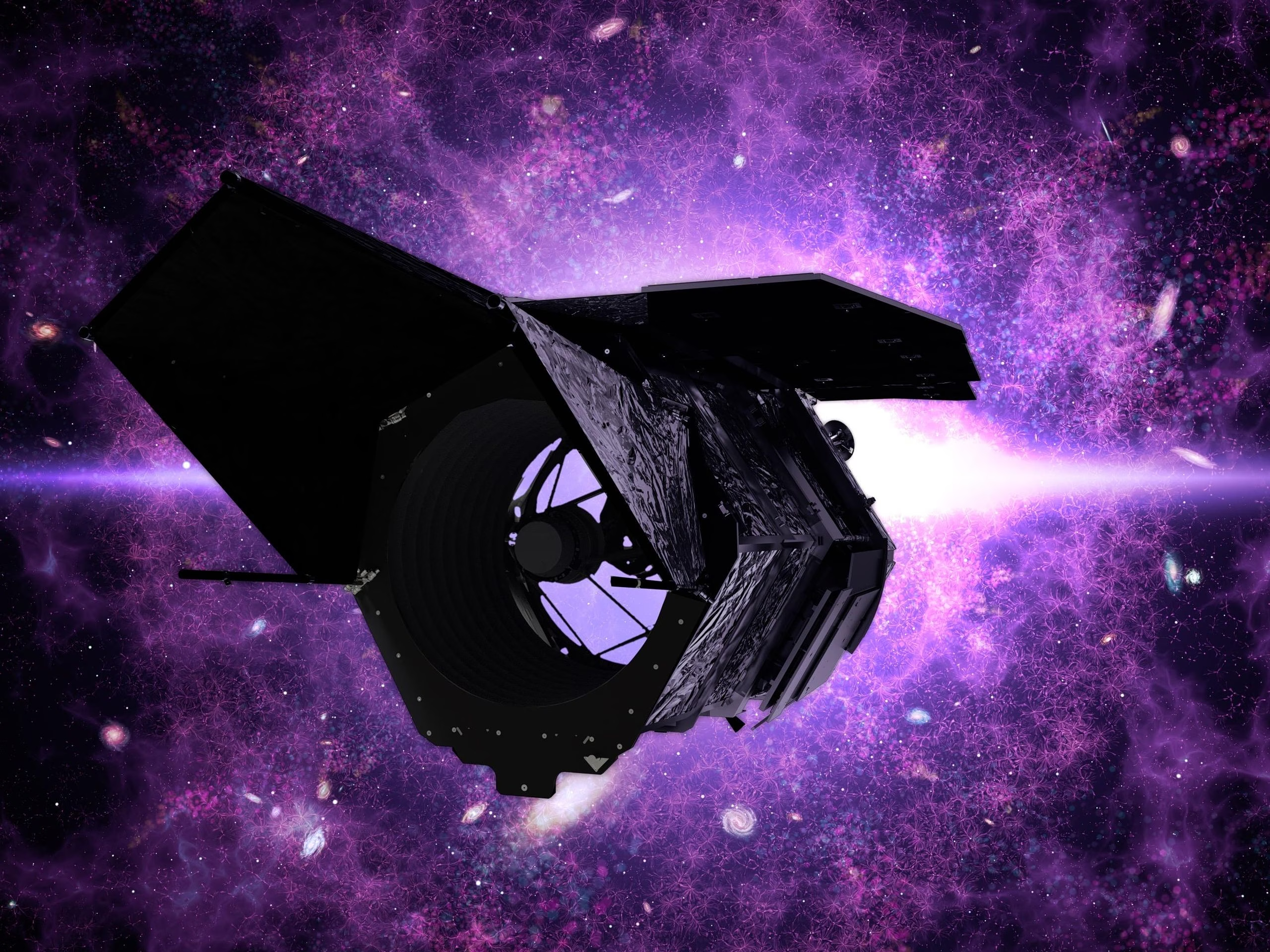
The upcoming launch of the Nancy Grace Roman Space Telescope marks a significant milestone in astronomical research. This advanced observatory, named in honor of Nancy Grace Roman, often referred to as the 'Mother of Hubble' for her pivotal role in developing the Hubble Space Telescope, is poised to dramatically expand humanity's view of the universe. With a primary mission focused on unraveling the enigmatic properties of dark matter and dark energy, the Roman Space Telescope is equipped with capabilities that far surpass its predecessors, promising to deliver insights that could redefine our understanding of cosmic evolution.
Technological Leaps and Enhanced Capabilities
A defining feature of the Nancy Grace Roman Space Telescope is its remarkably wide field of view. This instrument is designed to capture images of the cosmos with an area approximately 100 times larger than that observed by the Hubble Space Telescope. This unparalleled breadth of vision will allow astronomers to survey vast regions of space in a single observation, dramatically accelerating the pace of discovery. Instead of meticulously stitching together numerous small images, Roman will provide sweeping panoramas, enabling the detection of rare and faint objects across immense cosmic distances. This capability is particularly crucial for statistical studies of galactic distribution and the large-scale structure of the universe.
Beyond its expansive field of view, the telescope incorporates a 2.4-meter primary mirror, identical in size to Hubble's, ensuring high-resolution imaging. However, Roman's instruments are optimized for infrared wavelengths, which are essential for peering through cosmic dust clouds and observing light from the universe's earliest galaxies, whose light has been stretched into the infrared spectrum by the expansion of space. This infrared capability will allow scientists to observe phenomena that are otherwise obscured or too distant for visible-light telescopes.
The Quest for Dark Energy and Dark Matter
The primary scientific objectives of the Nancy Grace Roman Space Telescope revolve around the mysteries of dark energy and dark matter. These two elusive components are believed to constitute approximately 95% of the universe's total mass and energy, yet their nature remains largely unknown. Dark energy is hypothesized to be responsible for the accelerating expansion of the universe, a phenomenon first observed in the late 1990s. Dark matter, on the other hand, is thought to provide the gravitational scaffolding upon which galaxies and galaxy clusters form, though it does not interact with light, making it invisible to conventional telescopes.
“The Roman Space Telescope is a game-changer for cosmology. Its ability to survey vast swathes of the sky with high precision will allow us to map the distribution of dark matter and measure the effects of dark energy with unprecedented accuracy. We are entering a new era of discovery regarding the fundamental constituents of our universe.”
Roman will employ several key techniques to investigate these cosmic enigmas. One method involves studying weak gravitational lensing, a phenomenon where the gravity of massive foreground objects, including dark matter, subtly distorts the light from background galaxies. By meticulously measuring these distortions across millions of galaxies, scientists can create detailed maps of dark matter distribution and probe its properties. The wide field of view is indispensable for this technique, as it allows for the observation of a statistically significant number of background galaxies.
Another crucial technique is the measurement of baryonic acoustic oscillations (BAO). These are fossilized sound waves from the early universe that left a characteristic signature in the distribution of matter. By measuring the scale of these oscillations at different cosmic epochs, astronomers can track the expansion history of the universe and infer the influence of dark energy over time. Roman's extensive survey capabilities will enable precise measurements of BAO, providing critical data to distinguish between competing models of dark energy.
The telescope will also engage in a supernova survey, specifically targeting Type Ia supernovae. These 'standard candles' have a consistent intrinsic brightness, making them excellent tools for measuring cosmic distances. By observing how their apparent brightness diminishes with distance and how their light is redshifted, scientists can further refine our understanding of the universe's expansion rate and the role of dark energy. Roman's ability to quickly scan large areas of the sky will increase the detection rate of these relatively rare events, providing a robust dataset for cosmological analysis.
Exoplanet Discoveries and Beyond
While dark energy and dark matter are central to Roman's mission, the telescope is also expected to make significant contributions to the study of exoplanets. It carries a coronagraph instrument, an experimental technology designed to block out the overwhelming light from a star, allowing for the direct imaging of its orbiting planets. This capability could enable the detection and characterization of exoplanets, including those similar in size and composition to Earth, providing valuable insights into planetary formation and the potential for life beyond our solar system.
Furthermore, Roman will utilize microlensing, a gravitational phenomenon where a foreground star's gravity temporarily brightens the light of a background star. If the foreground star has planets, they can cause additional, smaller brightness fluctuations, revealing their presence. This technique is particularly effective at detecting planets that are far from their host stars, including 'free-floating' planets that are not gravitationally bound to any star. The wide field of view will be instrumental in identifying the millions of stars necessary for a productive microlensing survey.
Preparing for Launch and Future Impact
The Nancy Grace Roman Space Telescope is currently undergoing final preparations for its launch. The culmination of decades of scientific and engineering effort, this mission represents a monumental investment in humanity's quest to comprehend the cosmos. The data collected by Roman will be publicly available, fostering a collaborative global scientific effort and inspiring new generations of astronomers and physicists.
The insights gained from Roman are expected to have profound implications, not only for astrophysics and cosmology but also for our fundamental understanding of the laws of physics. By shedding light on the nature of dark energy and dark matter, Roman could help resolve some of the most pressing questions in modern science, potentially leading to new theories that reshape our perception of the universe. The telescope's unprecedented capabilities promise a wealth of discoveries, making its imminent launch a highly anticipated event for the scientific community and the public alike.