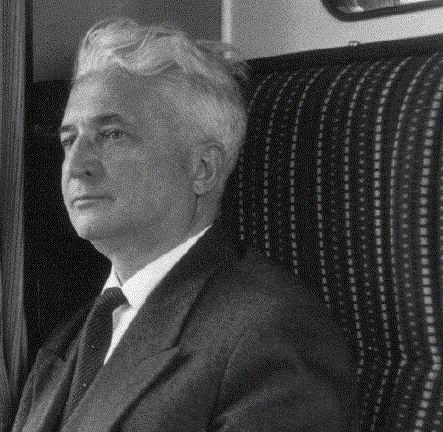
A Historian Who Saw Beyond His Time
Fernand Braudel, one of the most influential historians of the twentieth century, dedicated much of his intellectual life to understanding the deep structures of economic and social life. A leading figure of the French Annales school of historiography, Braudel approached capitalism not as a simple economic system, but as a layered and complex social phenomenon with roots stretching back centuries. Decades after his most significant writings, scholars and economists are revisiting his work and finding that his observations carry remarkable weight in the contemporary world.
Braudel was particularly interested in how power, privilege, and market structures interact over long periods of time. Rather than focusing on short-term political events, he examined what he called the longue durée — the slow, almost imperceptible movements of history that shape societies far more profoundly than revolutions or wars. This perspective gave him a unique vantage point from which to observe capitalism's tendencies, contradictions, and enduring features.
Privilege as a Persistent Feature of Modern Societies
Among Braudel's most enduring observations was his assertion that no modern society has truly renounced the tradition and use of privilege. This seemingly simple statement carries profound implications. Across different political systems, ideological frameworks, and historical periods, certain groups have consistently maintained access to resources, opportunities, and protections that are unavailable to the broader population.
Braudel did not view this as a flaw unique to capitalism, but rather as a structural characteristic of organized societies. Whether in monarchies, republics, or socialist states, elites tend to preserve advantages that insulate them from the forces of competition and change that affect ordinary citizens. What distinguished capitalism, in his view, was the particular sophistication with which these advantages were maintained and legitimized.
In the modern era, this observation resonates strongly. Critics of contemporary economic systems frequently point to the concentration of wealth among a small percentage of the global population, the influence of large corporations over regulatory frameworks, and the persistence of inherited advantage across generations. These phenomena align closely with what Braudel described in his sweeping historical analyses.
Capitalism and the Market: A Crucial Distinction
One of the most intellectually significant contributions Braudel made to economic thinking was his insistence on distinguishing between capitalism and the market economy. For many observers, these two concepts are essentially synonymous — capitalism is often described simply as a free market system. Braudel rejected this conflation entirely.
In his view, the market economy represented the realm of relatively transparent, competitive exchange — small traders, local commerce, and decentralized economic activity. Capitalism, by contrast, operated at a higher level, often working to circumvent or dominate market forces rather than submit to them. Capitalists, as Braudel described them, were those with the resources and connections to operate above the ordinary rules of competition, engaging in long-distance trade, financial speculation, and monopolistic practices that were largely invisible to the average participant in the local market.
This distinction has significant implications for how we understand economic policy debates today. Arguments in favor of free markets often assume that deregulation and reduced government intervention will lead to greater competition and broader prosperity. Braudel's framework suggests a more complicated picture, in which concentrated economic power can thrive in conditions of formal deregulation, using market language to justify arrangements that actually limit genuine competition.
The Role of the State in Sustaining Economic Power
Braudel also emphasized the intimate relationship between political authority and economic power. He observed that capitalism has historically depended on the support of the state — not merely tolerating government involvement, but actively seeking it when advantageous. Powerful economic actors have consistently used political connections to secure favorable regulations, protect their interests from competition, and gain access to public resources.
This relationship between economic and political elites is a recurring theme in contemporary discussions about inequality and governance. Concerns about regulatory capture, the revolving door between government and industry, and the influence of concentrated wealth on democratic processes all reflect dynamics that Braudel identified as fundamental to how capitalism operates over time.
Rather than seeing markets and states as inherently opposed forces, Braudel understood them as deeply intertwined. The rules of the economic game are not naturally occurring phenomena — they are constructed and maintained by political decisions, and those with the most to gain have the greatest incentive and capacity to shape those decisions in their favor.
Relevance in an Era of Growing Inequality
The early decades of the twenty-first century have seen significant debate about rising economic inequality both within and between nations. Studies and reports from international institutions have documented a growing concentration of wealth at the top of the economic distribution, even as technological progress and globalization have generated enormous overall growth. This pattern sits comfortably within the analytical framework Braudel developed.
His work suggests that inequality is not an accidental byproduct of capitalism's dynamism, but rather a structural tendency rooted in the way economic power compounds and protects itself over time. Wealth generates connections, influence, and opportunities that allow it to reproduce and expand, while those without such resources face a more genuinely competitive environment with fewer safety nets.
This perspective does not necessarily lead to any single policy conclusion. Braudel was a historian, not a political advocate. His aim was to illuminate how things actually work, rather than to prescribe a particular alternative. Nevertheless, his analysis provides a useful corrective to narratives that treat contemporary economic arrangements as the natural or inevitable outcome of neutral market forces.
A Legacy That Continues to Inform
Braudel's influence extends well beyond the discipline of history. Sociologists, economists, political scientists, and policy analysts have drawn on his frameworks to understand everything from global trade patterns to the dynamics of financial crises. His concept of the longue durée has encouraged researchers to look beyond immediate causes and consider the deeper structural factors that shape outcomes over generations.
His observation that no modern society has succeeded in abandoning the use of privilege remains a challenging one. It invites reflection on whether genuine economic equality is achievable within existing institutional frameworks, or whether more fundamental structural changes would be necessary. These are not questions with easy answers, but they are questions worth asking — and Braudel's work continues to provide valuable tools for thinking through them carefully.
In an era defined by rapid technological change, geopolitical uncertainty, and growing public concern about economic fairness, the insights of this mid-twentieth-century historian feel surprisingly immediate. Whether one finds his conclusions unsettling or simply clarifying, the depth and rigor of his analysis continue to reward serious engagement.